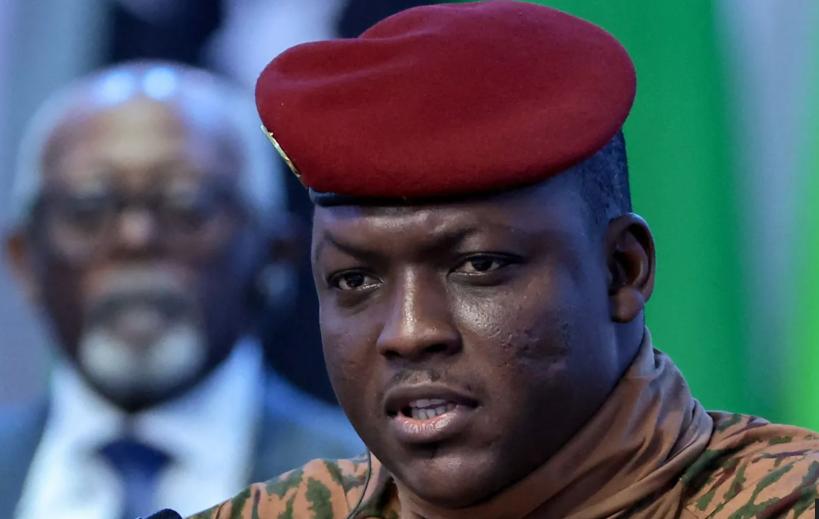
Burkina Faso’s top military leader Capt Ibrahim Traoré has pushed back against democratic governance, telling citizens that the system should no longer be part of the country’s future and insisting that a different path is being pursued under his leadership.
Speaking in a televised interview, he framed democracy as unsuitable for Burkina Faso and suggested that the nation must build its own model without following external examples.
Traoré, who came to power through a coup three years ago, has previously committed to restoring civilian rule by July 2024, but that plan was later dropped when the junta extended its stay in power by another five years. The shift marked a clear departure from earlier promises made to citizens and the international community.
In January, the authorities went further by banning all political parties, describing the move as part of a broader effort to rebuild state institutions and reshape governance in the country.
During the interview, Traoré strongly rejected democracy as a governing system for Burkina Faso. “People need to forget about the issue of democracy. Democracy is not for us.
"Look at Libya, this is an example close to us,” he said.
He referred to Libya’s political history, where long-time ruler Muammar Gaddafi maintained control for decades before being overthrown during a revolt backed by Western military forces. Since then, Libya has remained unstable, with no national elections held and power divided among competing authorities and armed groups.
“Wherever they [Western powers] try to establish democracy in the world, it's always accompanied by bloodshed,” Traoré said in his interview.
Across Africa, many countries continue to hold elections, although concerns about fairness and transparency are often raised. In a few instances, military-led governments have organised elections after taking power and later taken part in those polls as candidates.
Traoré also addressed the decision to dissolve political parties, describing them as harmful to unity and incompatible with his vision of governance.
“The truth is, politics in Africa – or at least what we've experienced in Burkina - is that a real politician is someone who embodies every vice: a liar, a sycophant, a smooth-talker,” he said.
Although he did not clearly outline an alternative political structure, Traoré said Burkina Faso would not follow established global systems.
“We have our own approach. We're not even trying to copy anyone else. We're here to completely change the way things are done.”
He added that the country’s future direction would be built on sovereignty, patriotism and mobilisation of communities, with traditional authorities and local structures expected to play an important role.
Traoré also stressed the need for stronger economic and military independence, alongside increased productivity, arguing that shorter working hours would not help the country close the gap with wealthier nations.
His government has faced criticism over restrictions on dissent, with reports pointing to pressure on opposition voices, journalists and civil society groups. There have also been claims that some critics are sent to the front lines in the fight against Islamist militants.
Despite these concerns, Traoré continues to attract support in parts of the continent, largely due to his pan-African stance and outspoken criticism of Western involvement in African affairs.
Burkina Faso, together with Mali and Niger, has moved away from close cooperation with Western nations, particularly France, in addressing the long-running insurgency by Islamist groups. Instead, the three countries have strengthened ties with Russia for military assistance, although insecurity has persisted.
A report released by Human Rights Watch noted that more than 1,800 civilians have been killed in Burkina Faso since Traoré assumed power in 2023. The report attributes about two-thirds of the deaths to the military and allied militias, while the remainder are linked to Islamist fighters.