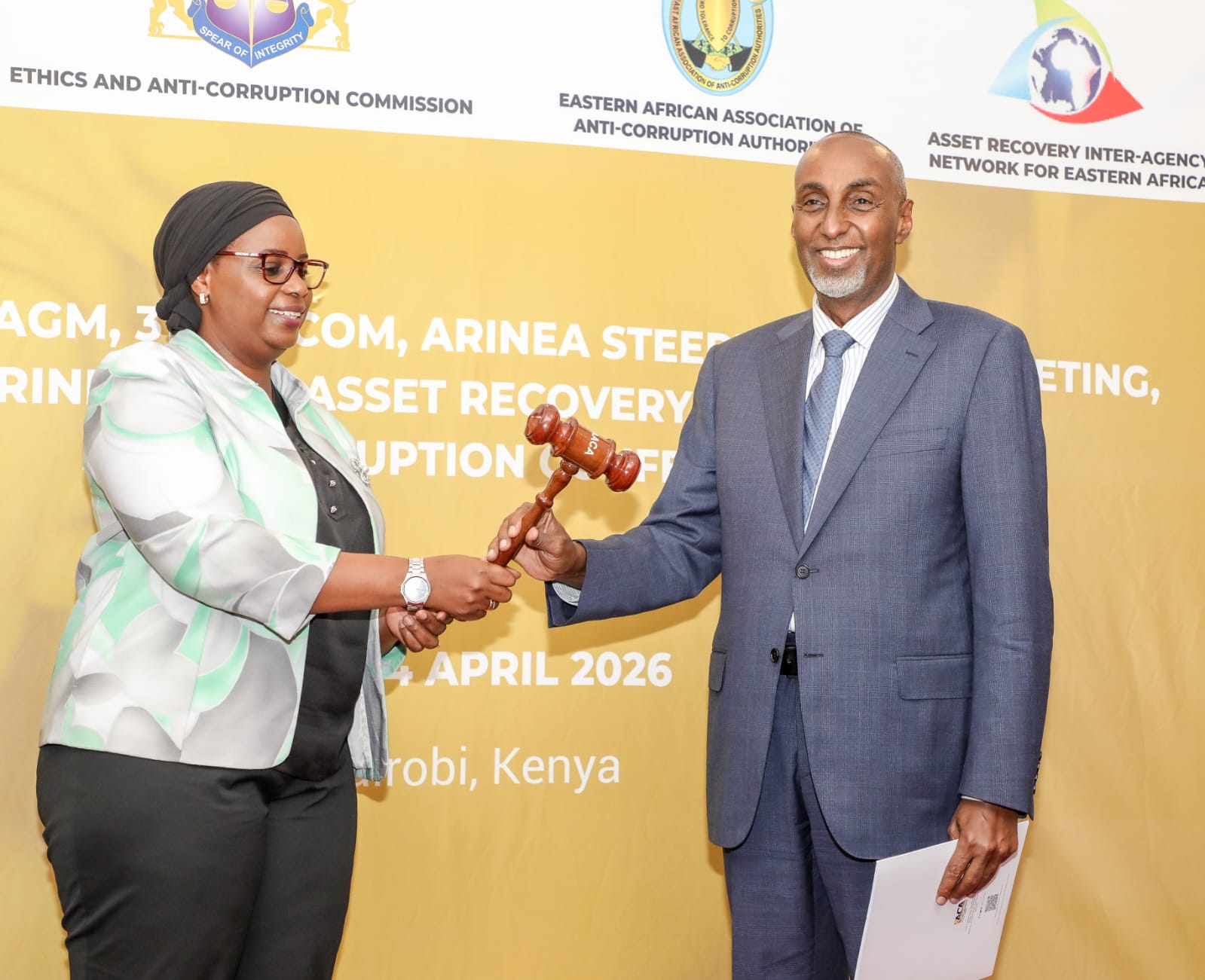
Leadership of a major Eastern Africa anti-corruption network has changed hands following a regional meeting in Nairobi that appointed Kenya’s graft agency chief to steer joint efforts in tackling corruption across member states.
The Chief Executive Officer of the Ethics and Anti-Corruption Commission, Abdi Mohamud, has taken over as president of the Eastern Africa Association of Anti-Corruption Authorities after the 16th Annual General Meeting held in Nairobi from April 20 to April 24, 2026.
He replaces Naluzze Aisha Batala (Uganda), who has been serving in the role and was praised by member countries for her “exemplary leadership and steadfast commitment to strengthening regional anti-corruption efforts” during her tenure.
Latest Stories
- Ruto brushes off critics, says insults won’t shake his grip on Mt Kenya
- Woman jailed for three years over child theft linked to love triangle dispute
- Tourism Authority, dismisses claims of tourists being held at Maasai Mara lodge
- FKF boss Hussein Mohammed suspended over alleged misappropriation of Sh42 million CHAN funds
- IEBC registers 1.87 million new voters as drive nears deadline
Mohamud steps into the position after serving as Vice President of the regional body for two years, continuing his involvement in the organisation’s leadership structure.
In his acceptance remarks, he thanked member institutions for the trust placed in him and pledged to strengthen cooperation among countries in the region in the fight against corruption.
He said his focus will build on “the strong foundation established by his predecessor”, with emphasis on improving coordination and enhancing collective regional responses.
He outlined priority areas including strengthening mutual legal assistance between member states, improving cross-border investigations, and enhancing intelligence sharing and joint operations among anti-corruption agencies.
He also called for harmonisation of anti-corruption laws and policies across the region, saying this would help close loopholes exploited by cross-border corruption networks.
Mohamud further noted that peer learning and technical exchange programmes will be expanded to help agencies improve skills, systems, and enforcement capacity.
He highlighted plans for the launch of the Centre for Research on Ethics and Anti-Corruption, scheduled for June 2026 in Nairobi.
He said the centre will support evidence-based research to guide policy development, prevention measures, and enforcement strategies across Eastern Africa.
He urged heads of anti-corruption agencies to support the initiative and take part in shaping its direction, stressing the importance of shared ownership.
He also invited member states and partners to attend the launch, describing it as a shared platform for innovation, collaboration, and knowledge exchange.
Mohamud said his election reflects “a strategic shift from national implementation to regional coordination”, aimed at strengthening policy influence, operational cooperation, and the global positioning of anti-corruption efforts in the region.
The 16th AGM brought together delegates from eight Eastern African countries and included several sessions such as the 31st Executive Committee Meeting, ARINEA Steering Group discussions, the 8th Asset Recovery Workshop, and an Anti-Corruption Conference.
The sessions focused on sharing experience, building capacity, and strengthening cooperation among anti-corruption institutions.
In his closing remarks, Mohamud thanked delegates for their participation and contributions and wished them a productive stay in Nairobi.


Comments
Sign in with Google to comment, reply, and like comments.
Continue with Google