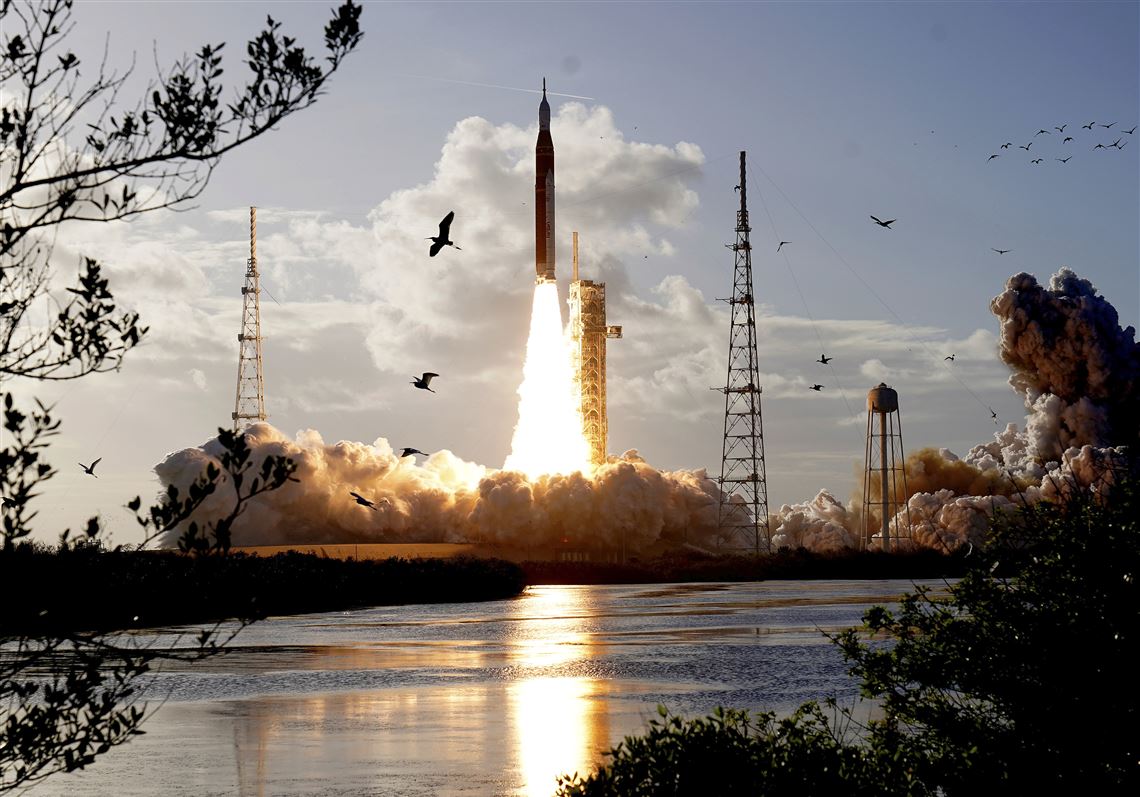
Astronauts aboard NASA’s Artemis II mission are approaching the Moon, where they will observe its heavily cratered surface firsthand. The mission, launched on April 1, 2026, marks humanity’s return to deep space in over 50 years.
Scientists say lunar craters preserve a record of early Solar System history largely erased on Earth by geological processes.
The four-person crew, Reid Wiseman, Victor Glover, Christina Koch and Jeremy Hansen, launched on April 1, 2026, aboard the Orion spacecraft.
Their mission, lasting about 10 days, is designed to test systems needed for future lunar landings while taking humans farther into space than at any time in more than half a century.
The spacecraft is expected to reach the Moon’s far side on Monday, when the crew will begin a closely watched lunar flyby.
The manoeuvre will take them thousands of miles above the surface before the Moon’s gravity sends them back towards Earth. Their return is scheduled for April 10, with a planned splashdown in the Pacific Ocean.
As the astronauts approach, one of the most striking features they will observe is the Moon’s cratered terrain.
According to mission commentary, “one of the most striking (pun intended) features they will see is the craters which mark its surface, and are especially numerous on the far side.”
These craters were formed by asteroid impacts over billions of years and remain largely intact due to the Moon’s lack of atmosphere, weather, and tectonic activity. Scientists say they provide a detailed record of early Solar System conditions.
“The Moon helps us fill in the picture and tells us a unique story about our planet’s past,” the mission notes explain, highlighting the contrast with Earth.
On Earth, similar impact craters have largely been erased. Geological processes such as plate tectonics, erosion, and volcanic activity have reshaped the planet’s surface over time, removing much of this ancient record.
Nevertheless, some impact sites remain visible. One example cited by observers is the Manicouagan crater in Canada, which is over 70 kilometres wide and was formed more than 200 million years ago when a five-kilometre asteroid struck the Earth.
From orbit, such structures can still be seen. “I saw this view through the Cupola window as I was exercising and had to pause to take a picture,” one account recalled, describing the experience of observing Earth’s geological scars from space.
For Artemis II, however, the focus is firmly on the Moon. The far side, never visible from Earth, offers an especially dense concentration of craters, including massive basins formed by ancient collisions.
The mission represents a significant milestone in human spaceflight. It is the first crewed journey to the Moon since the Apollo era and is intended to pave the way for future missions, including planned landings later in the decade.
Although Artemis II will not land on the lunar surface, its scientific and symbolic importance is considerable.
By combining human observation with modern technology, the mission aims to deepen understanding of both the Moon and Earth’s shared history.
As the spacecraft continues its journey, the images and observations gathered are expected to provide fresh insight into how planetary surfaces evolve, and how much of Earth’s own past may be preserved just a quarter of a million miles away.