
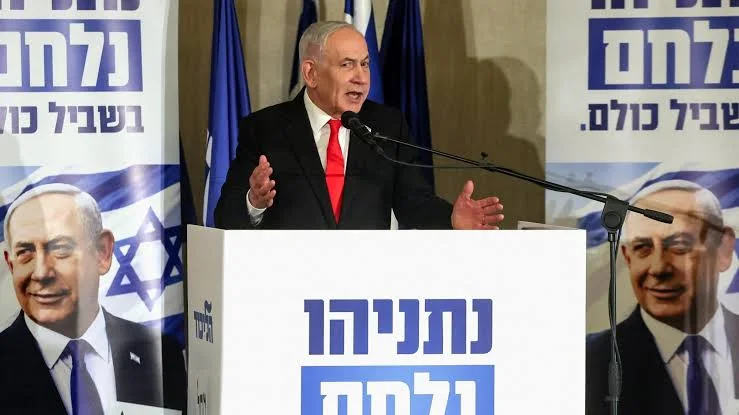
Israeli Prime Minister Benjamin Netanyahu’s Likud party has accused Arab political parties of stealing the country’s election, after partial results showed they could play a decisive role in determining the formation of the next government.
In a statement, Likud alleged that Arab parties supporting terrorism had used corruption, threats, violence and prohibited software to influence voters. The party said it was submitting testimonies and evidence to the authorities.
Netanyahu had earlier accused Arab parties, particularly Ra’am, of attempting to steal the election, citing reports of individuals being arrested with envelopes of cash.
With nearly 86 per cent of votes counted, Israeli broadcasters projected Netanyahu’s right-wing coalition would secure 53 seats in the 120-member Knesset, compared with 48 seats for the opposition bloc led by former military chief Gadi Eisenkot.
Arab parties were projected to win 19 seats, potentially giving them significant influence in coalition negotiations.
The results have also triggered a dispute over the role of the military. Defence Minister Israel Katz criticised Eisenkot for urging security officials to resist any attempt by Netanyahu to use the country’s security situation for political purposes.
Eisenkot, speaking to supporters after the election, described Netanyahu as a caretaker prime minister without a mandate and insisted that the military must serve the state rather than an individual leader.
“Stand firm in the face of any attempt to challenge you. You have my unequivocal backing. Netanyahu, do not dare use Israel's security for your political needs,” Eisenkot said.
Meanwhile, Joint List leader Yousef Jabareen said his party would use its projected 12 seats to help remove Netanyahu’s government and change Israel’s political direction.
Although the Joint List ruled out joining an Eisenkot-led government because of its position on the military campaign in Gaza and the occupation of southern Lebanon, Jabareen left open the possibility of supporting a minority government from outside the coalition.
He said the party’s priorities included tackling crime, increasing funding and opportunities in Arab communities, promoting equality and reopening peace negotiations towards establishing a Palestinian state.
Ra’am leader Mansour Abbas, whose party joined a governing coalition for the first time in 2021, also expressed willingness to join an Eisenkot-led administration. He said discussions with members of the opposition bloc had taken place before the election.
Netanyahu, meanwhile, called for a strong right-wing government and highlighted Israel’s military operations against Iran, describing the situation as a historic opportunity to eliminate what he called the Iranian threat.
The election, held amid regional conflicts and growing political divisions, recorded a turnout of 77.7 per cent, the highest in more than two decades.
Coalition negotiations are expected to determine whether Netanyahu can assemble a parliamentary majority or whether opposition parties can secure sufficient support to form an alternative government.