
Safaricom has generated Sh1.24 trillion in economic value for Kenyan society in the 2025/26 financial year, as the telecommunications company marked 15 consecutive years of sustainability reporting.
Chief executive Peter Ndegwa said the company’s economic contribution increased by 10 per cent from the previous financial year, with its wider business ecosystem supporting more than 1.4 million jobs.
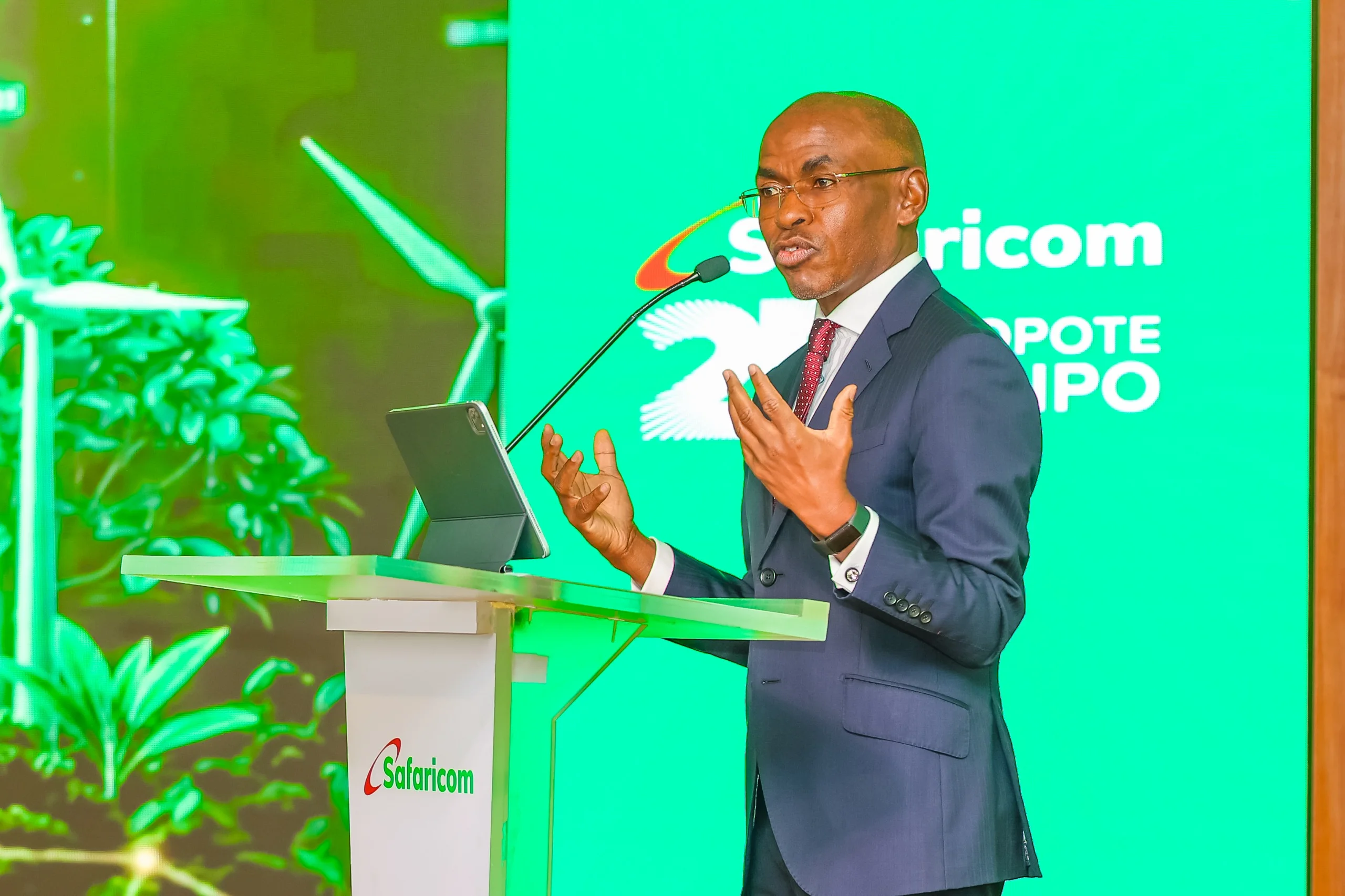
Speaking during the launch of Safaricom’s 2026 Sustainable Business Report in Westlands, Nairobi, on Tuesday, Ndegwa said the company’s contribution extended beyond its direct operations to the small businesses and individuals who depend on its services.
“The economic impact generated directly from our business activities amounted to Sh654 billion, and a lot of it is through partners, through the ecosystem of small businesses. So it’s not just ourselves, but it’s actually across the ecosystem,” he said.
Ndegwa clarified that the company’s ecosystem supported more than 1.4 million jobs, including an additional 70,000 created during the year.

He cited Safaricom’s network of approximately 330,000 M-Pesa agents, one million independent M-Pesa merchants and 3.3 million Lipa na M-Pesa customers as examples of how its operations support livelihoods.
The report also highlighted the company’s environmental and social investments, with its foundations reaching more than 4.4 million people during the financial year.
Safaricom maintained that its environmental programmes had grown a cumulative three million trees, while its long-term sustainability commitments included achieving net-zero emissions by 2050.
Ndegwa explained that sustainability had become central to the company’s business decisions rather than an activity conducted separately from its commercial operations.
“Sustainability cannot sit alongside the business. It has to be how we run our business,” he said.
He added that the company’s approach was guided by the need to balance commercial objectives with its responsibility to customers, communities and the wider society.
“For us, sustainability is not philanthropy; it’s not about reporting that we produce every year. It’s about the choices that we make every day, and about the value that we create for customers, for communities, and society at large.”
The report also highlighted Safaricom’s efforts to strengthen digital security as artificial intelligence and digital platforms become increasingly important to its operations.
Ndegwa said the company detected and monitored 1.25 billion intrusion attempts during the 2025/26 financial year and investigated more than 130,000 security events.
He added that artificial intelligence had enabled the company to predict and prevent more than 94 per cent of fraud attempts before they occurred.
The chief executive said the company processed between 120 million and 150 million M-Pesa transactions daily, making the protection of customer information, money and digital platforms a critical responsibility.
“Our customers must trust us with their data. They must trust our platforms with their money. They must trust that the technology we introduce will work for them,” he said.
Safaricom also reported that its contribution to nine priority United Nations Sustainable Development Goals received an overall B+ assessment, with an A+ performance in industry, innovation and infrastructure, reducing inequalities, and partnerships for the goals.
However, the company acknowledged challenges in its sustainability performance, including an increase in Scope 1 and Scope 2 emissions and one work-related fatality during the financial year.
Ndegwa said the company remained committed to addressing the shortcomings as it worked towards its environmental and social targets.
Principal Secretary for Environment and Climate Change Festus Ng’eno commended Safaricom for its contribution to the government’s tree-growing initiative, which targets 15 billion trees by 2032 and aims to increase national tree cover to more than 30 per cent.
Ng’eno said the company’s environmental programmes and partnerships with communities had supported restoration efforts, while its investments in renewable energy could help reduce reliance on diesel generators.
He also highlighted the role of digital technology in climate adaptation, including early-warning systems for communities vulnerable to floods and other extreme weather events.
“Safaricom has been a key partner in this through sending more than 70 million SMS alerts to communities in flood-prone and other high-risk areas,” Ng’eno said.
He urged businesses to strengthen climate-risk management and improve the accuracy of their emissions reporting, warning that climate disclosure would increasingly be held to standards comparable to financial reporting.
United Nations Resident Coordinator in Kenya Garry Conille said private-sector investment and public policy needed to work together to accelerate sustainable development.
Conille argued that financial inclusion should translate into lasting economic opportunities rather than simply expanding access to digital accounts and payment services.
“Today a payment takes three seconds, but an opportunity can still take years, and closing that gap is the development challenge of our generation,” he said.
He called on Safaricom, the government and the United Nations to collaborate on measurable interventions that improve livelihoods, strengthen climate resilience and build trust in digital services.
Safaricom’s Director of Sustainability and Shared Value Karen Basiye said the company had made progress in renewable energy, inclusion and environmental programmes but acknowledged that emissions reduction remained a challenge as its network expanded.
She explained that the company was working to improve performance across its supply chain and advance representation in leadership and employment, with further progress required to meet its 2030 targets.
The launch marked 15 years since Safaricom began sustainability reporting in 2012, following its commitment to the United Nations Global Compact.
The company maintained that its next phase would focus on integrating sustainability more closely into business strategy, strengthening digital trust and ensuring that technological growth contributes to inclusive development.