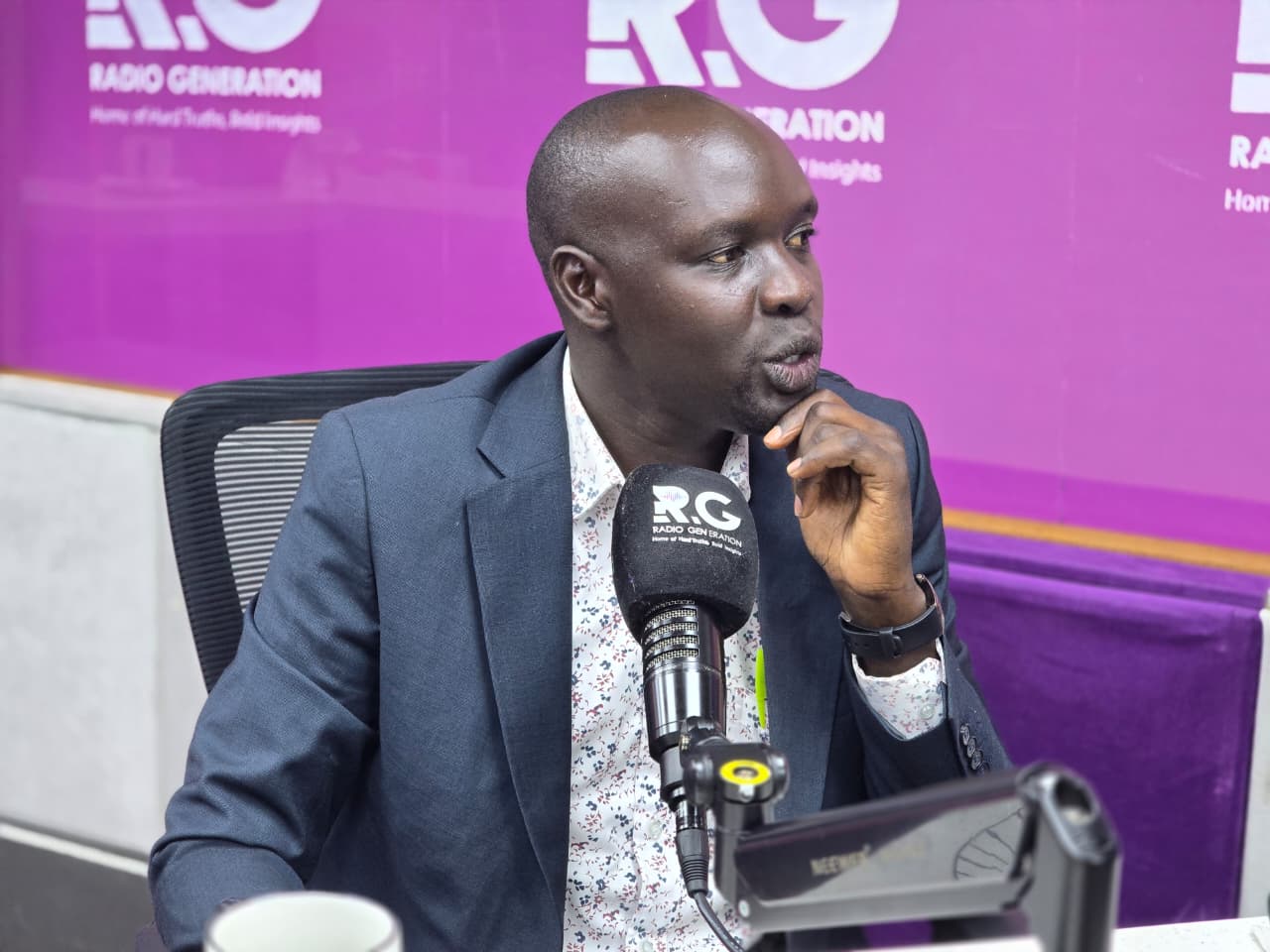
Teacher, Author and CBE facilitator Patrick Talam says the transition to senior school under Kenya’s CBC system has exposed gaps in student placement, career guidance and resource distribution, with some institutions lacking learners while others are overwhelmed, raising fresh concerns about equity, preparedness and the effectiveness of the new education structure.
Speaking on Wednesday during a Radio Generation interview, Talam said the first cohort of Grade 10 learners has largely settled into the new system, despite initial uncertainty.
“The CBC came to senior school, we received Grade 10, these being the first cohorts, they have already settled,” he said.
However, he pointed to ongoing issues around the availability of textbooks in public schools.
“There was that public outcry that this government has not supplied textbooks; others have received a few copies and others are yet to receive,” he said, adding that a status report may clarify the situation after the first term.
Talam highlighted a significant imbalance in student distribution across schools, driven largely by public perception and infrastructure differences.
He said top-tier institutions, commonly referred to as “C1” or national schools, have absorbed the majority of learners.
“These schools are competitive, they have the facilities and the capacity” he said.
This has left some lower-tier schools struggling to attract students, with reports of extremely low enrolment.
“I’m aware of about two schools that don’t have a quorum,” he said. “Imagine one teacher going to that class to teach one student.”
He noted that such disparities raise concerns about resource utilisation and the sustainability of some institutions.
The Competency-Based Curriculum (CBC) was introduced to replace the long-standing 8-4-4 system, with the aim of shifting education from exam-focused learning to skills development and competency acquisition.
The rollout began in 2017 under the guidance of the Kenya Institute of Curriculum Development, following years of education reforms and stakeholder consultations.
The reform was designed to address concerns that the 8-4-4 system placed too much emphasis on memorisation and national examinations, while failing to nurture practical skills, creativity and critical thinking.
CBC instead focuses on continuous assessment and the development of learners’ talents and abilities from an early stage.
The system is structured into three levels, pre-primary, primary and junior school, before transitioning to senior school, where learners specialise in career pathways such as Science, Technology, Engineering and Mathematics (STEM), social sciences, and arts and sports.
Since its introduction, CBC has progressively advanced, with the first cohort completing junior school and transitioning to senior secondary education in 2026.
However, the rollout has faced challenges, including concerns over infrastructure, teacher preparedness and learning resources.
Despite these hurdles, the government maintains that CBC is central to equipping learners with skills aligned to the demands of a modern, dynamic economy.
This transition from the 8-4-4 system has also created temporary capacity distortions, with senior schools accommodating overlapping cohorts.
“That means we don’t have one class, so that capacity is to be utilised,” Talam explained.
As a result, well-established schools have filled up quickly, often at the expense of sub-county and county schools.
“You cannot compare a national school with what we would call sub-county school because there is no convergence of comparison,” he said.
He attributed this to historical inequalities in funding and infrastructure. “These schools have benefited in terms of the resources that go to them,” he said.
The CBE facilitator highlighted that examination systems may not fairly reflect the realities of all learners.
A major area of confusion, he noted, is the introduction of career pathways under CBC. “Pathways are the career journeys, we have three pathways,” he explained.
These include Science, Technology, Engineering and Mathematics (STEM), Social Sciences, and Arts and Sports.
“The government give 60% to STEM, 25% social sciences and 15% arts and sports,” he said.
However, he said arts and sports are often undervalued despite their potential. “This is actually where the talents are, if well nurtured,” he added.
Talam questioned whether students are adequately prepared to choose career paths at a young age.
“They’re about 14, the assumption is, they needed to have understood themselves, that is where we have the disconnect,” he said.
He emphasised the importance of career guidance, noting that many students make decisions based on limited information or external influence.
“Have they understood their personalities? do they have that career information?” he questioned.
He cautioned against choosing careers solely based on perceived financial rewards, instead, he stressed the importance of passion and self-awareness.
“There’s somebody who may not like biology but wants to be a doctor, that is where the disconnect is,” he explained.
While acknowledging progress in implementing the CBC, Talam said the system is still evolving and requires adjustments.
“These are the first cohorts, there could be one or two challenges,” he said.
He maintained that addressing inequalities in resources, improving career guidance and aligning curriculum with real-world contexts will be key to ensuring the success of the new education model.
The transition, he suggested, presents both an opportunity and a test for Kenya’s education system as it seeks to balance equity, quality and relevance for future generations.