
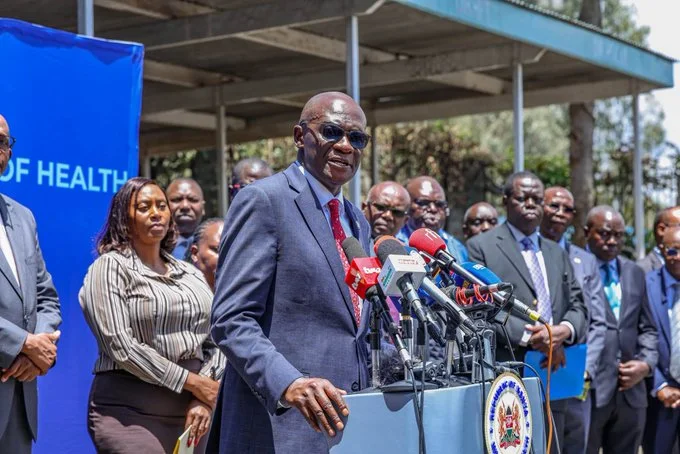
Five patients being treated for Ebola (Bundibugyo virus) in Kenya have been discharged after laboratory tests confirmed they had cleared the virus, marking a significant milestone in the country's efforts to contain the outbreak.
The Ministry of Health announced on Tuesday that the five male patients, two treated at Kenyatta National Hospital (KNH) and three at The Nairobi Hospital, had completed treatment and remained free of symptoms before their discharge.
In a statement, Director General for Health Dr Patrick Amoth said their recovery was encouraging news in the national response to the outbreak.
"Their recovery is a tribute to the skill and dedication of our health workers," he said.
The Ministry also announced that 46 additional contacts had completed their mandatory monitoring period and were released from quarantine to reunite with their families. This brings the number of contacts released to 66, following the discharge of 20 people on October 25.
A further 52 contacts are expected to leave quarantine by November 11, provided they complete the 21-day monitoring period without developing symptoms.
The Ministry reassured the public that individuals who complete the quarantine period without developing symptoms cannot transmit the disease.
"Contacts who complete this quarantine period without developing any symptoms cannot transmit the disease and pose no risk to anyone," the statement said.
It also urged families, employers and communities to welcome those returning home with compassion and avoid discrimination.
Kenya's confirmed Ebola cases remain at nine, including two deaths, representing a case fatality rate of 22.2%. No new infections have been recorded since October 19, with all confirmed cases linked to a single cluster originating from the first imported infection.
The two remaining patients, one at each of the designated hospitals, are continuing to receive treatment and will be discharged once they meet the established medical criteria.
Despite the progress, the Ministry warned that the outbreak was not yet over, with heightened surveillance continuing across the country.
"These milestones bring us closer to the end of the outbreak but are not the end itself," Dr Amoth said.
Kenya will begin a 42-day countdown after the final patient has recovered or been laid to rest, with the outbreak declared over only if no new infections are recorded during that period.
The Ministry also addressed travel measures introduced by Saudi Arabia and Kuwait, saying Kenya would continue to follow scientific evidence and the International Health Regulations (2005).
"Kenya remains open for business with no restrictions on travel, trade or public gatherings," the statement said.
The Ministry urged anyone experiencing symptoms suggestive of Ebola to seek immediate medical attention, warning that early treatment is critical to survival and preventing further infections.
Members of the public can report suspected cases through the toll-free number 719 or the Ministry's WhatsApp chatbot on 0700 719 719.
Kenya confirmed its first imported Bundibugyo Ebola case in October 2026. The patient, a Kenyan man who had been living in the Democratic Republic of Congo (DRC), travelled through Uganda before arriving in Nairobi, where he was admitted to hospital and later died. Subsequent infections were linked to the initial case through contact tracing.
The Bundibugyo Ebola outbreak was first declared in the Democratic Republic of Congo (DRC) on 15 May 2026. According to the World Health Organization's update of October 20,2026, the outbreak had recorded 9,704 confirmed cases and 4,687 deaths in the country.