
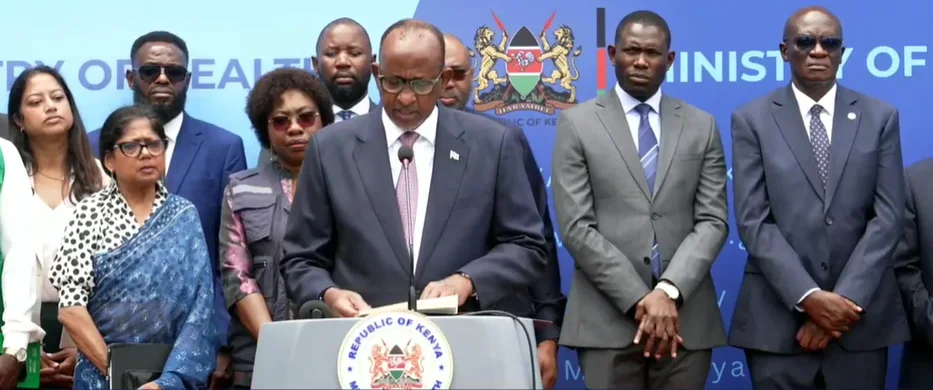
Kenya has begun a 42-day countdown to being declared free of Ebola on December 23, 2026, after the last patient recovered and all identified contacts completed their monitoring period without further infections being reported.
Health Cabinet Secretary Aden Duale said the country had reached a major point in containing the Bundibugyo Ebola outbreak, with no patient remaining under treatment and no contact still in quarantine for the first time since the disease was detected.
representing twice the virus's longest incubation period.
“If no new case is recorded in that period, Kenya will be declared free of Ebola on the 23rd of December 2026,” Duale said.
He credited the progress to swift contact tracing, isolation, surveillance and cooperation between the national government, county administrations, healthcare facilities and international partners.
According to Duale, all 135 contacts linked to the initial patient had been traced, both within Kenya and abroad. Those identified as being at risk were placed under quarantine and subjected to daily monitoring to ensure any signs of infection were detected early.
The outbreak later recorded eight additional infections, involving four family members of the first patient and four healthcare workers who had attended to him before Ebola was suspected.
All the secondary cases were already in quarantine when they developed symptoms, a measure that helped prevent the disease from spreading into the wider community.
Duale said two patients had died during the outbreak, while seven others recovered and were discharged from hospital.
Despite the progress, the CS warned that the start of the countdown should not be mistaken for the end of the country's response, saying emergency teams would remain ready to act on any suspected infections.
He added that surveillance would continue across all counties, including in healthcare facilities, communities and at the country's points of entry.
“Every alert will be investigated. Screening will continue at all points of entry, and our survivors, who we cherish, will receive follow-up care and support,” he said.
Director General of Health Patrick Amoth said Kenya's response had shown how quickly identifying exposed individuals, placing them in quarantine and maintaining regular checks could prevent further transmission.
He also commended health workers who managed the outbreak, noting that no secondary infections were recorded among medical personnel.
Amoth said the government planned to expand screening beyond airports and recognised border crossings, warning that the virus could potentially enter the country through unofficial routes and porous borders.
“We are not going to lower our guard, not for a single second, not for a day,” he said.
The Ministry of Health will also coordinate with the Ministry of Foreign Affairs to develop travel guidance for Kenyans returning from Ebola-affected areas.
The proposed measures will include health declarations before departure, screening upon arrival and 21 days of follow-up after entering the country.
Kenya confirmed its first imported case of Bundibugyo Ebola virus disease on October 6, 2026, involving a Kenyan man who had travelled from the Democratic Republic of Congo through Uganda before arriving in Nairobi on October 3.
The man died shortly after being admitted to hospital, triggering contact tracing and surveillance efforts to identify anyone who may have been exposed.
The outbreak subsequently recorded eight additional infections involving the first patient's relatives and healthcare workers who had attended to him.
Health authorities managed to identify all the subsequent cases while the individuals were in quarantine, with no evidence of transmission within the wider community.
The last confirmed infection was reported on October 19. No new cases have been recorded since then, allowing the remaining patients to recover and the country to begin the countdown towards being declared Ebola-free.