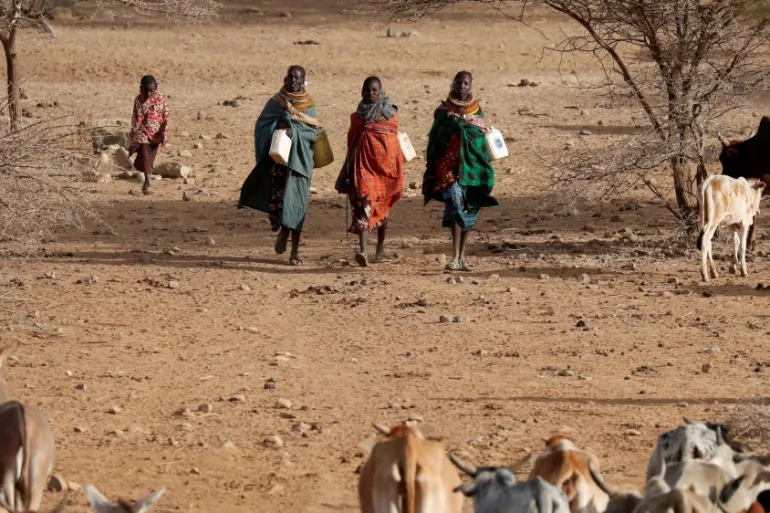
The government has raised funding for emergency food aid after setting aside an extra Sh12.6 billion to support families facing hunger across drought-affected regions.
Details in the supplementary budget presented to Parliament show that the State plans to deliver relief food to about 3.4 million households while another 200,000 households will receive non-food support items as part of efforts to cushion communities struggling with food shortages.
The new allocation dramatically increases the funding for the State Department for Special Programmes, pushing its budget to about Sh13.5 billion from the earlier approved amount of Sh653.7 million.
Latest Stories
- Nigeria football mourns as Eneramo dies following on-pitch collapse
- Kenya issues flood warning as rains intensify in parts of the country
- Ruto brushes off critics, says insults won’t shake his grip on Mt Kenya
- Woman jailed for three years over child theft linked to love triangle dispute
- Tourism Authority, dismisses claims of tourists being held at Maasai Mara lodge
The increase of nearly 21 times points to the growing pressure drought and changing weather conditions are placing on government planning and disaster response.
Treasury said part of the additional resources will cover staff payments and other spending tied to relief operations.
“This reflects a net increase of Sh12.9 billion on current expenditures on account of additional funding for Personnel Emolument and humanitarian and disaster response,” said the Treasury.
The funding comes as large parts of the country’s arid and semi-arid lands continue to struggle with prolonged hunger following repeated poor rains. The Kenya Red Cross has described the drought situation as one of the most severe the country has faced in recent years.
At present, about 3.3 million people in 23 ASAL counties are said to be facing food insecurity. Projections show that the number could climb to 3.68 million by June 2026 if the March-May long rains fail to perform as expected.
The Kenya Red Cross recently issued an appeal for Sh6 billion to continue supporting drought-affected families with food assistance over the next two months as the crisis deepens.
A recent assessment by the National Drought Management Authority on the drought and food security situation in the ASAL areas indicates conditions have worsened following the weak performance of the October-December 2025 short rains and extended periods of hot and dry weather.
The government has also increased funding aimed at strengthening drought response measures. An extra Sh146.46 million has been allocated to drought management, raising the total allocation to Sh643.56 million from Sh497.1 million.
In addition, the State Department for the ASALs and Regional Development has received more funding through the supplementary estimates. Its overall allocation has been raised to Sh14.8 billion from the earlier Sh10.9 billion.
The additional resources include Sh9.5 billion set aside for recurrent expenditure and Sh5.3 billion meant for development projects.
“The net increase of Sh3.9 billion is mainly on account of enhanced allocation under the Hunger Safety Net Programme and capital projects under the Regional Development Authority,” said the Treasury.
Meanwhile, an update released yesterday by Oxfam International warned that poor rains across Somalia, Kenya and Ethiopia have created a major food and water crisis affecting millions who are still recovering from the drought that lasted between 2020 and 2023.
During that period, five rainy seasons failed in a row, leaving communities across the region struggling to rebuild their livelihoods.
Across the three countries, nearly 26 million people are now facing extreme hunger as drought continues to destroy crops before harvest and large numbers of livestock die due to lack of water and grazing pasture.


Comments
Sign in with Google to comment, reply, and like comments.
Continue with Google