
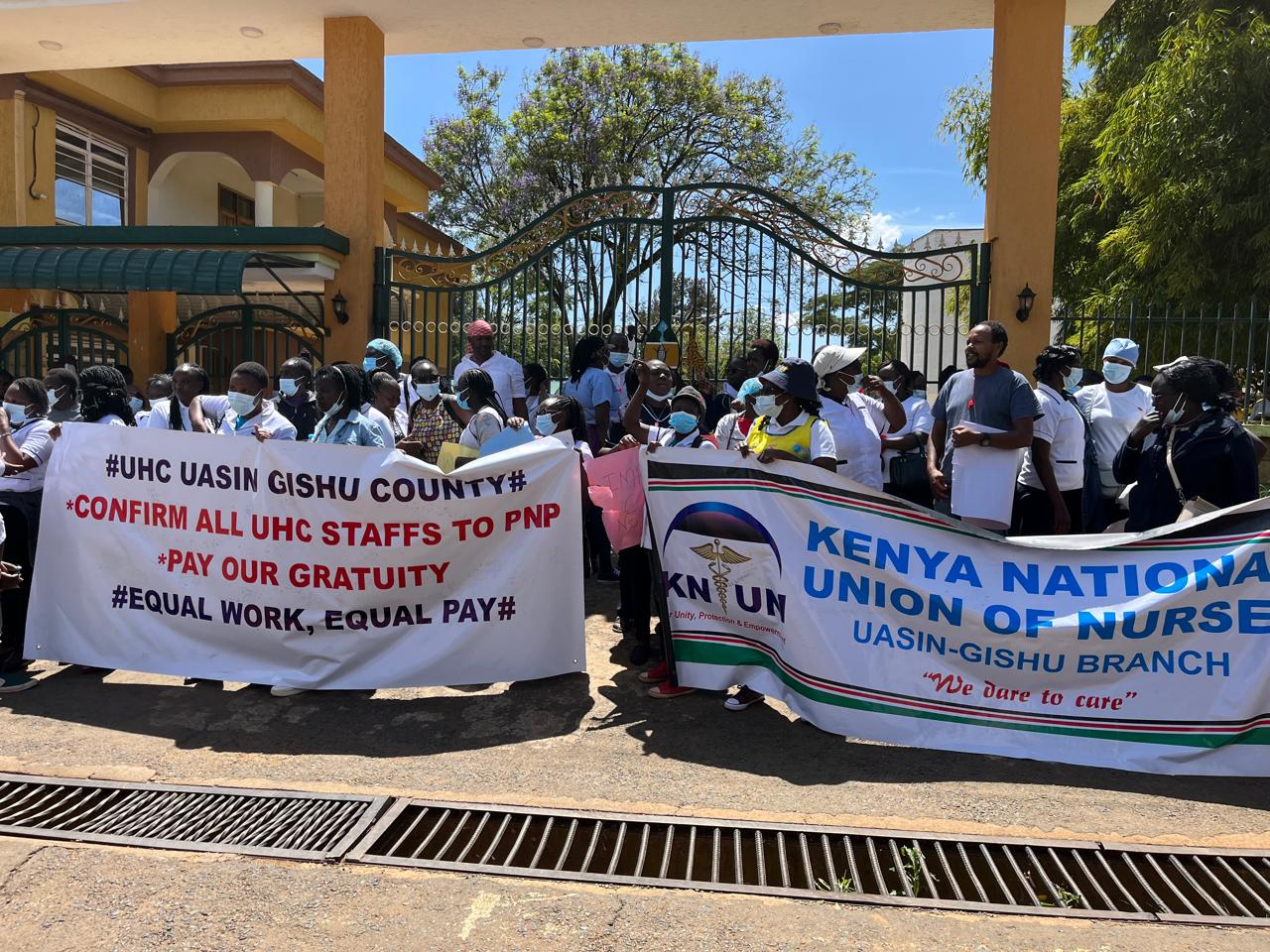
Public hospitals are facing growing pressure as the nurses’ strike enters its fourth week, with women struggling to access maternity services and young children missing important care in several parts of the country.
Although the Kenya National Union of Nurses and Midwives (KNUNM) says talks have started yielding some movement, the union has maintained that nurses will not return to work until all outstanding issues are settled.
The nationwide strike began on July 29 and has disrupted services in public health facilities, leaving patients in some counties to seek treatment from private and mission hospitals.
KNUNM Secretary-General Seth Panyako said there had been progress on some of the matters raised by the union, including career guidelines and the delayed absorption of Universal Healthcare (UHC) workers.
Panyako said an informal meeting with Mombasa Governor Abdulswamad Nassir had led to an agreement to establish a committee made up of representatives from the Council of Governors (CoG) and KNUNM.
The committee will handle the disagreement surrounding career guidelines, one of the matters that has kept the two sides apart.
The union has also seen some movement over UHC workers whose absorption has been delayed.
Panyako said President William Ruto’s commitment could be relied upon if county governments failed to resolve the matter.
He said the President had promised at last week’s Health Summit to determine the fate of UHC workers by the end of this week, including the possibility of having them absorbed by the national government.
But with those matters showing some progress, Panyako said the collective bargaining agreement (CBA) had now become the main concern for the union.
"What we are left with now as the main thing is the collective bargaining agreement (CBA)," he said.
The Intergovernmental Budget and Economic Council met yesterday and is expected to hold talks with the National Treasury.
Panyako said KNUNM would closely follow the discussions, hoping they would produce a solution before the end of the week.
"Hope is a must. There is no way we can continue to be out and have people suffering over issues that have spanned more than 10 years.
"We are looking forward to having an amicable solution before Friday," he said.
The union official accused the government of taking too long to resolve the CBA issue.
A meeting between Panyako and Nassir, who chairs the CoG’s Health committee, also failed to produce an agreement on how the dispute should be settled.
Panyako stressed that the strike was a national matter and should not be linked to Mombasa County.
He said Mombasa had met its obligations to nurses, including paying salaries and other dues.
The disruption has been particularly serious in the South Rift, where Narok County Referral Hospital, Nakuru County Referral and Teaching Hospital, Kericho County Referral Hospital and Longisa County Referral Hospital are among the facilities that have suffered the greatest impact.
Patients requiring admission in Meru and Tharaka-Nithi have also been forced to seek help from private and mission hospitals.
Nurses in the two counties stopped working on July 29, although those in Tharaka-Nithi resumed their duties earlier this month after citing court orders.
In Meru, however, KNUNM officials have rejected the orders, insisting that their members will remain out of work until their grievances are addressed.
Nurses in neighbouring Isiolo County did not participate in the strike.
In Homa Bay, the disruption has placed newborns and children below five years at greater risk, with some missing vaccinations that protect them from preventable diseases.
The shortage of services has also affected mothers. Some have moved to private hospitals, while others have been left without the care they need.
The county health department has started medical outreaches in communities affected by the strike as it seeks to reduce the danger of disease outbreaks.
Kenya Expanded Programme on Immunisation County Coordinator Justus Ocholla said the exercise is being done through a mobile clinic, although he noted that the approach has limitations.
KNUNM Executive Secretary Emmadick Okeyo said another concern was the declining number of women going to hospitals for skilled delivery.
He warned that the trend could increase maternal and newborn deaths as more mothers seek assistance from unskilled birth attendants.
Women who give birth in hospitals are normally provided with mosquito nets to protect them against malaria.
Okeyo said mothers and newborns could therefore face a greater risk of infection when they deliver outside health facilities.
At Kisii Teaching and Referral Hospital, services have also been badly affected, with about 200 nurses staying away despite threats of dismissal from Governor Simba Arati.
A visit to the hospital yesterday found some wards largely empty, while patients faced long queues and limited staff.
Only a few clinical officers and casual workers were available to attend to patients, forcing relatives to take on some of the duties normally handled by nurses.
The strike has also affected nurses themselves.
A nurse working at a dispensary in Nyaribari Chache, who requested anonymity because of fears of victimisation, said she was struggling to raise money for her daughter’s university admission after failing to receive her July salary.
"I was supposed to take my daughter to Rongo University for admission on Monday. I have not received my July salary, and I do not know how I will admit her, he told Nation.
Nurses in Kisii have accused the county government of failing to pay their salaries and remit statutory deductions.
The situation contrasts with neighbouring Nyamira County, where workers have confirmed that their salaries have been paid in full.
In Kisumu, the strike has increased the number of women seeking services at Jaramogi Oginga Odinga Teaching and Referral Hospital, pushing the facility beyond capacity.
The maternity ward has been particularly affected as more women look for help there.
Women requiring urgent care after delivery are also struggling to access services.
Jane Auma, who delivered her baby a week ago, went to the hospital after experiencing bleeding and needed medical attention.
She found the maternity ward full when she arrived, highlighting the strain facing the facility.
Despite the difficulties being reported in different counties, Panyako singled out Mombasa for praise, saying the county had continued paying nurses’ salaries and union dues while also carrying out competitive promotions.
"Mombasa is among the counties that actually run our union. We thank Mombasa County for that. It is the only county that was first to pay these allowances KNUNM is fighting for," he said.
With the CBA now at the centre of the dispute, the union says it is waiting to see whether the latest government engagements will produce an agreement before Friday and pave the way for nurses to return to work.