
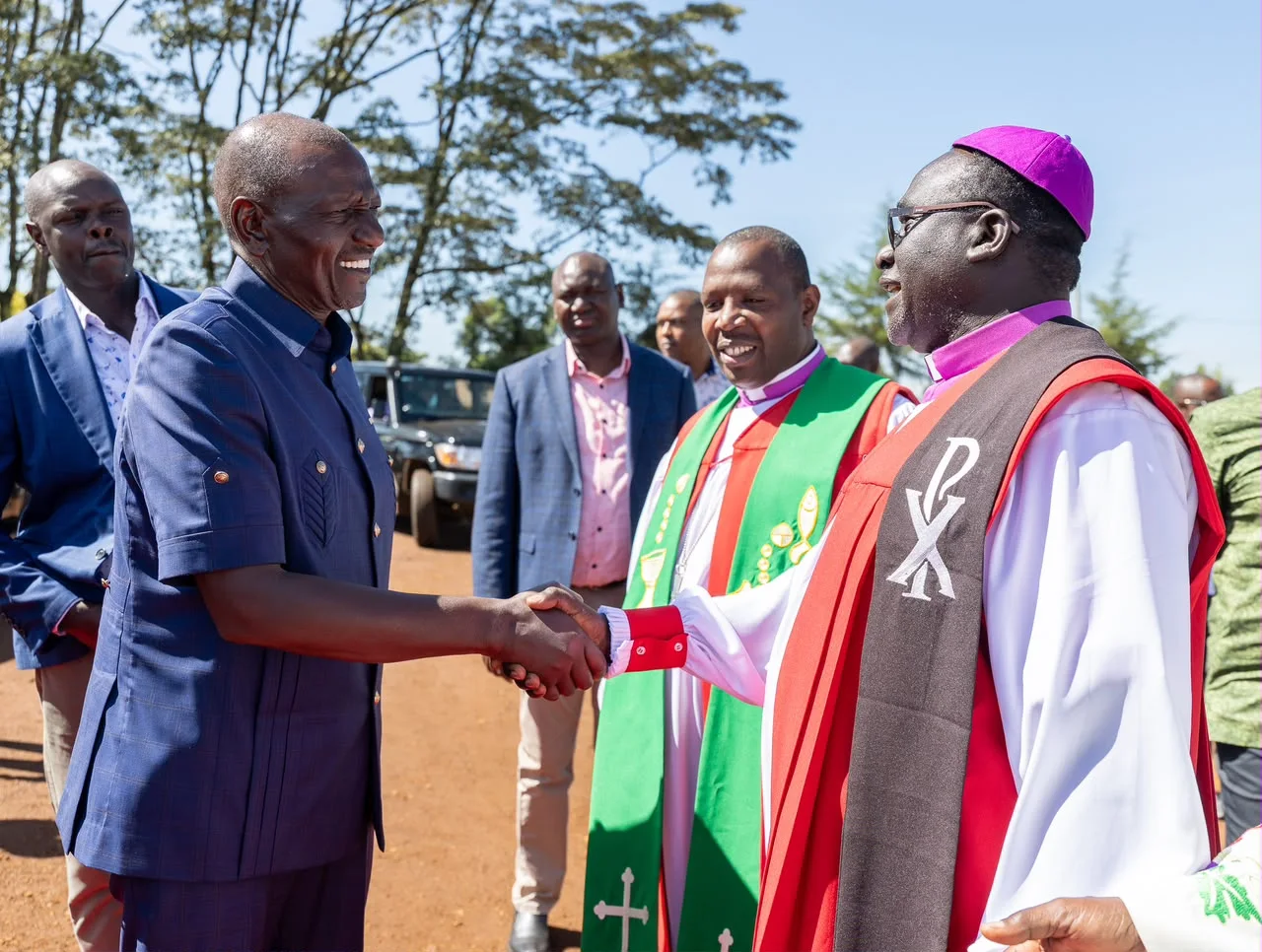
President William Ruto has warned public health facility managers against spending funds received through the Social Health Authority (SHA) on infrastructure projects such as gates instead of prioritising medicines and medical supplies needed by patients.
Speaking during an Anglican Church of Kenya (ACK) service in Kapsabet, Nandi County, on Sunday, Ruto said health facilities receiving money through the new financing system must ensure the funds translate into better treatment and access to essential drugs.
The President questioned spending priorities in some facilities, warning that investments in physical infrastructure would mean little if patients continued to leave hospitals without the medicines prescribed by health professionals.
His remarks place accountability at the centre of the government’s healthcare financing reforms, which are intended to expand access to treatment by directing funds to facilities based on the services they provide.
“I am asking because we are now sending money to every dispensary, directly to every health centre, directly. The boards of management of every facility must prioritise purchase of medicines and health commodities over other infrastructure development. So that in every health facility we must have medicine,” Ruto said.
He urged facility management boards, medical professionals and government officials to ensure that purchasing medicines takes precedence over other expenditure.
The President said the government had changed the way public health facilities receive funding, with dispensaries, health centres and Level Four hospitals receiving monthly payments through SHA.
Under the arrangement he described, payments are linked to the number of patients treated, with facilities expected to use the money to support service delivery.
“In the past, money was not being sent to dispensaries. But now, through SHA, every dispensary receives money every month. Every health centre receives money, and every Level Four hospital receives money every month. If they treat 500 patients, we send them money for 500 patients. If they treat 20 patients, we send them money for 20 patients.”
However, the President warned that the financing model could fail to improve healthcare if facility managers did not direct resources towards patients’ immediate needs.
He specifically criticised the use of SHA money to construct gates and undertake other projects before ensuring adequate supplies of medicines.
“Some people, when they receive the money we have sent through SHA, go and build a gate or a grave. They forget that what matters is not the gate, but the medicine,” he said.
The warning comes as the government seeks to move away from the former National Hospital Insurance Fund (NHIF) model towards SHA, which is intended to broaden healthcare financing beyond formally employed people.
Ruto argued that access to healthcare should not depend on whether a person has a formal job, a payslip or a steady income.
“We changed the old system of healthcare, which largely targeted people who were employed and had payslips, so they could contribute. But people who become sick include every Kenyan, whether they have a job or not, whether they have money or not.”
The success of the reforms depends not only on registering households and transferring funds, but also on whether health facilities have medicines, equipment and personnel to provide treatment.
Ruto called for stronger public participation in the management of health centres, saying community representatives, medical professionals and government officers should help oversee operations.
He compared the proposed oversight arrangements to school management structures, arguing that local communities should have a role in monitoring service delivery.
The President announced that 630,000 residents in Nandi County had registered with SHA, praising the county’s enrolment performance.
He also outlined plans to expand healthcare infrastructure, including the proposed enlargement of Kapsabet Hospital and the construction of additional hospitals in different parts of the country.
Ruto said the government was pursuing universal health coverage to ensure that more Kenyans could access medical services regardless of their financial circumstances.
The planned investments, however, will require adequate staffing, equipment, medicine supplies, and accountable management to translate infrastructure spending into improved patient care.