
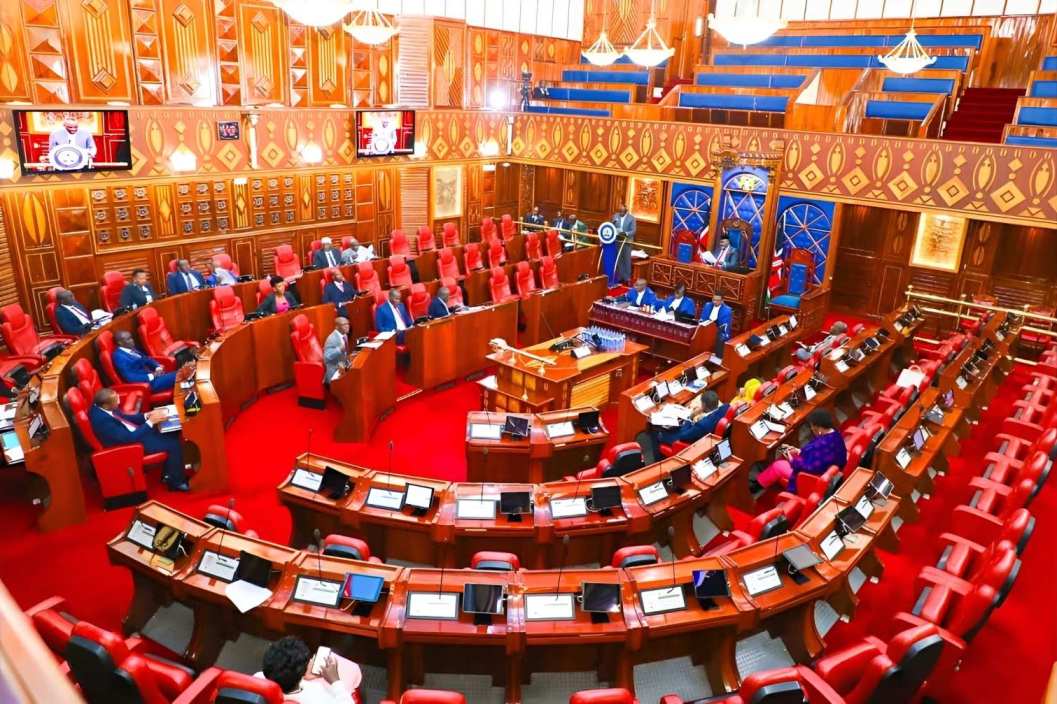
The Senate has moved to stop the implementation of the Sh80 billion cooperation agreement between the national government and Nairobi County, saying the deal cannot proceed until concerns over its legality, funding, and governance are fully addressed.
A report presented by the Senate Committee on Devolution and Intergovernmental Relations recommends that the agreement, signed at State House in February 2026, be suspended while both levels of government resolve issues identified during the committee’s review.
“The cooperation agreement between the National Government and Nairobi City County Government be temporarily suspended pending the resolution by the parties of the issues arising from the committee’s observations and analysis of the agreement,” reads the report.
The committee said the document, which contains 17 clauses, appears to go beyond cooperation and instead resembles a transfer of county functions under Article 187 of the Constitution without following the safeguards required by law.
It has directed the national government and Nairobi County to return to the Senate within 60 days with a report detailing the progress made in addressing the concerns raised.
Among the issues highlighted is the governance structure created by the agreement. Senators noted that policy oversight is placed under a steering committee dominated by officials from the national government, while the Nairobi governor only chairs the implementation committee.
“It is unclear whether the arrangement in substance remains one of cooperation under Article 189 or has taken on characteristics more consistent with a transfer of functions under Article 187 without the safeguards that would ordinarily attend such a transfer,” reads the report.
The committee also questioned how the programme will be financed, saying the agreement does not explain the source of funds or the mechanism for financing its activities. It further noted that although the deal has been linked to an Sh80 billion implementation cost, that amount is not contained anywhere in the signed document.
According to the report, the figure only emerged when Prime Cabinet Secretary Musalia Mudavadi and Nairobi Governor Johnson Sakaja appeared before the committee.
The panel also observed that Sh270 million had already been included in the 2026/27 financial year budget for road improvements in Nairobi instead of being treated as a conditional allocation.
Senators further faulted the agreement for failing to spell out the specific duties and financial commitments of each party, saying the omission makes it difficult to distinguish the responsibilities of the national government from those of the county government.
“The absence of this specificity makes it difficult to establish where the national government’s role ends and where the county government’s role begins, blurring the line between cooperation and assumption of county functions,” reads the report.
The committee also said the public participation process did not meet constitutional requirements because it was carried out after the agreement had already been signed and become operational.
“The exercise conducted on the agreement took place after its execution and coming into force,” reads the report.
It also raised concern that the agreement does not require regular reporting to either the Nairobi City County Assembly or the Senate, despite involving billions of shillings in public funds.
“The agreement does not provide for any reporting to the Nairobi City County Assembly or the Senate, notwithstanding the commitment of substantial public resources to the implementation of core county functions,” reads the report.
The committee also questioned the proposal to establish the Nairobi Metropolitan Police, saying it appears in White Paper 7 but is not captured in the cooperation agreement itself.
While appearing before the committee on February 26, 2026, Governor Sakaja defended the partnership, saying Nairobi carries responsibilities that go beyond those of an ordinary county because it is also the country’s capital and hosts the national government.
He told senators that the county’s Sh33.8 billion from the equitable share and locally generated revenue is not enough to support services for an estimated seven million people