
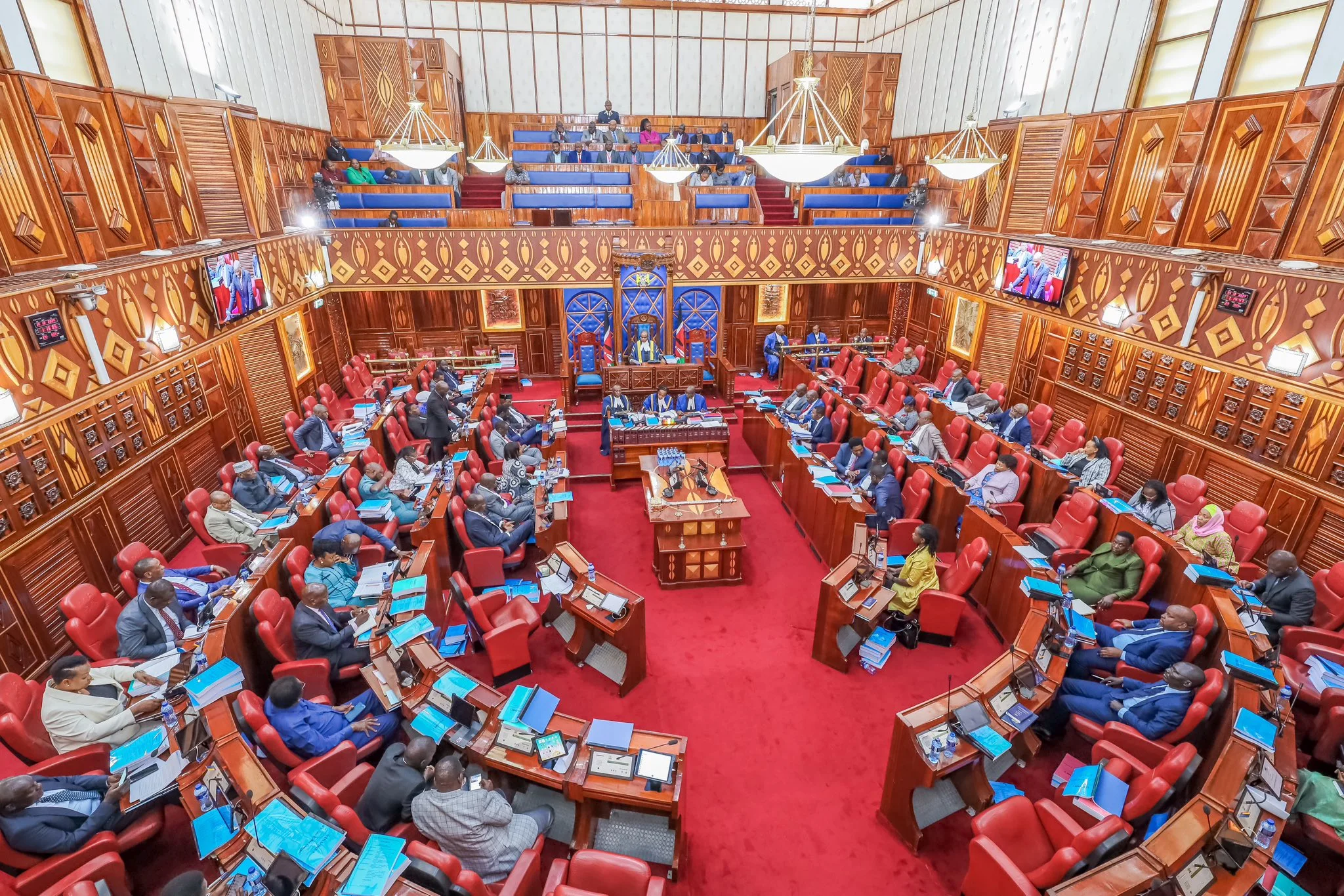
A dispute over how election results should be made public has reignited tensions between the Senate and the National Assembly, with senators rejecting changes proposed by MPs to the Elections Law Amendment Bill of 2024 and insisting that the legislation must address concerns raised by courts over livestreaming.
The Senate on Wednesday opposed amendments to 11 clauses of the Bill, faulting the National Assembly for removing a provision that sought to revise Section 39 of the Elections Act, which deals with the livestreaming of results announced at polling stations.
Lawmakers argued that the National Assembly's decision to retain Section 39(1G), despite previous court rulings against the provision in its current form, could complicate preparations for the August 10, 2027 General Election and expose the electoral process to further legal disputes.
The Senate Justice and Legal Affairs Committee, whose report was presented by Senator Veronica Maina, recommended rejecting the National Assembly's changes to 11 provisions, saying the proposed alterations failed to adequately address concerns surrounding the legality of the livestreaming clause.
"After due reflection and consideration, the committee rejected amendments by the National Assembly to Clause 10, Clause 15, Clause 19, Clause 22, Clause 23, Clause 24, Clause 25, new Clause 26A, Clause 30, Clause 32 and new Clause 33 of the Bill," Maina stated.
Senator Eddy Oketch defended the push for livestreaming, arguing that electoral laws should provide clear instructions to the Independent Electoral and Boundaries Commission (IEBC) on how results should be transmitted and made accessible to the public.
"The transmission of results must be guided by well-stipulated laws that direct, instruct and clarify to IEBC what it must do in transmitting the results. In the same manner, as Senate, we must give IEBC a law that mandates it to put in place a mechanism to livestream results," Oketch said.
The senators maintained that the proposed changes by the National Assembly risked weakening transparency safeguards ahead of the next election, although the debate also revealed disagreements over whether livestreaming results from polling stations could be implemented effectively.
Nandi Senator Samson Cherargei questioned how the proposal would work, arguing that the process of announcing results across different locations could not be handled in the manner suggested by proponents of the amendment.
"The question is, how would our brothers and sisters want us to declare the results? Should the chair of IEBC go to Magarini and declare results from Magarini, move to Bungoma, move to Nairobi, move to Kilifi, move to Mombasa? We must be realistic," Cherargei stated.
Makueni Senator Dan Maanzo called on lawmakers to draw from past judicial decisions when developing electoral legislation, citing the Okiya Omtatah and Kiai cases as rulings that should inform Parliament's work to avoid introducing provisions that could face legal challenges.
Senator Richard Nyutu also questioned why the National Assembly had retained a provision that had been declared unconstitutional, warning against reinstating a clause that could conflict with judicial findings.
"Which then means whatever the High Court declared unconstitutional was retained by the National Assembly. Mr Speaker, we cannot go by the decision of the National Assembly because we will be trying to introduce something that is a constitutional nullity," Nyutu said.
The disagreement will now be taken to a mediation committee comprising members of both Houses, with the Senate Justice and Legal Affairs Committee recommending that the process be expedited to allow Parliament to agree on a common version of the Bill.
The mediation is expected to be concluded before the first week of December, when Parliament is scheduled to break for a long recess.