
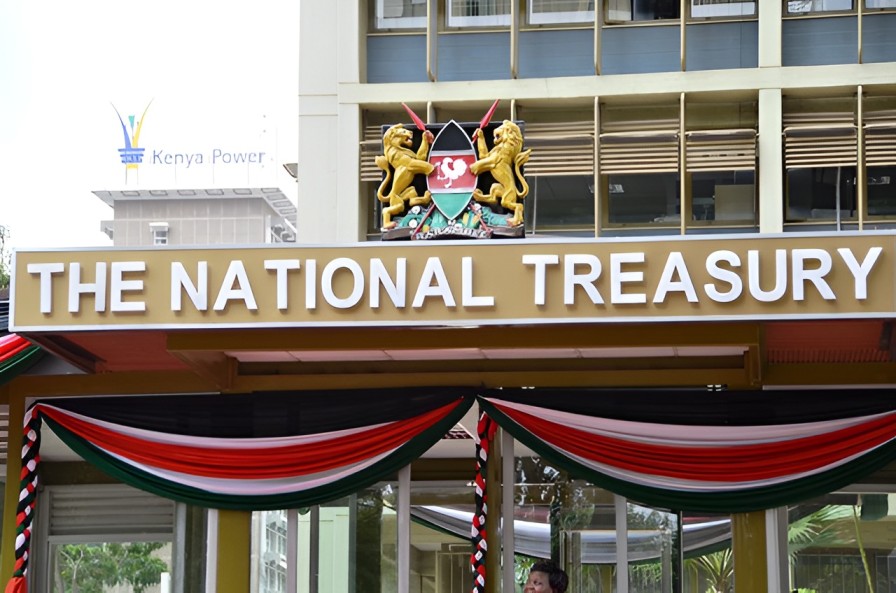
The National Treasury ended the last financial year with a Sh90.1 billion revenue gap after failing to collect enough taxes and other government income, forcing the State to borrow more from the local market to keep its spending plans on track.
The latest figures show that even after lowering its revenue target, collections still fell short, exposing the continued challenge of raising enough money to fund government operations.
New data from the Treasury shows total revenue for the financial year ended June 30, 2026 stood at Sh3.168 trillion against a target of Sh3.259 trillion for ordinary revenue and ministerial appropriations-in-aid, leaving an overall shortfall of Sh90.1 billion.
Taxes accounted for the biggest share of the missed target. Ordinary revenue reached Sh2.587 trillion, falling Sh53.5 billion below the expected Sh2.64 trillion.
Revenue collected by ministries, State departments and government agencies through appropriations-in-aid also failed to meet expectations. The collections stood at Sh581.7 billion against a target of Sh618.3 billion, creating another Sh36.6 billion gap.
The latest results show a wider revenue miss than the previous financial year. In the year ended June 2025, the overall gap stood at Sh62 billion after tax collections missed their target by Sh76 billion, although appropriations-in-aid exceeded the goal by Sh14 billion.
The latest performance points to the government's continued struggle to generate enough domestic revenue to support public spending. The shortfall also reflects the challenge of meeting revenue targets even after they have been revised.
The Treasury said the weaker collections pushed the government to depend more on domestic borrowing to finance the budget deficit.
“Total revenues amounted to Sh3.168 trillion, resulting in an underperformance of Sh90.1 billion mainly on account of shortfall registered in ordinary revenue of Sh53.5 billion,” the National Treasury said.
“Ministerial appropriation in aid collection at Sh581.7 billion was below target by Sh36.6 billion.”
Most major taxes achieved the revised targets during the financial year. Import duty, Pay As You Earn (Paye) and Value Added Tax (VAT) all performed as expected, while excise duty was the only major tax head that fell below target after posting a Sh1.5 billion shortfall.
The biggest weakness in ordinary revenue came from non-tax income, which includes penalties, levies and other charges collected by the Kenya Revenue Authority (KRA). The government collected Sh125.3 billion from this category, far below the target of Sh183.2 billion.
Lower revenue from taxes and appropriations-in-aid widened the financing gap, forcing the government to increase borrowing from the domestic market.
“From the financing side, total financing for the fiscal year 2025/26 amounted to Sh1.34 trillion or 7.1 percent of GDP. The deficit was financed by net domestic financing of Sh1.135 trillion or six percent of GDP and net foreign financing of Sh205.5 billion.”
The Treasury data shows net domestic borrowing exceeded the planned target by Sh161.7 billion during the financial year.
For the current financial year, which began on July 1, 2026, the government expects ordinary revenue to rise to Sh2.985 trillion. Total revenue has been projected at Sh3.629 trillion, including Sh644 billion expected from ministerial appropriations-in-aid.
Even so, Treasury says achieving the new target could become more difficult as fresh economic pressures emerge. Among them is the US-Israel war on Iran, which has pushed up fuel prices in Kenya and is expected to affect revenue collection.
To cushion consumers from higher fuel costs, the government has reduced VAT on petroleum products from 16 percent to eight percent for the next six months. The tax relief is expected to leave a Sh32 billion hole in government revenue.
The Treasury is also considering changes to Pay As You Earn (Paye) tax bands in September 2026 to leave workers with more disposable income and encourage spending.
At the same time, it has lowered Kenya's economic growth forecast for 2026 from 5.3 percent to five percent, pointing to a more difficult economic outlook as it pursues higher revenue targets.