
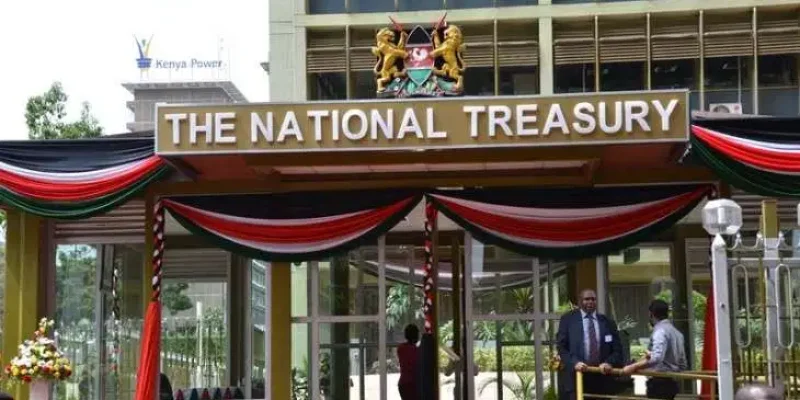
The government signed fresh borrowing deals worth Sh416 billion in just four months, using the money to finance the national budget, refinance maturing debt and fund development programmes across key sectors.
The latest figures, contained in a National Treasury report presented to Parliament, highlight the continued role of external financing as Kenya's public debt remains just below Sh13 trillion.
The report shows the borrowing was made up of a sovereign bond issued in the international market and several loan agreements signed with development partners.
The largest amount came from a $2.25 billion (about Sh290 billion) Eurobond issued in February through Citibank Europe Plc Germany Branch.
The bond was divided into two tranches. One raised $900 million (about Sh116 billion), carrying an interest rate of 7.9 per cent and maturing in 2034. The second raised $1.35 billion (about Sh174 billion), carries an interest rate of 8.7 per cent and will mature in 2039.
The Treasury says the funds were allocated to liability management operations and budget support.
Part of the proceeds was used to refinance existing debt, while the remaining amount helped finance the government's spending requirements during the current financial year.
In addition to the Eurobond, Kenya signed seven external loan agreements valued at about Sh161 billion with bilateral and multilateral lenders.
The funding will support projects in affordable housing, education, climate resilience and general budget financing.
One of the largest facilities is a $350 million (about Sh45.4 billion) World Bank loan that will finance affordable housing, improve land administration systems and support urban planning.
Another $125 million (about Sh16.2 billion) loan from the International Bank for Reconstruction and Development will increase access to affordable housing finance, improve property registration and encourage private investment in the housing sector.
The education sector will benefit from a Sh29 billion World Bank loan that will finance classroom construction and other education programmes aimed at improving learning outcomes, reducing regional inequalities and increasing the retention of girls in junior secondary schools.
The government also secured UA55.16 million (about Sh9.8 billion) from the African Development Fund to strengthen research, innovation and skills development.
Counties are set to benefit from another $30 million (about Sh3.9 billion) credit under the Kenya Locally Led Climate Action Programme to support climate adaptation and resilience projects.
Japan also extended a JPY25 billion (about Sh20.3 billion) loan that will support budget financing, implementation of the National Automotive Policy and efforts to reduce energy losses to strengthen the country's electricity grid.
According to the Treasury, the financing supports the Bottom-Up Economic Transformation Agenda and is expected to fund investments aimed at promoting economic growth while expanding access to public services.