
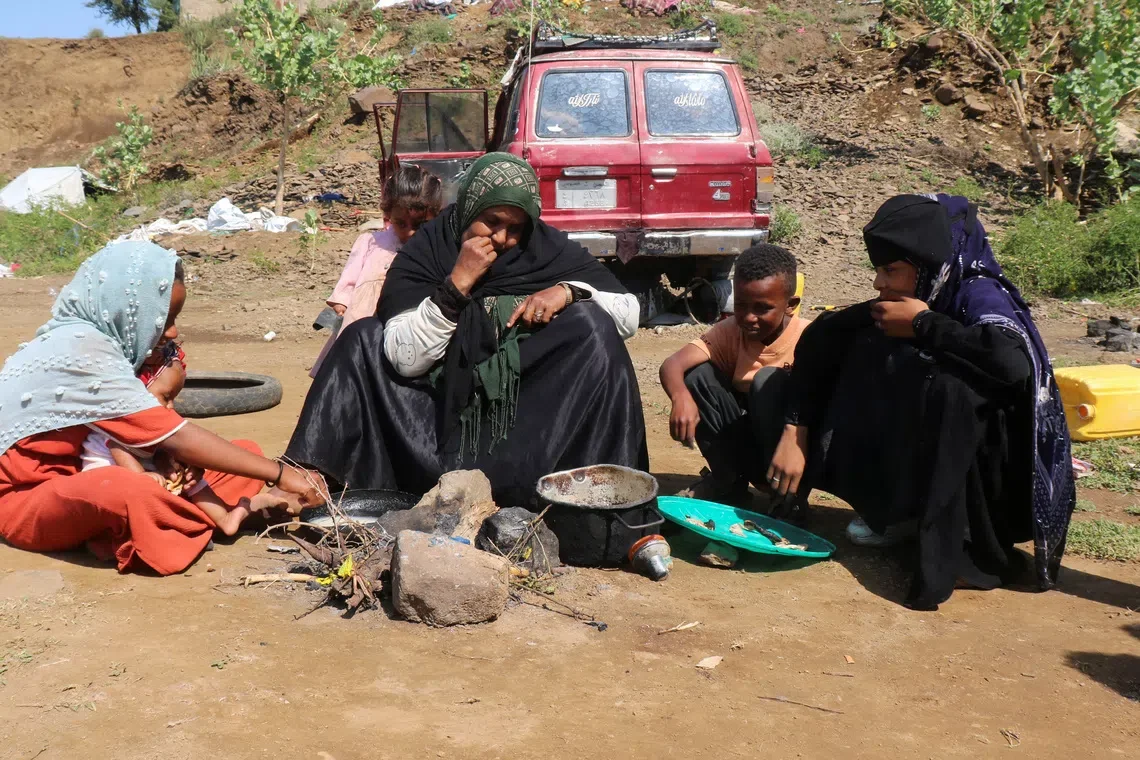
Fresh fighting in Yemen has pushed food insecurity to its worst level this year in areas under the control of the internationally recognised government, with thousands of newly displaced families struggling to access food and humanitarian assistance.
The World Food Programme (WFP) said on Friday that the latest escalation had displaced more than 149,000 people, according to the International Organization for Migration (IOM), adding pressure to communities already affected by years of conflict and repeated displacement.
Many of those forced from their homes had previously been displaced during Yemen's long-running conflict, leaving families with limited resources as fighting disrupts markets, blocks aid access and makes it harder to meet basic food needs.
WFP said recent monitoring in areas it could access found that 74 per cent of households were unable to meet their basic food requirements. The agency said this was the highest level recorded this year and pointed to a sharp worsening of food security.
“Accordingly, all Mobile Network Operators are hereby directed to exempt Government-authorized emergency bulk SMS communications from the opt-in and opt-out requirements applicable to commercial messaging services,” the CA said.
Across Yemen, an estimated 18.3 million people are facing acute food insecurity, while 2.2 million children below the age of five are acutely malnourished.
Of these children, about 500,000 are suffering from severe acute malnutrition, which WFP describes as the most life-threatening form of malnutrition.
The worsening situation comes as Yemen continues to face a humanitarian crisis driven by years of conflict, displacement, economic disruption and restrictions affecting humanitarian operations.
The country is also highly dependent on imported food, with about 90 per cent of food supplies coming from outside Yemen. Any disruption to trade, shipping or supply chains therefore leaves families exposed to shortages and rising prices.
The renewed fighting is already putting more pressure on fragile food markets.
In parts of Ta'iz, wheat flour prices have increased by 10 per cent in just two weeks. Traders have also estimated that current wheat stocks may be enough to meet only about two months of demand.
Supplies of vegetable oil have also been disrupted, adding to pressure on food prices.
WFP warned that further instability along Yemen's west coast and around the Bab al-Mandab corridor could push food prices even higher and deepen food insecurity in Yemen and the wider region.
Displaced families face additional challenges because markets near some displacement sites are either limited or inaccessible. As a result, some communities can only receive food assistance in kind.
The agency is expanding its emergency response for people recently forced from their homes and is preparing to assist up to 1.5 million people if the conflict worsens and displacement increases.
WFP has already reached more than 70,000 people in two major displacement hotspots in Ta'iz and Lahj.
In September, the agency distributed ready-to-eat food rations to more people than in any other month this year, reflecting the growing demand for emergency assistance.
WFP is also moving food stocks into key displacement areas in preparation for further needs. At the same time, it continues to support about 2.4 million people facing severe hunger in areas controlled by Yemen's internationally recognised government.
The crisis is also affecting neighbouring Djibouti, where more than 3,700 people fleeing the conflict had arrived by late September after crossing the Bab al-Mandab Strait.
The arrivals have placed additional pressure on humanitarian services and reception facilities in Djibouti, with WFP and its partners supporting the response alongside Djiboutian authorities.
However, WFP said its ability to meet the growing needs is being limited by dwindling resources.
The agency has already moved funds from food assistance distributions planned for November to address immediate emergency needs caused by the latest escalation.
Fighting has also prevented access to parts of Ta'iz and Hodeidah, leaving WFP and its partners unable to reach about 350,000 people because of insecurity, damaged or disrupted transport routes and rising delivery costs.
WFP needs $109 million to provide emergency food and nutrition support to up to 1.5 million people affected by the latest escalation.
It is also seeking another $158 million to maintain its regular operations through March 2027, including food, cash, nutrition assistance and school meals for 2.4 million people.
The agency warned that without additional funding, vulnerable families could begin experiencing interruptions in food and other assistance as early as next month.