
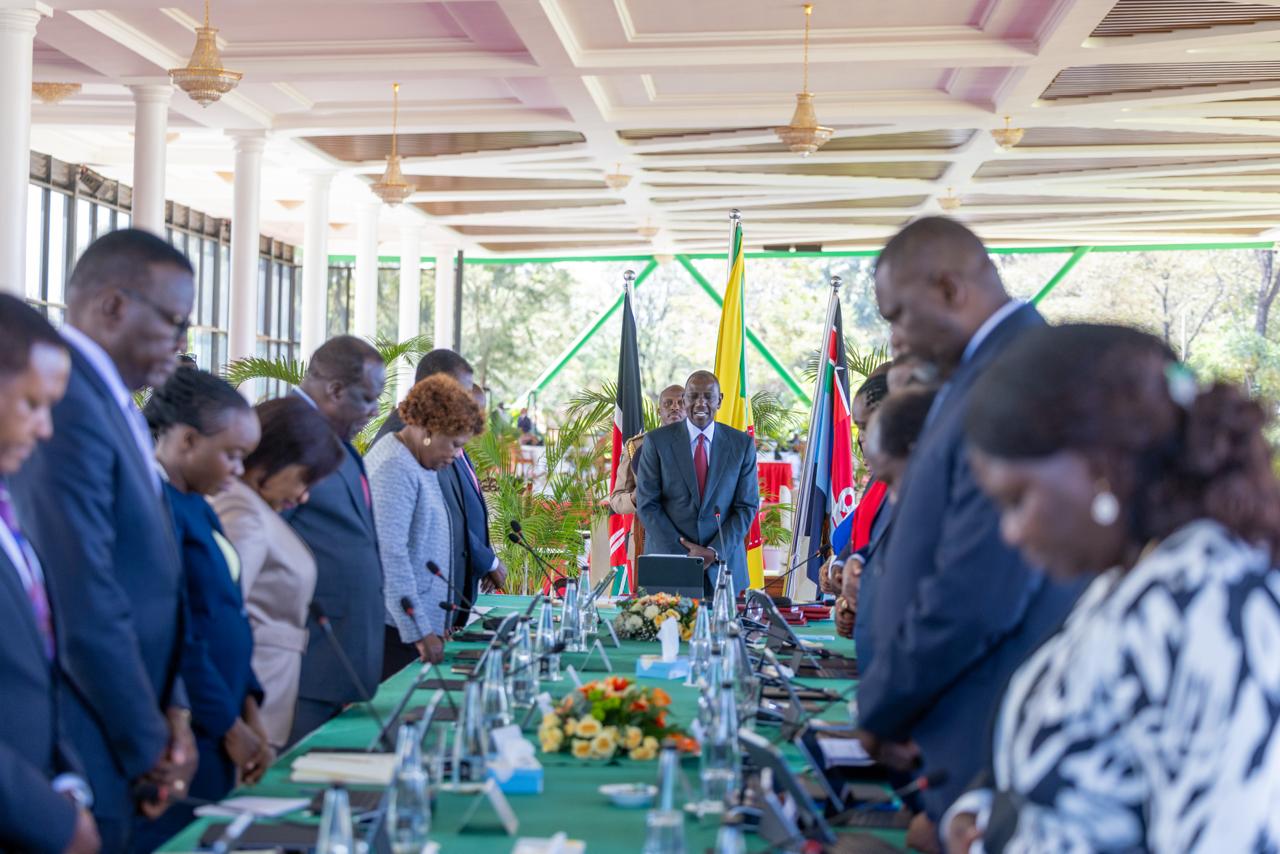
The Court of Appeal has declined to suspend a High Court order requiring President William Ruto to reconstitute his Cabinet to comply with the two-thirds gender rule, leaving the directive in force after the October 28 deadline expired.
In a ruling delivered on Thursday, October 29, the appellate court rejected the government’s application to suspend the orders pending the determination of the appeal. It also directed Attorney General Dorcas Oduor to serve court papers as proceedings continue.
The dispute centres on the Cabinet’s composition, which the High Court found unconstitutional because women accounted for only seven of its 25 members, compared with 18 men.
In its June 30 judgment, a three-judge bench comprising Justices Eric Ogola, Stephen Githinji and Jairus Ngaah ruled that the composition failed to meet the requirements of Article 27(8) of the Constitution.
The provision requires the state to take measures to ensure that no more than two-thirds of members of elective or appointive bodies are of the same gender.
The judges ordered Ruto to reconstitute his Cabinet within 120 days, giving him until October 28, 2026, to make the necessary appointments. The court calculated that at least nine members of the 25-person Cabinet needed to be women to meet the constitutional threshold.
The Cabinet, as defined in the case, comprises the President, Deputy President, Attorney General and Cabinet Secretaries.
The petition was filed after Ruto dissolved his Cabinet in July 2024 following nationwide anti-government protests. Although the High Court upheld the legality of several appointments, it ruled that the overall gender balance fell short of constitutional requirements.
Ruto had earlier signalled reluctance to treat the changes as an immediate obligation. Speaking during Katiba Day celebrations at the Kenyatta International Convention Centre in Nairobi in July 2026, he compared the issue to Parliament’s constitutional challenges.
“Just the same way the court has ruled that Parliament is not constitutional. That may not be achieved today, as it is a work in progress. Progressively, that is work in progress,” he said.
The missed deadline has renewed debate over the Executive’s compliance with court orders, while the appeal remains before the Court of Appeal.