
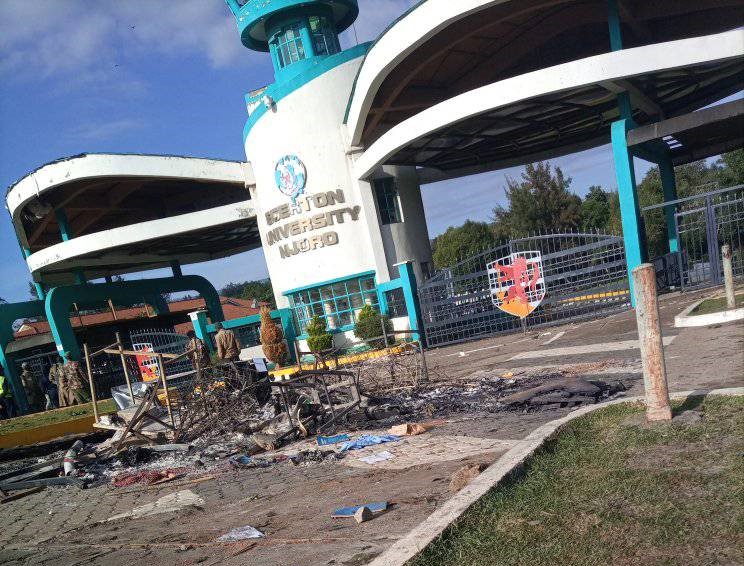
A years-long fight by six part-time lecturers for payment has ended in court after Egerton University was ordered to clear more than Sh3.8 million in unpaid earnings and compensate them for violating their constitutional rights.
The Employment and Labour Relations Court found that the university failed to pay the lecturers for work they had already completed, despite acknowledging that the money was owed.
The ruling by Justice James Rika followed a dispute involving Ruben Karuru, John Mbagara, Peter Wairigu, Francis Nderitu, Alex Mwaura and Joseph Mwai, who taught at Egerton University's Nairobi campus under part-time arrangements.
The lecturers were hired on an hourly basis and were to earn Sh2,000 for undergraduate classes and Sh2,500 for master's level teaching.
The court declared that the university acted unlawfully by withholding the lecturers' pay and ruled that their constitutional rights had been violated. In addition to the unpaid earnings, each of the six lecturers was awarded Sh100,000 in general damages.
The case arose from teaching assignments carried out between 2009 and 2021. During that period, the lecturers submitted examination processing forms, attendance sheets and payment schedules through their supervisors. The documents were verified before being forwarded to the university's main campus in Njoro for processing.
The court heard that the Nairobi campus director also wrote to the university's deputy vice chancellor in charge of academic affairs requesting that the lecturers be paid, but the payments were never made.
“Their contracts were never terminated. They did not resign and considered themselves as continuing employees of the respondent,” the court heard.
The university's legal officer admitted that the six lecturers had worked for the institution and that outstanding payments were still due. However, the university denied discriminating against them and challenged the amounts they had claimed.
“It is within public knowledge that the university has pending bills to the tune of Sh9.2 billion,” the court heard. “It was not an issue of unfair labour practice, but inability to pay, occasioned by underfunding.”
The university further told the court that its Nairobi campus was closed in 2021 because of financial challenges. It said pending payments were being handled according to the age of each claim, with older debts being cleared first.
Justice Rika dismissed that explanation, saying the process unfairly treated the lecturers.
“The payment of remuneration in arrears to various employees, based on the age of their claims, without consulting the claimants, simply means that the claimants have been subjected to workplace discrimination.
“Some of their colleagues were paid their dues, when the director Nairobi campus put in demands.”
The judge also rejected the university's argument that lack of funds excused the delayed payments.
“In regard to the institution’s inability to pay, the judge ruled the university provided a "financially sound explanation, but is nonetheless legally and constitutionally unsound".
“Employees’ remuneration is protected under Sections 17 and 18 of the Employment Act.
“It must be paid when it falls due. If the employer is broke, it must consult the employee, and agree on a reasonable payment plan.”
While the lecturers argued that they still regarded themselves as employees because their contracts had never been terminated, the court ruled that each engagement came to an end once the agreed teaching assignment was completed.
“The employment relationship ended on the completion of each piecework,” the judge ruled.
“It was not a continuous relationship, that could be deemed to be still alive, years after the claimants finished teaching their units.”
The court eventually adopted the university's computation of the outstanding amounts, saying it found those figures more reliable than the calculations presented by the lecturers.