
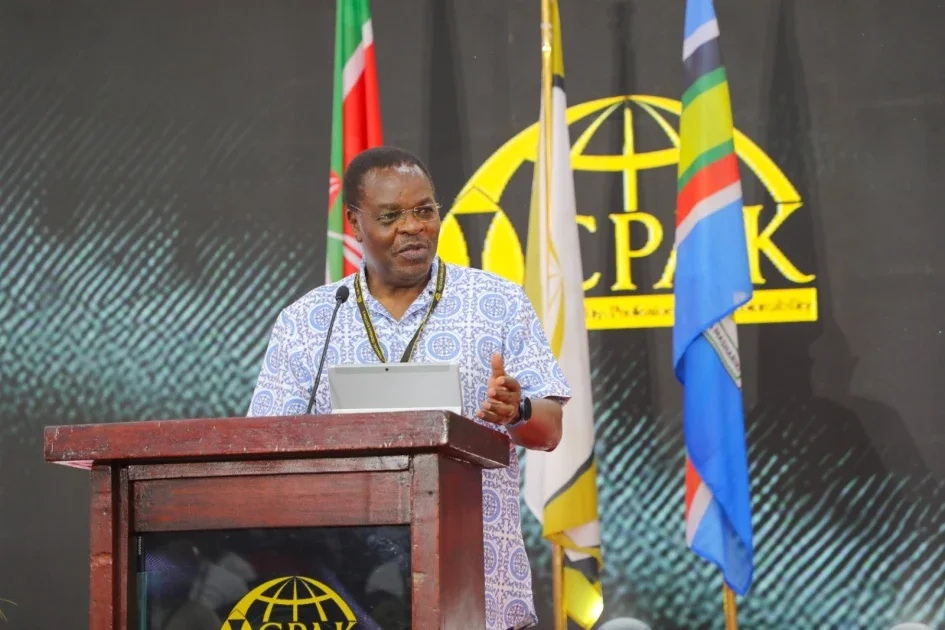
Accountants and other professionals have been put on notice over their role in facilitating corruption, with the Ethics and Anti-Corruption Commission (EACC) warning that specialised knowledge is increasingly being used to disguise financial crimes and make it difficult for investigators to trace stolen public resources.
EACC Chairperson Dr David Oginde said professionals entrusted with maintaining financial accountability must not turn their technical skills into instruments of corruption, urging accountants to resist pressure to falsify records, manipulate figures or compromise their independent judgement.
Speaking during the Institute of Certified Public Accountants of Kenya (ICPAK) Annual Seminar in Mombasa on Friday, November 14, Oginde said the involvement of professionals in corrupt schemes posed a major challenge to the commission because of the technical nature of the crimes.
He maintained that ethical conduct must begin with individual decisions, arguing that professional qualifications and regulatory requirements alone cannot guarantee honesty.
"Integrity is not enforceable – it is a personal choice," he said.
Oginde observed that individuals with specialised financial knowledge could exploit their understanding of accounting systems and professional procedures to conceal irregularities, leaving investigators with complicated cases to unravel.
"The wickedness that's done by professionals is professionally done. It's not an easy crime for the Commission to crack," he observed.
He challenged accountants to protect the credibility of their profession by ensuring that financial information remains accurate and that audit findings are not altered to accommodate powerful individuals or personal interests.
According to Oginde, ethical accounting should be demonstrated through practical decisions, including refusing to manipulate financial statements and maintaining independence when reporting wrongdoing.
"Integrity is reflected in the accountant who refuses to manipulate figures, the auditor who stands by uncomfortable findings and professionals who will not compromise independent judgement," he said.
The EACC chairperson also turned his attention to the wider public, urging Kenyans to examine the contradiction between condemning corruption and accepting opportunities that encourage dishonest behaviour.
He said the fight against graft required more than public criticism of corrupt individuals, noting that people who witness wrongdoing must be prepared to speak out instead of allowing misconduct to continue unchecked.
"If we keep silent about wrongdoings, then evil will perpetuate," he cautioned.
Oginde called on professionals and members of the public to demonstrate the courage to challenge unethical conduct, regardless of the status or influence of those responsible.
He argued that transforming society required individuals who could defend what was right even when doing so involved confronting powerful people.
"Men and women who ultimately transform society have moral courage – they stand up against anyone who wants to do wrong," he said.
The commission chairperson further challenged Kenyans to change their outlook on national development, saying the country should aspire to create an environment that attracts international visitors and residents rather than one that encourages its citizens to seek opportunities abroad.
He questioned why Kenya could not develop institutions and living standards that would make it an attractive destination for people from countries that Kenyans currently admire.
"If Americans built their country to the extent we want to go there, why can't we build Kenya so that the Americans, Singaporeans and other foreigners would want to come and live here?" he posed.
Meanwhile, ICPAK Chairperson CPA Prof. Elizabeth Kalunda said the institute remained committed to supporting efforts to eliminate corruption and strengthen professional accountability.
She assured the EACC that ICPAK would not become a refuge for individuals seeking to use their professional standing to escape scrutiny over corrupt activities.
Kalunda said the institute intended to deepen its working relationship with the commission to advance ethical conduct, transparency and good governance among accounting professionals.
She also committed to presenting a progress report at the next summit, detailing the steps taken by ICPAK members to promote integrity and contribute to the fight against corruption.
The annual seminar was held in Mombasa between November 9 and 13, attracting accounting professionals and other stakeholders for discussions on challenges and developments affecting the sector.
The EACC said its engagement with professional institutions, including ICPAK, was part of efforts to strengthen cooperation and encourage ethical leadership across different sectors.