
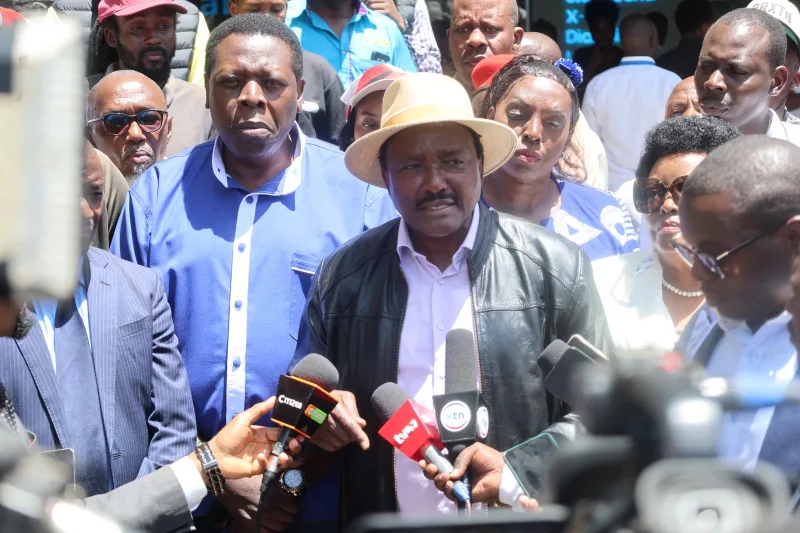
Wiper leader Kalonzo Musyoka’s efforts to bring opposition leaders together under The Ukombozi Alliance (TUA) ahead of the 2027 General Election have encountered fresh resistance, with Jubilee leaders and allies of former Deputy President Rigathi Gachagua questioning the proposed arrangement and calling for a different approach to building a united front against President William Ruto.
The resistance follows a proposal to appoint Gachagua as chairman of the alliance’s council, replacing former President Uhuru Kenyatta, but some of his close allies have dismissed the offer, arguing that the position would not give him enough influence over the coalition’s affairs.
The Ukombozi Alliance is a rebranded Azimio La Umoja coalition, which sponsored the late Raila Odinga’s presidential bid in the 2022 General Election.
Embakasi North MP James Gakuya, a close ally of Gachagua, questioned the value of offering his political ally the council chairmanship, saying the position was not enough for a politician of his standing.
Gakuya urged Gachagua to turn down the proposal unless he was given greater control of the rebranded political outfit.
“I find council chairman position as a low deal considering the size of our party,” Gakuya said as quoted by the Star.
Gatanga MP Edward Muriu, another ally of Gachagua, also played down the proposal, saying the Democracy for the Citizens Party (DCP) needed to strengthen its support base before engaging other opposition parties in coalition talks.
Muriu said the party’s immediate focus was to consolidate its political ground before joining discussions aimed at forming a larger opposition alliance to challenge Ruto in 2027.
“Our focus as DCP is to consolidate our bases and eventually sit down with other opposition leaders and come up with giant coalition to send Ruto home,” Muriu told the Star.
He added that DCP would make its own decisions on coalition arrangements without interfering with the choices of other political parties.
“As DCP we know what we want and we do not dictate other parties which coalitions they join or what they call them.”
DCP deputy party leader Cleophas Malala has also ruled out the party joining TUA, signalling that Gachagua’s camp prefers a separate political arrangement before negotiations on a common opposition coalition can begin.
Malala said DCP intended to work with Nairobi Senator Edwin Sifuna, while the other opposition leaders continued with their plans under TUA. He maintained that the different groups could later come together to negotiate an agreement.
“We as DCP cannot join the Ukombozi Alliance. They should join together as TUA, while we in the DCP will join Sifuna. Then we will negotiate together for one coalition,” Malala said.
“We will sit down after they have come together as TUA. Then they will come and sit with us for an agreement,” he added.
The remarks point to differences within the opposition over how to organise a common political platform, with some leaders pushing for their preferred arrangements before committing to a broader coalition.
Kalonzo chaired an Azimio steering committee meeting on Wednesday, where the proposal to have Gachagua replace Uhuru as chairman of the TUA council was discussed.
The Wiper leader currently serves as TUA’s party leader, a role that gives him considerable influence over the coalition’s direction and leadership.
Under the Azimio coalition agreement, the party leader serves as the political and executive head of the coalition and its spokesperson. The position also involves overseeing its daily operations and acting as its official representative.
The council chairmanship would give Gachagua a prominent place in the coalition’s leadership, particularly at the council level. However, political observers see the proposal as one that could also leave Kalonzo with greater influence over the opposition’s emerging leadership structure and negotiations over a joint presidential ticket.
The debate over the proposed leadership arrangement has also drawn criticism from Jubilee, with deputy party leader Jeremiah Kioni questioning why the party continues to associate itself with the Azimio-Ukombozi framework.
Kioni called for opposition leaders to move away from existing political formations and establish a new coalition that would accommodate the different groups and give them a voice in decision-making.
“I really don’t understand what we are doing as Jubilee in this whole Azimio/Ukombozi arrangement,” Kioni said.
“At this point, I believe we should be thinking beyond the old formations and working towards a new, genuinely inclusive coalition that brings everyone on board and gives every voice a place at the table.”
His position adds to the pressure facing Kalonzo’s plan, as some leaders question whether a rebranded version of Azimio can provide the basis for a united opposition ahead of the next election.
Uhuru resigned as Azimio Council chairman, saying the time had come to give younger leaders an opportunity to take charge.
In his resignation note, the former President said leadership required making room for others rather than holding on to a position.
“Leadership is not the clinging to the front of the current; it is the courage to step aside and allow the next generation to navigate the waters,” Uhuru said in his resignation note.
Despite stepping down, Uhuru has previously been suggested as a possible mediator if opposition leaders fail to agree on a single presidential candidate for the 2027 race.
Gachagua has said the former President could serve as an elder to help rival opposition groups settle their differences, rather than taking charge of the opposition or financing its activities.
However, Uhuru’s close relationships with several leading opposition figures could complicate efforts to present him as a neutral figure capable of helping the different camps reach an agreement.
With Jubilee leaders questioning the current coalition arrangement and Gachagua’s allies demanding a stronger role for their party, Kalonzo’s effort to build a common opposition platform faces the challenge of securing support from leaders who have different views on how the alliance should be structured.
The disagreements over TUA’s leadership and the order in which coalition talks should take place leave the opposition with more negotiations ahead as leaders seek a common strategy to challenge Ruto in 2027.