
Kenya’s first confirmed Ebola case has exposed a possible gap in airport screening after health officials said the patient may have lowered his temperature with medication before arriving at Jomo Kenyatta International Airport (JKIA).
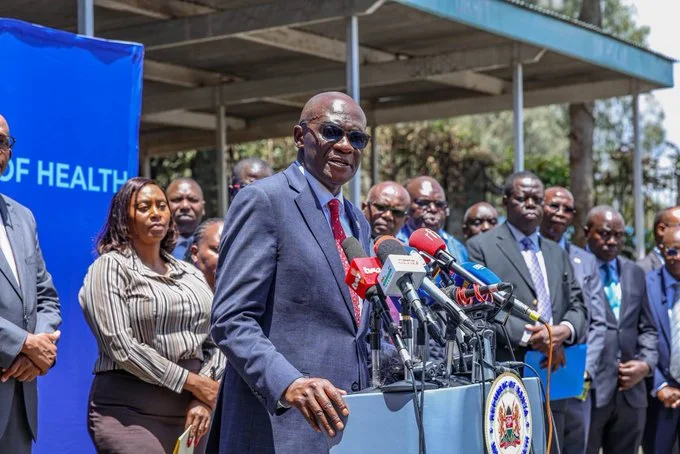
Director-General for Health Dr Patrick Amoth said the patient went through the required checks after flying into Nairobi from Entebbe, Uganda, but officials suspect medication may have hidden some of the warning signs that would otherwise have triggered further assessment.
The development comes as the Ministry of Health steps up efforts to identify people who may have been exposed to the deceased patient and trace passengers and crew members who travelled on the same flight.
Speaking on Citizen TV’s The Explainer on Tuesday night, Amoth said the patient had travelled from northwestern Democratic Republic of Congo (DRC) to Uganda before proceeding to Kenya.
“So far, we have screened more than 650,000 travellers from our 15 designated points of entry. This patient came from North Western DRC up to Entebbe then took a flight to Nairobi. He underwent normal screening which is an automatic thermo-scanner,” Amoth said.
The health official said the patient's ability to get through the screening may have been linked to medication he had taken before travelling.
“We postulate that this patient took some medication to be able to mask some of his symptoms, including lowering his temperature and therefore could pass through. We think that is the reason he moved direct from the airport, called a relative to pick him to Nairobi Hospital. That is our hypothesis."
According to Amoth, the patient did not proceed to seek care on his own using public transport after landing. Instead, he contacted a relative, who picked him up from the airport and took him to Nairobi Hospital.
The patient, a Kenyan citizen who had spent seven years in the DRC, arrived in Kenya on October 3 after travelling by road from the DRC to Kampala.
He later boarded Jambojet flight 8523 from Entebbe to Nairobi and underwent routine public health checks at JKIA before leaving the airport.
The patient had been sick for about a month and had sought treatment at several health facilities while in the DRC.
His condition became clearer at Nairobi Hospital, where he was placed in isolation after displaying several symptoms. They included fever, severe fatigue, weakness, muscle pain, painful swallowing, sore throat and bleeding beneath the skin at the site of an injection.
Laboratory tests subsequently established that he had Ebola Bundibugyo virus disease.
He was given supportive care but died on Monday at 11:30 pm.
Amoth said the airport screening system also depends on information supplied by travellers through surveillance forms. These forms require people to provide details about their travel and disclose any symptoms they may be experiencing.
He appealed to travellers to give health officials accurate information, saying the declarations are meant to help identify people who need assistance rather than to penalise them.
“If we ask whether you've travelled to a particular place and you've done so, please indicate, it is not a punitive measure, it is to protect your health. If you have any particular symptom that is listed in the surveillance form, if it is positive for you, check it out as positive so that we be able to identify you and offer you help,” Amoth remarked.
The Ministry of Health has so far identified 28 people who came into contact with the deceased and is monitoring them as part of measures to prevent further transmission.
Officials are also looking for 23 passengers and four crew members who were aboard the flight that carried the patient from Entebbe to Nairobi.
Amoth said Ebola can take between two and 21 days before symptoms appear following infection. He added that most infected people begin showing signs of illness within four to five days after exposure.
He explained that people generally become capable of transmitting the virus once symptoms have developed, making prompt reporting and medical assessment important.
The Bundibugyo strain diagnosed in the patient is one of three Ebola virus species associated with major outbreaks, according to Amoth. The other two are the Zaire and Sudan strains.
Unlike the Zaire strain, Bundibugyo does not have a vaccine or a specific treatment, meaning patients are mainly managed through supportive care.
Amoth nevertheless stressed that people who develop symptoms or believe they have been exposed should seek help without delay.
He directed members of the public to use the Ministry of Health's toll-free 719 hotline so that trained teams can assist them and arrange safe transportation where necessary.
“The best thing to do is to call our line, 719, toll-free number, and our team will be able to pick you up wherever you are,” Amoth said.
He cautioned suspected patients against making their own way to hospital in taxis, matatus or vehicles driven by relatives, warning that such travel could expose other people to the virus.
“It is unsafe to be able to get into a taxi because of the risk of exposure. It is unsafe to get into a matatu or to be driven by a relative because of the potential for exposure,” he said.
Amoth also advised mothers infected with Ebola not to breastfeed because of the possibility of transmitting the virus to their babies.
At the same time, he called for survivors of the disease to be accepted back into their communities without stigma after completing the required monitoring period.
He said people who remain without symptoms for 21 days can be cleared, while male survivors require additional follow-up because the virus may remain in semen after recovery.
For male survivors, semen samples are tested every month until two consecutive negative results are obtained. Only after those results can they be advised to resume normal sexual relations.