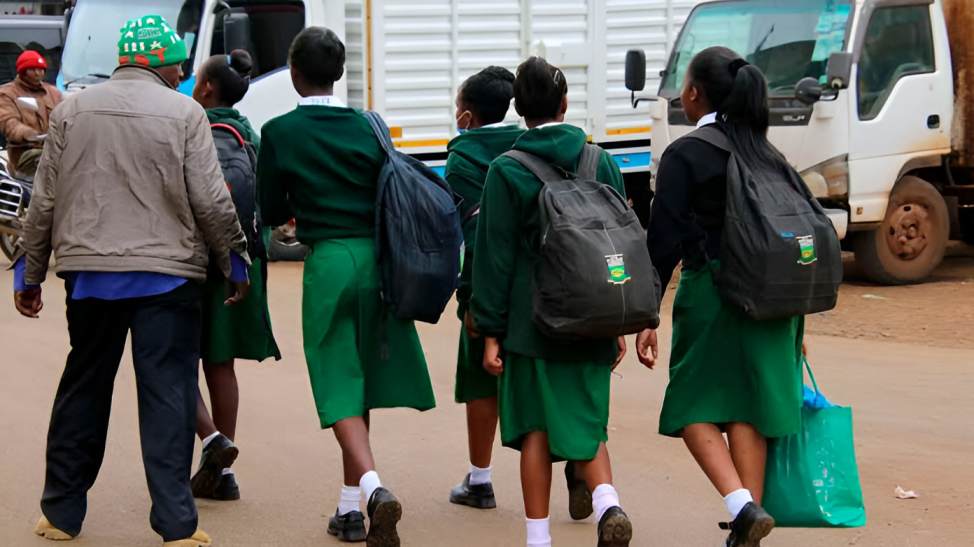
As learners head home for the August holidays, many secondary schools are shutting their gates under the weight of unpaid bills, growing debts and shrinking government funding. Principals say months of delayed and reduced capitation have left them struggling to buy food, pay utility bills and keep schools running, exposing the widening gap between the government's free secondary education policy and the reality on the ground.
The Kenya Secondary School Heads Association (KESSHA) says schools across the country are facing a Sh22.5 billion capitation deficit that has pushed many institutions into financial distress.
The association says principals have been forced to rely on parents and sponsors to bridge the gap, even as schools remain barred from charging extra levies under the free secondary education programme.
Schools are supposed to receive Sh22,244 per learner every year under the government's capitation programme. The amount is distributed in three phases, with Sh11,122 released in the first term, Sh6,673 in the second term and Sh4,449 in the third term.
KESSHA chairperson Willy Kuria said schools received only Sh6,577 per learner during the first term, while Sh1,375 was retained by the Ministry of Education. That brought the total allocation to Sh7,952, leaving schools with a funding gap of Sh3,170 per learner.
During the second term, schools received Sh4,852 per learner, while Sh285 was retained by the ministry, bringing the total allocation to Sh5,137. This left another shortfall of Sh1,535 per learner.
Kuria said the situation has been worsening over time, noting that in 2025 schools received Sh14,572 per learner, with another Sh817 retained for textbooks. The total allocation therefore stood at Sh15,389, leaving schools with a funding gap of Sh6,855 per learner.
“Schools are in debt. Sometimes we engage parents and explain the deficit, and some agree to contribute. But when they do, the ministry classifies it as extra fees. The reality is that no school can survive on the current funding,” he said.
According to Kuria, the capitation rate has remained unchanged since 2017 despite a steady rise in the cost of operating schools.
“Utilities such as water and electricity have become more expensive, yet the capitation has remained unchanged. Day schools are particularly affected because parents pay only the approved charges while operating costs continue to rise,” he said.
He added that feeding learners alone now costs schools an average of Sh61,000 per student every year, making it one of the biggest financial burdens facing institutions.
“That covers food only. Schools must also purchase learning materials, equipment and meet many other operational expenses,” he said.
Kuria also questioned how the government intends to deliver fully funded secondary education when it is already unable to provide the current capitation.
“If it has been impossible to provide the current allocation, how will fully funded secondary education be achieved? It is simply not possible,” he said.
He also linked the funding crisis to delays in paying Kenya National Examinations Council (KNEC) examiners.
“If the government has been unable to provide enough money to pay KNEC examiners, how can it promise fully funded secondary education?” he asked.
Although sponsors continue supporting some learners and schools, Kuria said their assistance is too small to close the widening funding gap.
“The support the government provides is simply inadequate,” he said.
Besides the reduced capitation, schools are also battling delays in receiving funds because of challenges affecting the Kenya Education Management Information System (KEMIS).
Several principals, who requested anonymity for fear of victimisation, said differences between learner data captured in KEMIS and actual enrolment have denied some schools funding altogether, while others have received less money than they qualify for.
They said repeated attempts to correct the records have not resolved the problem, leaving schools to shoulder expenses without government support.