
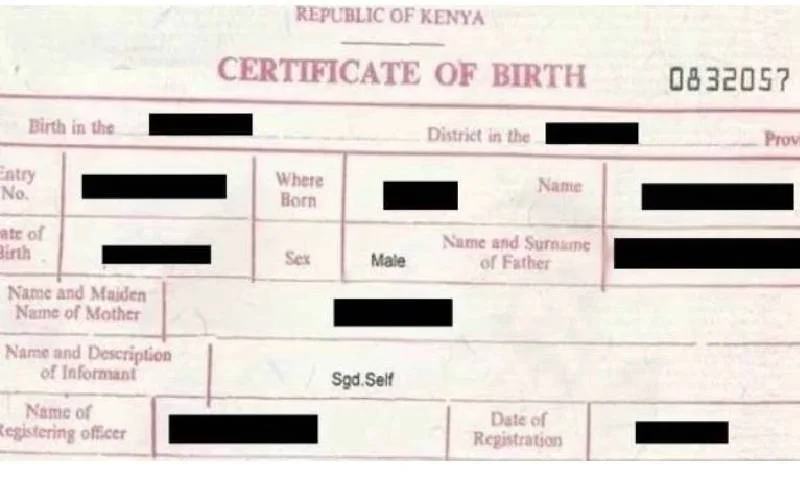
Parents could soon be spared the cost and inconvenience of obtaining birth certificates as the government prepares to introduce a nationwide digital registration system that will automatically assign every child a unique personal identifier at birth and allow families to access the documents without visiting government offices.
Principal Secretary for Immigration and Citizen Services Belio Kipsang said the government was working towards abolishing all fees charged for birth and death certificates, with a formal announcement expected through a Gazette notice.
He told the National Assembly Committee on Administration and Internal Security that the government was also racing against time to complete the technical integration required to move the country fully to the Unique Personal Identifier (UPI) system within 30 days.
"Once the technical work that is ongoing is finalised, we would want to ensure that within the next 30 days, this integration has been done, so that we can migrate fully to the UPI," Dr Kipsang told the committee.
The planned changes would remove the existing charges that parents incur when registering their children or seeking amendments to birth records. Currently, a standard birth certificate costs Sh200, while late registration attracts Sh500 and correction of names costs Sh1,000, excluding additional charges on the e-Citizen platform.
The digital programme will link the civil registration system to the Ministry of Health's Hospital Management Information System, enabling hospitals to transmit birth details electronically as soon as children are delivered.
Kipsang said the process would do away with physical birth notification forms and reduce the need for parents to make trips to civil registration offices to secure their children's documents.
Technical teams from the Interior and Health ministries are already working on the integration, which will pave the way for the nationwide introduction of electronic birth notifications and automatic assignment of UPIs.
The government has already tested the system in Nairobi City County and Bomet County, which hosted this year's International Identity Day celebrations.
More than 7,500 public hospitals are expected to be connected to the platform, alongside private health facilities that are empanelled by the Social Health Authority.
"This will make it possible for every other hospital to issue electronic notifications and, therefore, the UPI," said the PS.
Once the system becomes operational, parents will be able to obtain their children's birth certificates online, download them and print copies from wherever they are, without having to appear physically at registration offices.
Kipsang likened the process to the Kenya Revenue Authority's online services, which allow taxpayers to access and print their PIN documents remotely.
"The same way we download the PIN card or PIN number from the Kenya Revenue Authority, we will also be able to print a birth certificate anywhere," the PS said.
The proposed reforms follow concerns raised by Gilgil MP Martha Wangari over the financial and logistical challenges families face when applying for birth certificates.
Wangari told the committee that the cost of acquiring the documents was placing pressure on households, particularly those in rural communities where parents have to travel considerable distances to reach civil registration offices.
She noted that birth certificates were essential for school admission and access to other important services, making it necessary for the government to ensure that families could obtain them without facing unnecessary financial hurdles.
The MP also questioned the practice of charging parents for correcting mistakes made during manual registration, arguing that families should not bear the cost of errors they did not cause.
"I feel that sometimes it is not even a problem for the parent because of the manual writing of the names. Sometimes you miss a letter, and you have to change it to get the right spelling," said Wangari.
She further raised concerns about whether members of the public had been adequately consulted before the charges were introduced, warning that the costs could lock out families with limited incomes.
The legislators called on the government to strengthen funding for the civil registration department, saying its services were central to ensuring citizens obtain the documents needed to establish their identity.
Under the new arrangement, the UPI issued to a child at birth will serve as their lifelong identification reference before transitioning into a national identity card number when they turn 18.
Kipsang said individuals would only need to submit their biometric details when applying for national identity cards upon attaining adulthood.
The government also expects the digital registration platform to improve the accuracy of the national population register by ensuring that information about deceased persons is updated immediately after their deaths are registered.
According to the PS, the system will help address cases of identity fraud in which individuals continue using identification documents belonging to deceased persons.
Once a death is recorded, the individual's details will be deactivated across identification platforms, including those relied on by banks, insurance companies and other institutions when conducting electronic Know Your Customer checks.
The move is intended to ensure that deceased persons do not remain active in systems used to verify identities and access financial and other services.
Kipsang, however, did not reveal the projected cost of developing and implementing the digital UPI platform. He only indicated that the new identification document would be equipped with its own security features.
The Births and Deaths Registration Act provides for compulsory registration of births and deaths, while the Births and Deaths Registration Rules outline the procedures, timelines and charges governing the process.