
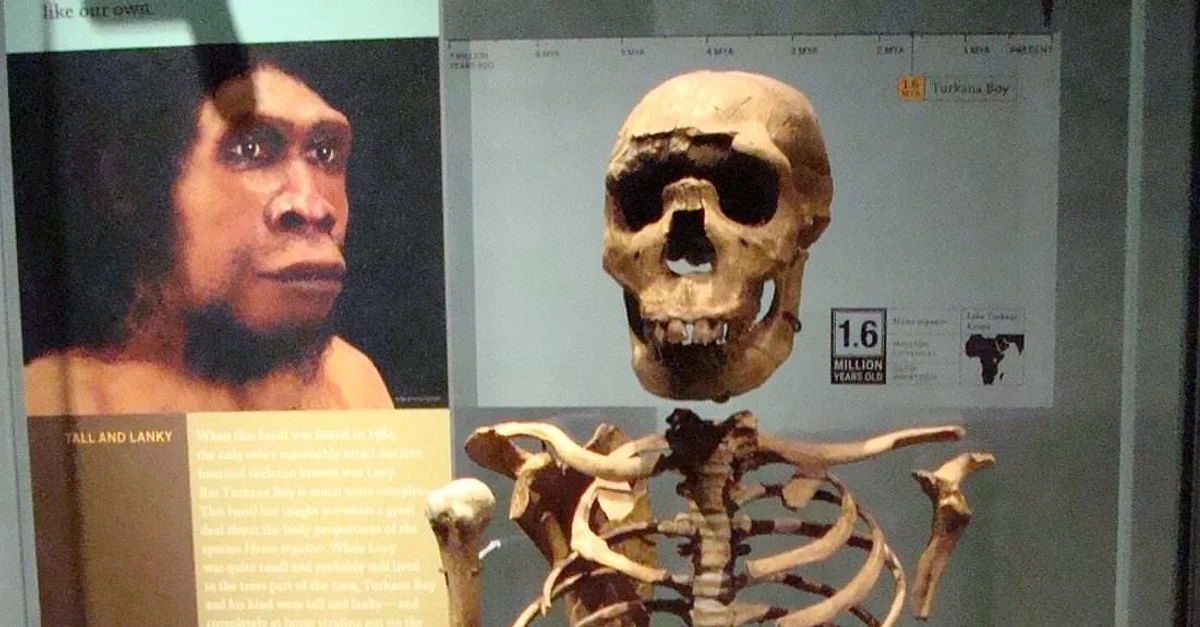
President William Ruto on Monday announced plans to make the remains of Turkana Boy, one of the world's most significant early human fossils, accessible to the public at Uhuru Park in Nairobi.
Currently preserved in a vault at the National Museums of Kenya in the capital, the fossil is expected to be moved to a public display site, allowing Kenyans and visitors to view one of the most important discoveries in the study of human evolution.
But who exactly was Turkana Boy, and why is his discovery so significant?
Who was Turkana Boy?
Turkana Boy, also known as Nariokotome Boy, is the name given to fossil KNM-WT 15000, the nearly complete skeleton of a young early human who lived approximately 1.5 to 1.6 million years ago.
Scientists classify the fossil as Homo erectus, although some researchers use the classification Homo ergaster.
The individual is believed to have been between seven and eleven years old at the time of death, although estimates vary depending on whether researchers examine the development of the teeth or bones.
Where and when was he discovered?
Turkana Boy was discovered in 1984 by Kenyan fossil hunter Kamoya Kimeu on the banks of the Nariokotome River, near Lake Turkana in northern Kenya.
The discovery was part of archaeological research led by renowned palaeoanthropologist Richard Leakey.
The fossil is particularly important because it comprises 108 bones, making it the most complete early human skeleton ever discovered.
What did Turkana Boy look like?
A 2018 study estimated that Turkana Boy stood approximately 154 centimetres tall and weighed between 51 and 54 kilogrammes at the time of death.
Scientists estimate that he could have grown to between 160 and 178 centimetres as an adult.
His physical features included a relatively tall body, long arms and legs, a narrow pelvis and a projecting nose.
Unlike modern humans, he had a low, sloping forehead, prominent brow ridges and no chin.
His body structure also suggests that he was adapted to walking upright on two legs over long distances.
Why is the discovery important?
Turkana Boy provides scientists with valuable evidence about how early humans developed physically and adapted to their environments.
His skeleton offers insights into how early humans walked, grew, moved and survived in different climatic conditions.
Researchers also believe that Homo erectus had more advanced social structures and hunting abilities than earlier human ancestors, supported by evidence from stone tools discovered at archaeological sites.
The fossil also provides clues about the evolution of the human brain, although scientists continue to debate the extent of early humans' ability to communicate through complex speech.
What makes Turkana Boy unique?
Unlike many early human discoveries, which consist of scattered bones or fragments, Turkana Boy's skeleton is largely complete.
This has allowed researchers to study different parts of the body together and develop a better understanding of early human anatomy.
His discovery remains one of the most important contributions to the study of human origins, placing Kenya at the centre of research into human evolution.
To pick up a draggable item, press the space bar. While dragging, use the arrow keys to move the item. Press space again to drop the item in its new position, or press escape to cancel.
To pick up a draggable item, press the space bar. While dragging, use the arrow keys to move the item. Press space again to drop the item in its new position, or press escape to cancel.