
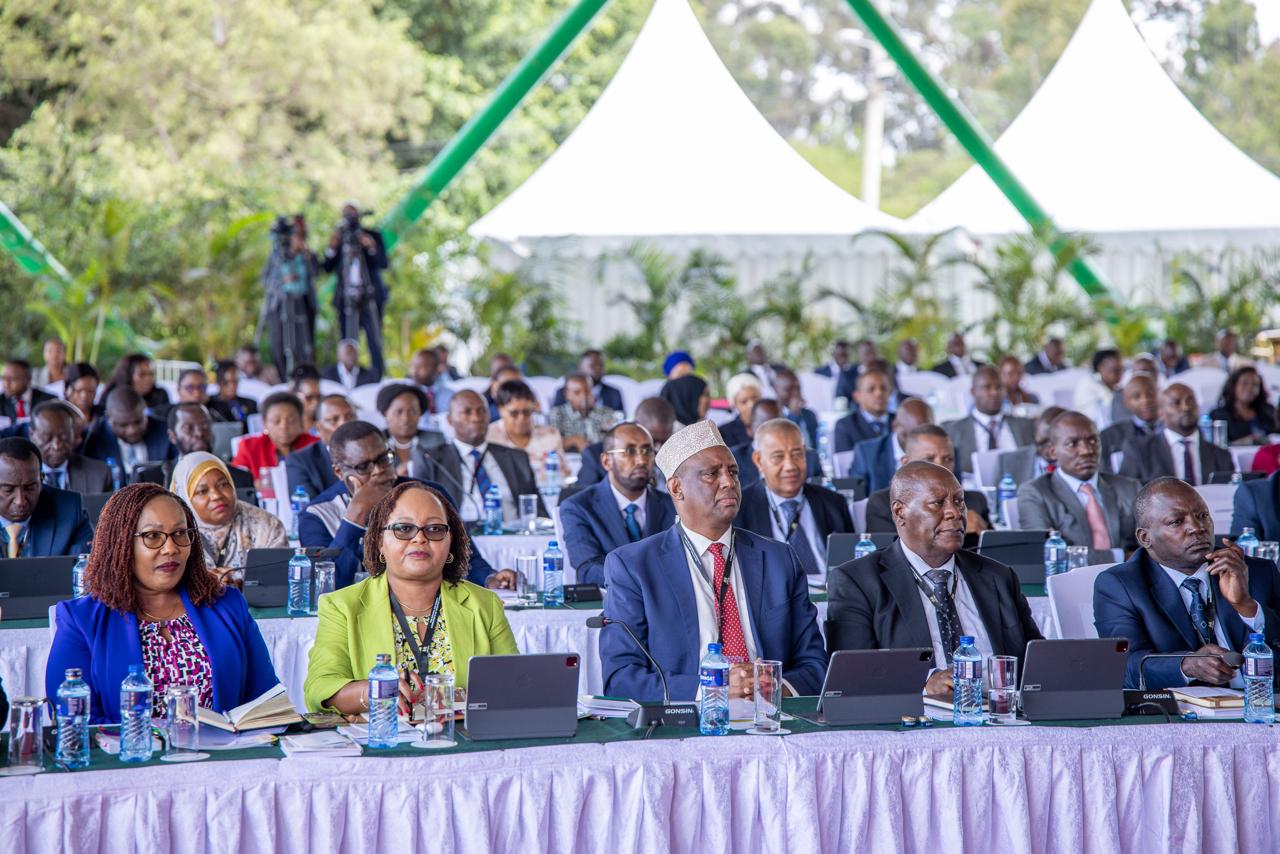
County governments have demanded an increase in their share of national revenue to at least Sh500 billion for the 2027-28 financial year, warning that the proposed Sh440.84 billion allocation will leave them struggling to meet wage demands, fund healthcare commitments and carry out devolved functions.
The governors have also accused the National Treasury and the Commission on Revenue Allocation (CRA) of undermining counties through what they describe as an unfair revenue-sharing process, questioning why the commission's recommendation mirrors the Treasury's position.
Through the Council of Governors (CoG), the county chiefs said the proposed amount would not adequately cover their financial responsibilities, including salary adjustments recommended by the Salaries and Remuneration Commission (SRC), collective bargaining agreements (CBAs) for health workers and the recruitment of staff under the Universal Health Coverage (UHC) programme.
They also raised concerns over the use of audited and approved national government accounts for the 2022-23 financial year to determine allocations for 2027-28, arguing that the figures do not capture more recent revenue growth.
CoG chairperson Muthomi Njuki, who is also the Tharaka Nithi governor, questioned the Treasury's involvement in determining how resources are shared between the national and county governments, saying an independent body should oversee the process.
“This is the first time that I’ve seen CRA making the same recommendation as the National Treasury,” Njuki said.
“The Treasury is partisan. If you have two levels of government that are sharing resources, there should be an independent adjudicator but not one of them.”
Njuki made the remarks on Wednesday during a meeting between governors and the CRA at Serena Hotel to discuss the proposed allocations for the next financial year.
He argued that the constitutional provision requiring counties to receive at least 15 per cent of nationally raised revenue should not be treated as a measure of how much revenue has grown over the years.
According to Njuki, relying on older financial records could deny counties a fair share of the country's revenue, particularly when their responsibilities and spending needs continue to increase.
He challenged the commission to explain why accounts from 2022-23 were being used to determine funding for 2027-28, nearly five years later, despite the existence of more recent financial records.
“How do you use audited accounts of the year 2022-2023, when we are allocating resources for 2027-2028, almost five years later? It practically means that we do not have any audited accounts of the Kenya Kwanza administration, or maybe the first ones,” he said.
The governors said the proposed allocation would make it difficult for counties to meet their obligations without additional financial support.
Njuki said county governments required Sh21 billion to implement salary increases recommended by the SRC, Sh2 billion to meet agreements with health workers and another Sh8.6 billion to take in staff working under the UHC programme.
These additional needs amount to about Sh36 billion, excluding the funding required for functions transferred from the national government to counties.
He said the national government should provide more money to support devolved units as they take on responsibilities previously handled at the national level.
“Even if the national government could not immediately provide the entire Sh65 billion required for unbundled functions, counties should receive at least half of that amount,” he said.
Njuki insisted that counties needed no less than Sh500 billion in the next financial year to enable the incoming group of governors to perform their duties and maintain public services.
“We are not looking at anything less than half a trillion, Sh500 billion, if the next cycle of governors are to be effective in delivery of services,” he said.
The governors also opposed the suggestion that allocations to the Equalisation Fund should be considered additional support for all county governments.
They argued that the fund is specifically intended for marginalised areas and should not be used to suggest that all 47 counties are receiving extra resources through the arrangement.
CRA chairperson Mary Chebukati defended the commission's recommendation, saying it had been guided by constitutional requirements and the latest audited and approved accounts available.
Chebukati cited Article 203(2) of the Constitution, which provides that counties must receive at least 15 per cent of nationally raised revenue, calculated using the most recent audited and approved accounts.
She maintained that the proposed allocation was above the constitutional minimum, arguing that counties were being recommended a share equivalent to 21.5 per cent of national revenue.
“The revenues are for the year 2022-23, but we want to make it clear that what we are now recommending is an equivalent of 21.5 per cent, which is above the 15 per cent,” she said.