
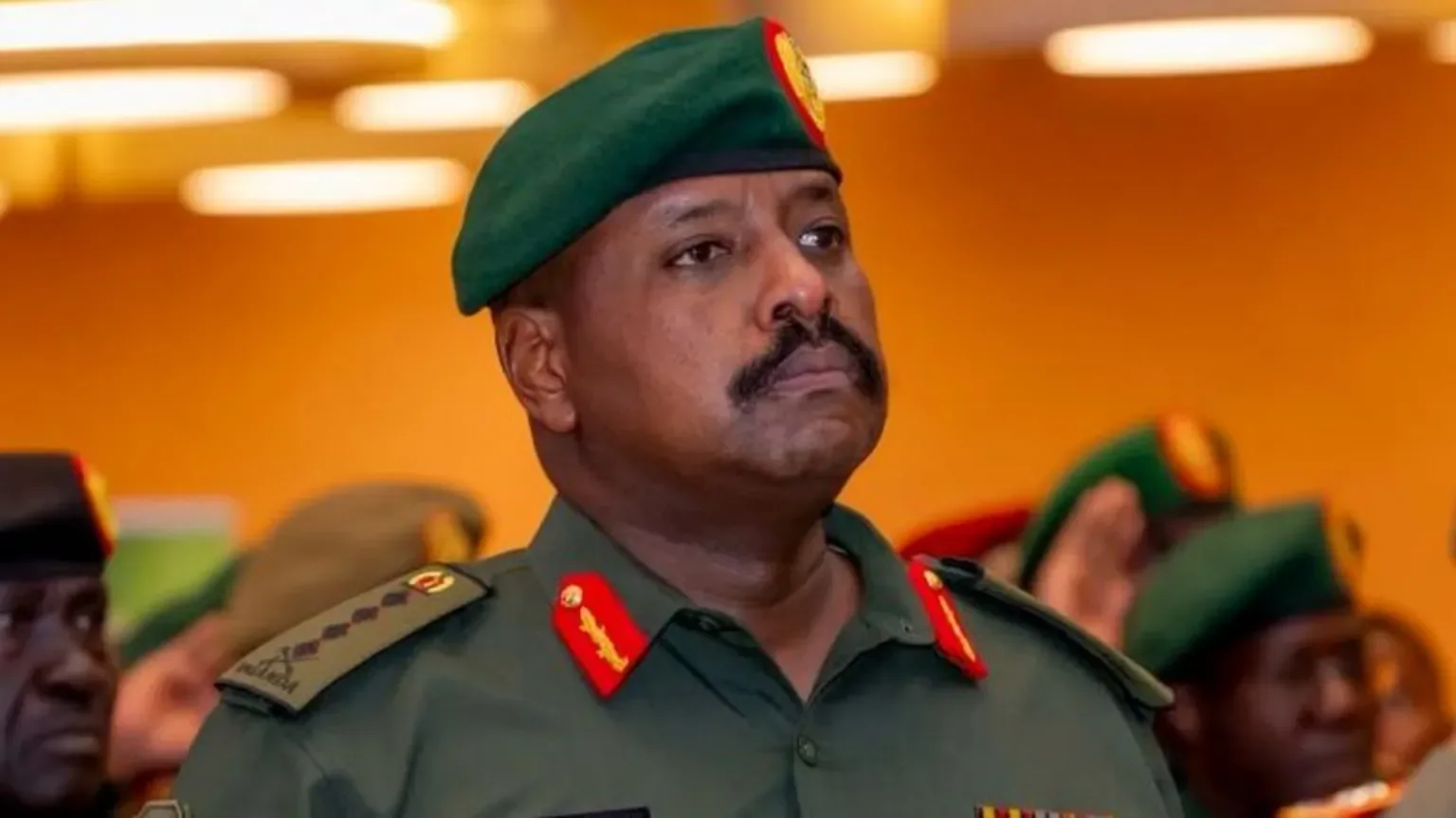
A fierce contest over Uganda's political future is taking shape within President Yoweri Museveni's administration, with his son, Gen Muhoozi Kainerugaba, at the centre of growing military tensions, arrests of senior commanders and confrontations with top government officials.
At least 12 generals and senior military officers have been detained over the past 15 months under Kainerugaba's leadership of the army, raising questions about whether the operations are intended to clean up the armed forces or remove individuals who may stand in the way of his presidential ambitions.
The developments have brought renewed attention to the possibility of a father-to-son transfer of power in Uganda, where Museveni has remained in office for four decades.
Kainerugaba, 52, is widely considered a possible successor to his father and has already indicated that he intends to contest the presidency in 2031, when Museveni's current term is expected to end.
However, his ambitions appear to be facing resistance from sections of the ruling National Resistance Movement (NRM), even as he continues to exercise considerable authority within the military.
The succession debate took a fresh turn after Kainerugaba publicly demanded the removal of Vice-President Jessica Alupo, questioned her loyalty and suggested that he should occupy her position.
In posts published on X on November 9, the army chief warned that whoever held the office should prepare to leave, while suggesting that the government would operate under military terms if he became his father's deputy.
The remarks came at a sensitive moment for the ruling party, which has been grappling with disagreements over whether to support Kainerugaba as Museveni's eventual replacement.
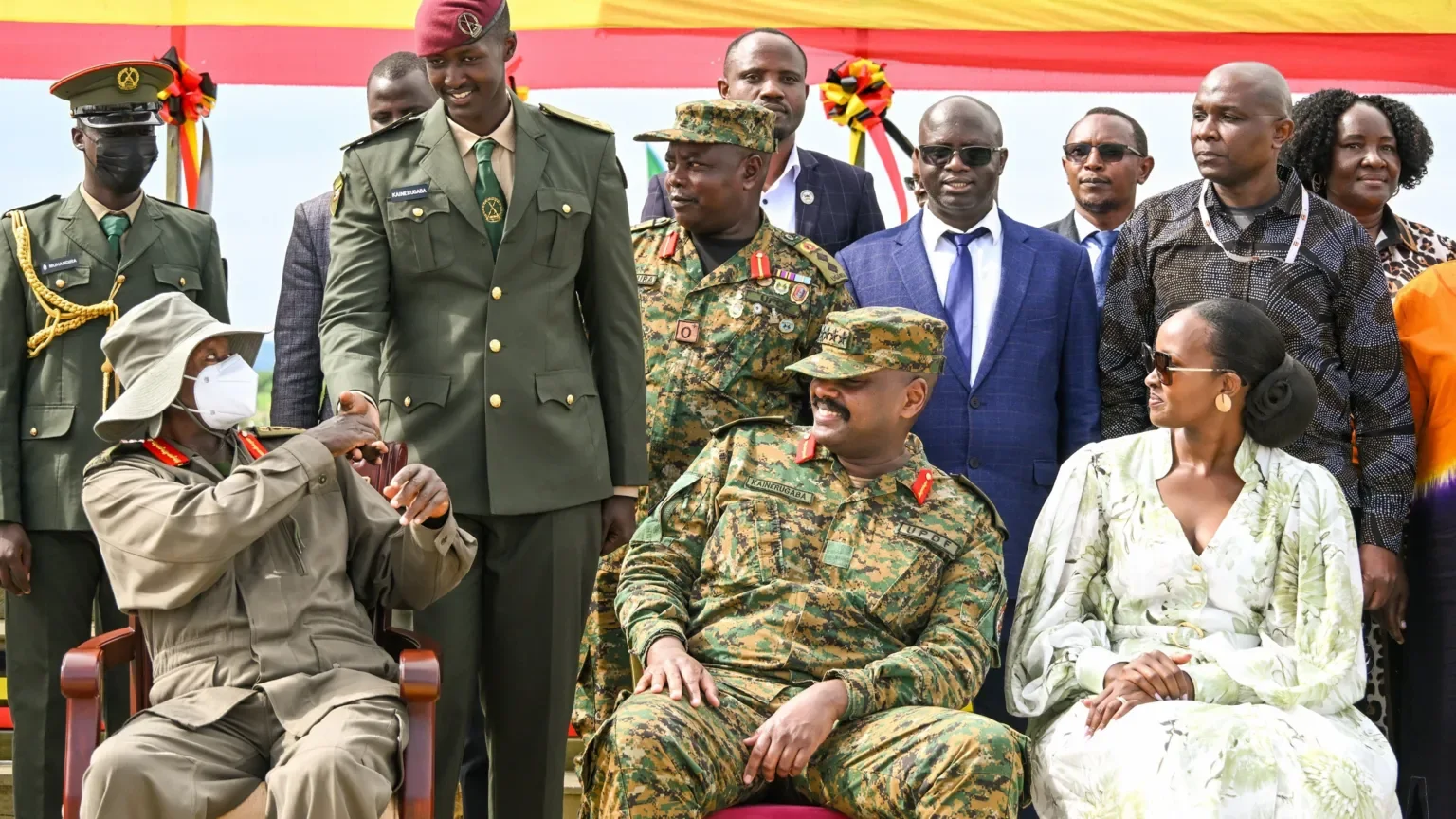
A recent meeting of the NRM's senior leadership reportedly ended without a consensus on the proposal to position him as the party's next presidential candidate.
According to AFP, five party officials who attended the closed-door meeting said a vote on the matter was abandoned after several members expressed opposition.
However, Ugandan news website ChimpReports gave a different account, reporting that most of those who spoke supported Kainerugaba's potential presidency, although some questioned whether he was adequately prepared for civilian leadership.
NRM Secretary General Richard Todwong Awany addressed the reports in a statement issued on Thursday, confirming that the party's leadership had met on November 10 to discuss "political, social and economic issues".
He dismissed claims that the meeting had rejected a proposal to make Kainerugaba Uganda's next president, insisting that any decisions would be communicated "through the right channel, at the right time".
The disagreements have drawn attention to the relationship between the military, where Kainerugaba has considerable influence, and the NRM, where his political future remains a subject of debate.
Ugandan-born political scientist Gerald Bareebe, who teaches at Canada's York University, links the arrests of senior officers to the growing succession contest, which is commonly referred to as the "Muhoozi Project".
"Senior officers believed not to support the project have been arrested, detained or charged with corruption and treason," he tells the BBC.
Bareebe argues that accusations against some of the commanders are widely perceived as politically driven, reflecting divisions within the military over Kainerugaba's possible rise to the presidency.
Several detained officers have since been released, apparently after the army chief announced that he had forgiven them.
One of the most notable cases involves former deputy army chief Lt Gen Peter Elwelu, whose arrest has intensified scrutiny of the military operations.
Elwelu was detained on November 2 over allegations that he had planned to destabilise the eastern Teso region.
Before his arrest, Kainerugaba had taken to social media to accuse the former commander of treachery and announce that he had lost his three-star rank and been reduced to the lowest military position.
"The traitor Peter Elwelu is hereby stripped of his ranks. He is demoted to Private," Kainerugaba wrote on X.
He also claimed that more than 20 soldiers associated with Elwelu had been arrested.
The announcement raised questions about the procedures governing military promotions and demotions, with Ugandan media reporting that regulations do not permit a senior officer to lose his rank through a social media declaration.
The UPDF subsequently confirmed Elwelu's detention, saying investigators had recovered 15 guns, military uniforms and two pickup trucks linked to him. His family has rejected the allegations.
An investigation by Uganda's Daily Monitor newspaper established that Elwelu was among at least 12 generals and senior officers arrested since April 2025.
The list also includes three former heads of military intelligence who previously oversaw some of Uganda's most sensitive security operations.
Maj Gen James Birungi, who formerly headed defence intelligence and security, was arrested in August 2025 over allegations that included treason, terrorism and corruption.
He was charged before a military court but was later released after Kainerugaba publicly announced that he had "forgiven" him.
Another former intelligence chief, Maj Gen Abel Kandiho, was arrested in September this year over accusations of providing false intelligence and treachery. He remains in detention, according to the Daily Monitor.
Kandiho's predecessor, Brig-Gen Charles Bakahumura, was also arrested in September over similar allegations but was subsequently freed after the army chief declared that he had forgiven him.
Other officers have faced investigations over claims ranging from the theft of military fuel to receiving money in exchange for spying on military communications.
The military has maintained that the arrests are part of a wider effort to address corruption and criminal activities within the armed forces.
Security analyst Freddie David Egesa has defended the operations, arguing that the cases involve investigations conducted by different security agencies rather than an organised campaign against officers opposed to Kainerugaba.
He says the detention of senior commanders is necessary to protect witnesses and demonstrate that authorities are committed to investigating wrongdoing, regardless of the positions held by those involved.
"Gen Muhoozi has the overall duty to permit the investigation team to arrest these high-profile people, in consultation with the commander-in-chief," Egesa says, adding: "The arrests are not summarily done."
Bareebe, however, maintains that the crackdown has a wider political dimension, with serving and retired officers suspected of opposing Kainerugaba's ambitions facing pressure.
"The result is a broad purge that has affected both serving and retired officers perceived to be anti-Muhoozi," he says.
He identifies divisions between the elite Special Forces Command (SFC), which he says is largely loyal to Museveni's son, and other military commanders who remain unconvinced about his possible succession.
The accusations against the detained officers have not all reached the same stage. Some have been charged, others remain in custody without publicly announced charges, while several have already been released.
Bareebe has also questioned the ability of military courts to conduct independent proceedings in cases involving senior commanders.
"Many Ugandans regard the charges as politically motivated and therefore expect little justice," he adds.
He further alleges that some officers have secured the withdrawal of charges following private negotiations involving Museveni and his son, during which they were pressured to declare support for Kainerugaba.
Government spokesperson Allan Kasujja has rejected suggestions that the arrests are connected to disagreements over the country's political succession, dismissing the claims as "hogwash".
Beyond the arrests, Kainerugaba's approach to communication has also become a source of concern.
Unlike previous army chiefs who mainly relied on formal military channels to communicate official decisions, he regularly uses X to announce arrests, attack public officials and express views on domestic and international matters.
Some of his online statements have previously triggered diplomatic controversy.
His latest confrontation with Alupo began on the night of November 9, when he called on the vice-president to prepare to surrender her office.
"Whoever is in that office should prepare to hand it over soon," he wrote in posts that were later deleted.
He also questioned her loyalty and threatened her removal, adding that the government would operate "on military terms", if he became his father's deputy.
By the following day, his X account, which had nearly 1.4 million followers, was no longer accessible.
It was not established whether the general had deactivated the account himself, as he had done on previous occasions, or whether the platform had suspended it.
Alupo remained in office and had not publicly responded to the remarks.
Egesa says the controversial posts reflect Kainerugaba's preferred way of communicating, although security analysts are examining what his statements could mean for Uganda's political and military stability.
Bareebe views the confrontation differently, arguing that the army chief is increasingly seeking to extend his influence into civilian government affairs.
He says the public exchanges with senior political figures demonstrate how the succession debate is no longer confined to the armed forces but is also exposing divisions within the ruling party.
Kainerugaba's position within the military has given him considerable influence over the country's security structure.
He was appointed army chief in March 2024 after previously leading the Special Forces Command, the elite unit responsible for protecting Museveni and strategic installations.
Under Uganda's military structure, he reports directly to the president, placing him in a powerful position within the armed forces.
Bareebe argues that the SFC's loyalty to Museveni and his son could be decisive in determining how power changes hands when the president eventually leaves office.
"The regular army remains important but has been sidelined by the SFC, which now functions as a personal army for Museveni and his son," he adds.
The growing political uncertainty is centred on Museveni, 82, who has governed Uganda since 1986.
He came to power after his rebel National Resistance Army captured the country following a five-year guerrilla war.
Earlier this year, he was sworn in for a seventh elected presidential term, extending his leadership into a fifth decade.
Kainerugaba has emerged as one of the leading figures in discussions about who should succeed him, having indicated his intention to seek the presidency in 2031.
He also leads the Patriotic League of Uganda, a political movement that has been mobilising support around his leadership.
However, disagreements within the NRM suggest that his potential transition from military commander to civilian president may not receive unanimous backing.
During the recent meeting of the party's senior leadership, one official reportedly suggested that Museveni should retire his son from the military and appoint him to a civilian position to help him acquire administrative experience, AFP reported.
Other local media reports indicated that some party officials viewed Gen Salim Saleh, Museveni's younger brother, as a more suitable figure for civilian leadership.
There is, however, no indication that Saleh intends to pursue the presidency.
Other officials reportedly supported Kainerugaba, pointing to his military leadership, anti-corruption efforts and ability to mobilise political support at the grassroots.
Bareebe says opposition to the proposed succession arrangement has been growing within the NRM, with both experienced politicians and younger members raising concerns about what they consider an attempt to secure power through coercion.
He suggests that Museveni's reluctance to move his son out of the military could be linked to the importance of maintaining control over the armed forces during a future transfer of power.
"The underlying calculation appears to be that, so long as Muhoozi controls the SFC, he can use it to capture power even in an event of a contested transition," he says.
The military has been a central pillar of Museveni's long rule, making the loyalty of senior commanders particularly important as the succession question gains prominence.
The family's influence over the armed forces has also raised questions about whether Uganda could be heading towards a political dynasty extending across generations.
Kainerugaba's son, Ruhamya, recently graduated from Britain's Sandhurst military academy, drawing further attention to the family's military connections.
Meanwhile, the succession debate is taking place against a background of continued pressure on opposition figures.
Veteran opposition politician Kizza Besigye remains in detention over treason charges, which he denies.
Bobi Wine, who finished second to Museveni in this year's presidential election, has gone into exile in the United States after being threatened by Kainerugaba.
The government has maintained that its security operations are lawful and necessary to protect the country's stability.
Although Museveni remains in power, the arrests of senior military officers, his son's threats against government officials and the reported disagreements within the NRM have intensified uncertainty over Uganda's next political chapter.
The central question now is whether Museveni will eventually pave the way for his son to take over or whether resistance within the ruling party and military will complicate the succession plan.