
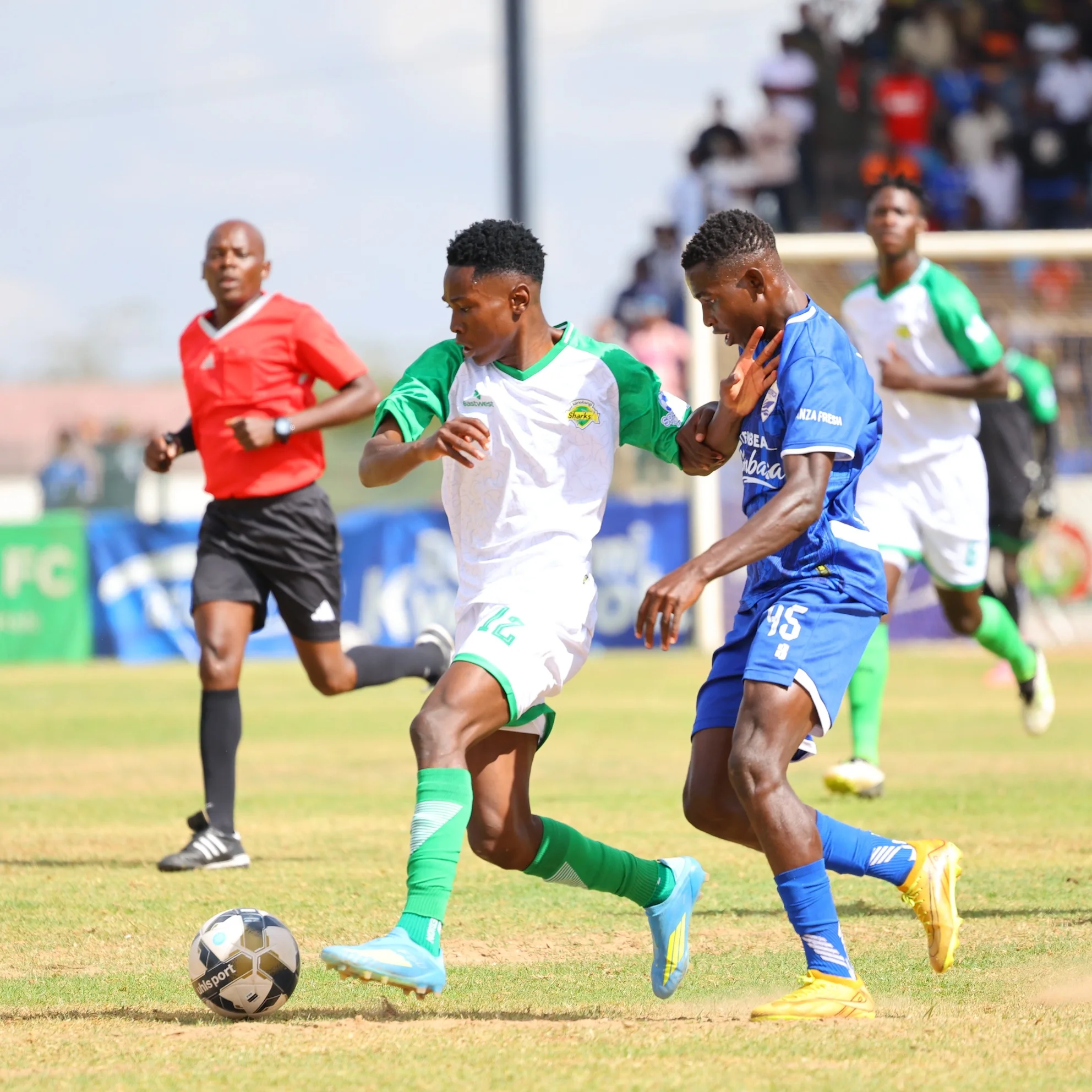
The whistles are scheduled to sound. But after two months of injunctions, counter-injunctions, a violent pitch invasion and a referee attack, the 2026/27 FKF Premier League is set to kick off this weekend — if the courts allow it. With Kariobangi Sharks having already escalated matters to the High Court once, and the FKF Disciplinary Committee yet to rule on sanctions, another postponement remains a real possibility. The question every Kenyan football fan is asking remains unanswered: Are we there yet?
The answer, for now, is a fragile yes.
The postponed match
On the afternoon of October 6, 2026, the Ulinzi Sports Complex in Nairobi was supposed to host a football match. Instead, it hosted what can be described as a crime scene.
Kariobangi Sharks and Mombasa United were contesting the second leg of a promotion/relegation playoff — a match ordered by the court, mediated by the Football Kenya Federation, and designed to finally settle who would claim the 18th and final berth in the Premier League. United won the first leg in Mombasa 2-1. In Nairobi, Sharks fought back ferociously, scoring twice to lead 2-1 and level the tie at 3-3 on aggregate. With the match poised at 3-3 and everything to play for, the game was exactly what a playoff should be: tense, dramatic, and alive.
Then, in the 64th minute, referee John Sulwe pointed to the penalty spot. A corner had been swung in, a Mombasa United player went down under a challenge, and Sulwe awarded a penalty to the visitors. The decision was, to put it mildly, contested.
What happened next will be remembered as one of the darkest afternoons in the history of Kenyan football.
Kariobangi Sharks players surrounded the referee, shoving him and forcing him to retreat across the pitch. The confrontation escalated rapidly. According to the FKF Leagues and Competitions Committee, Sharks' kit manager, Patrick Paul Otieno, together with a section of fans from the stands occupied by Kariobangi Sharks supporters, invaded the field of play and physically assaulted the centre referee. Video footage showed Sulwe being chased around the pitch, a plastic seat flying through the air and narrowly missing his head, before military and private security personnel escorted him to safety. The referee was assessed by medical personnel, who confirmed he was unfit to continue. The match was abandoned. It was reported at Langata Police Station under OB NO. 56/6/10/2026.
By the time the chaos subsided, the tie was level at 3-3. Neither team had won. Neither team had lost. Everyone had lost.
'Embarrassing' — the reaction
The word that appeared in headline after headline was "embarrassing." The Standard, Kenya's leading newspaper, splashed a photograph of Sulwe being punched in the face by a man in a yellow cap across its front page. The Star described the match as having "descended into extraordinary chaos". International media picked up the story, with outlets from France to Brazil running footage of the referee being pursued across the pitch.
Gor Mahia official Sally Bolo, speaking before the match, had already raised concerns about Sulwe's appointment. "I'm not questioning the integrity of any official personally, but as a football stakeholder, I cannot ignore what naturally raises questions," Bolo said. "For the FKF Premier League/NSL promotion playoff return leg between Sharks and Mombasa United, centre referee John Sulwe has been appointed after officiating only five matches cumulatively over the last two seasons. Assistant referee Jane Cherono is also returning after serving a suspension in the FKF Premier League before being demoted to the NSL".
Bolo's words proved prescient. "With so much at stake, appointments matter. They must not only be fair; they must also be transparent and inspire confidence," he added. "I believe in fair play; not just for the 90 minutes, but in every process leading to those 90 minutes. Let the game be decided on the pitch, not by perception before kick-off".
FKF head of referees Edward Lumbugu defended Sulwe's appointment, insisting the referee had gone through the federation's normal vetting process. "Before a referee is selected to officiate a match, his performance is analysed," Lumbugu said, noting that a review panel considers an official's "officiating trends, operational history" and individual strengths before making an appointment. He condemned the assault on Sulwe as a criminal act and warned against attempts to resolve disagreements through violence.
FKF Referees Department chairman Caleb Amwayi was blunter. "When we appoint referees, we don't want to appoint them to the death traps," he said. "Whatever happened at Ulinzi Sports Complex was very unfortunate". He called for players and supporters found culpable to face firm legal and disciplinary action, insisting that violence should not be excused as part of football passion.
The courtroom battles
The chaos at Ulinzi was not an isolated incident. It was the violent culmination of two months of legal warfare that had already brought Kenyan football to a standstill.
At the heart of the dispute was a deceptively simple question: which set of rules governed the 2026/27 season?
Kariobangi Sharks finished 16th in the 2025/26 Premier League. Under the amended 2025 rules — which increased automatic relegation from two teams to three and abolished the playoff between the 16th-placed top-flight team and the third-placed National Super League side — Sharks were relegated directly to the NSL. Mombasa United, who finished third in the NSL, were promoted automatically.
Sharks, however, insisted that the 2019 regulations still applied. Those rules entitled the 16th-placed team to a playoff against the third-placed NSL side. The club argued that the 2025 amendments had not been introduced through the proper legal process — specifically, that they required approval by the FKF General Assembly, which had never been obtained.
The club took its case to the Sports Disputes Tribunal (SDT). On August 10, 2026, the tribunal dismissed the case, upholding the validity of the 2025 regulations. The tribunal found that FKF's National Executive Committee had the authority under the federation's constitution to formulate competition regulations and that the General Assembly's approval was not required. The tribunal also held that the process leading to the adoption of the rules met the required threshold for public participation.
Sharks refused to accept the ruling. They escalated the matter to the High Court.
What followed was a legal labyrinth that would paralyse Kenyan football for two months.
On August 28, 2026, High Court Justice Janet Mulwa issued a status quo order halting the original season kickoff scheduled for late August. The Murang'a High Court then ordered FKF to conduct a two-legged playoff before starting the league. Days later, the Kiambu High Court — in a case filed by the Centre for Litigation Trust — issued a separate directive ordering FKF to include Mombasa United directly as the 18th team in provisional fixtures.
FKF was caught in a vice. On September 19, 2026, the federation indefinitely postponed the opening-round matches, stating it was "left with no other option" given the conflicting court orders. The season that was supposed to start on August 22 had been delayed yet again.
FKF, meanwhile, was furious with Sharks for taking a football dispute to an ordinary civil court. In a statement of claim dated September 1, 2026, the federation accused the club of violating local, continental and FIFA statutes. "Recourse to Ordinary Courts is prohibited unless specifically provided for in the FIFA Regulations," FKF's charge read. The federation summoned Sharks before its Disciplinary Committee, threatening the club with a ban.
The club's courtroom battles were not fought in isolation. A figure named Evans Nduta filed a separate petition at the Murang'a High Court, which resulted in the temporary injunction stopping FKF from proceeding with the league until the playoff was conducted. The identity of Nduta and his motivations became a subject of intense speculation, with some outlets describing him as "the man behind three FKF league postponements."
Police FC Technical Director Mbarak 'Mnyama' Bashatir warned that the prolonged dispute could have wider consequences for Kenyan football. "Kenya is a big country, and football affects a vast number of people," Bashatir said. "Leaders need to resolve their differences without resorting to court battles or conflict, as this tarnishes Kenya's image. If you look closely, you will see that the players have been well-prepared through pre-season training, and sponsors have invested significant funds in logistics. When conflicts like this arise, we demoralise players, sponsors, and fans".
Bashatir's warning was echoed by many across Kenyan football. The delay was not just a legal inconvenience; it was a human crisis. Players went months without competitive action. Sponsors watched their investments sit idle. Fans — the lifeblood of the game — were left with nothing to watch. With Kenya set to co-host the 2027 Africa Cup of Nations alongside Uganda and Tanzania, the chaos raised uncomfortable questions about the country's readiness for the continental stage.
The verdict
With the season on the brink of collapse, FKF mediated an agreement between Kariobangi Sharks and Mombasa United to hold the two-legged playoff on October 1 and October 6. It was a pragmatic solution to a legal deadlock: settle it on the pitch.
The first leg in Mombasa was tense but peaceful. United won 2-1, taking a narrow advantage over Nairobi. Their coach, Abdulhamid Moalim, praised his players for their patience. "Patience was very important for us. We knew we had to remain calm because the goal would come," Moalim said. "We have won the first leg, but nothing is finished. We know what awaits us in Nairobi. We have to prepare well, remain disciplined and go there with the same fighting spirit. Our target is to complete the job".
The return leg, as we now know, never reached completion.
On October 9, 2026, the FKF Leagues and Competitions Committee sat to determine the matter. The panel — chaired by Peter Kamau Chege and including Boaz Kibet Kaino, Alex Musikeri, Dan Hibichu, Hussein Kadir, and Benard Odongo — heard from both clubs. Kariobangi Sharks were represented by club chairman Robert Maoga and deputy CEO Ronny Oyando. Mombasa United sent Ahmed Ibrahim and Abdirahman Mahmoud.
The committee's verdict was swift and decisive. Pursuant to Art. 3.3.2 as read with Art. 3.3.3 of the Rules & Regulations Governing Kenyan Football (2019), the Committee declared that Kariobangi Sharks FC forfeited the match. The match was officially awarded to Mombasa United FC on a 2-0 scoreline. Mombasa United were declared aggregate playoff winners and officially promoted to the SportPesa League for the 2026/2027 season.
All acts of violence and misconduct reported during the match were referred to the FKF Disciplinary Committee for criminal/disciplinary prosecution and applicable sanctions.
For Mombasa United, it was a moment of historic joy — promotion to the top flight for the first time in the club's history. For Kariobangi Sharks, it was a bitter end to a season that had begun with a desperate legal fight to preserve their top-flight status. The club that had spent months arguing that the 2019 rules should apply was ultimately undone by a ruling that invoked those very rules.
The league kicks off — if the courts allow it
With the legal disputes resolved and Mombasa United confirmed as the 18th team, FKF published the official Round 1 fixtures for the opening week of the 2026/27 SportPesa League.
The season is set to kick off today, Saturday, October 10, with two matches: Mathare United vs APS Bomet at Police Sacco Stadium (2:00 PM) and Posta Rangers vs Shabana at Wang'uru Stadium (4:15 PM).
Sunday, October 11, brings a full slate: Ulinzi Stars vs Tusker at Ulinzi Sports Complex (2:00 PM), 3K FC vs Mara Sugar at Moi Stadium Embu (3:00 PM), Migori Youth vs Kenya Police at Green Stadium Awendo (3:00 PM), and Nairobi United vs KCB at Police Sacco Stadium (4:00 PM).
Mombasa United will play their first-ever Premier League match on Tuesday, October 13, against Kakamega Homeboyz at Mbaraki Sports Club (3:00 PM). Later that day, Gor Mahia face Murang'a Seal at Nyayo National Stadium (7:00 PM). The opening week concludes on Wednesday, October 14, with AFC Leopards vs Bandari at Nyayo National Stadium (3:00 PM).
But the scars of the past two months will not heal quickly. The images of a referee being chased from the pitch, of players shoving an official, of fans invading the field of play — these are not images that fade easily. The FKF Disciplinary Committee now has the unenviable task of determining sanctions. Kariobangi Sharks face the prospect of further punishment, including potential bans for players and officials involved in the assault. The kit manager who invaded the pitch, Patrick Paul Otieno, may face criminal charges. The fans who attacked Sulwe may face arrest and prosecution.
The broader questions also remain. How did Kenyan football descend into such chaos? How did a dispute over promotion and relegation regulations spiral into a two-month paralysis that threatened the very existence of the domestic league? And, most importantly, what has been learned?
The parliamentary committee that called for a normalisation committee to take over the administration of Kenyan football — citing "persistent leadership disputes, financial issues and controversies surrounding the governance and regulations of the delayed domestic league" — has made clear that the problems run deeper than Sharks versus Mombasa United. The FKF's leadership under President Hussein Mohammed has faced mounting criticism, and the national team's recent struggles — a strike over unpaid allowances, a 1-1 draw with Eritrea, a 1-0 defeat to Guinea — have only added to the sense of crisis.
And yet, today, a whistle is supposed to blow. Players are supposed to take the field. Fans are supposed to fill the stands. The 2026/27 FKF Premier League is supposed to finally begin.
It would be a victory of sorts — a victory of football over litigation, of the game over its administrators. But it is a fragile victory, and everyone knows it.
Are we there yet? The league is scheduled to be here. Whether Kenyan football has truly arrived — whether it has learned the lessons of the past two months — is a question that only the coming season can answer. And whether the first whistle actually blows today, or whether another court order stops it again, remains anyone's guess.