
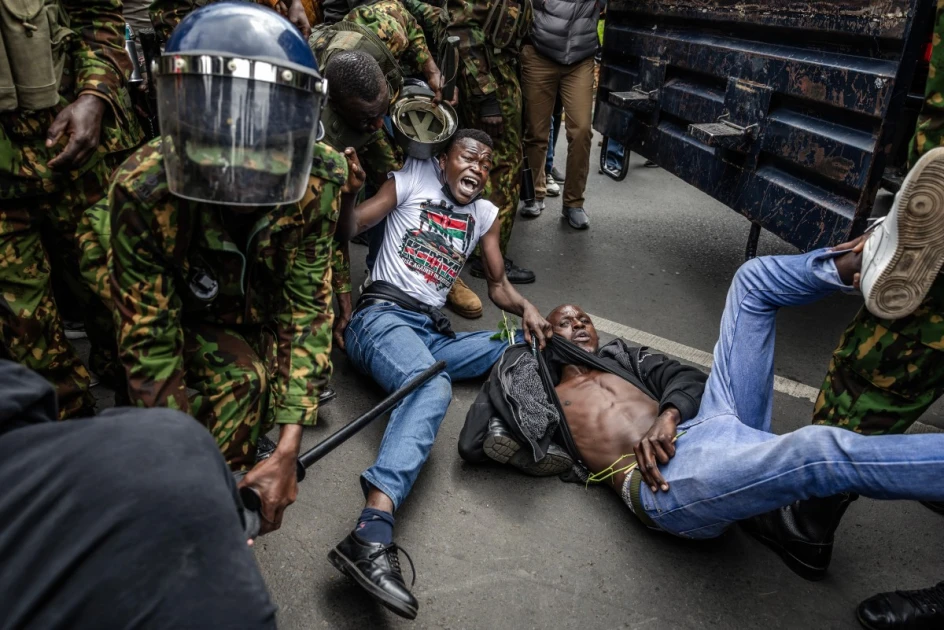
Protesters clashed with police in Nairobi’s Central Business District (CBD) on Monday, October 26, during demonstrations against rising fuel prices, the cost of living, and concerns over proposed changes to election laws ahead of the 2027 General Election.
Demonstrators gathered along Moi Avenue and Kimathi Street, carrying placards demanding the removal of fuel taxes and government intervention to ease the financial pressure on households and businesses.
Several protesters were arrested as police engaged demonstrators in running battles across the city centre. Some businesses remained closed amid the unrest.
The demonstrations followed a fuel price increase announced by the Energy and Petroleum Regulatory Authority (EPRA) for the October-November pricing cycle.
The revised prices pushed a litre of petrol in Nairobi up by Sh12.93 to Sh226.96, while diesel rose by Sh9.90 to Sh227.76. Kerosene recorded the largest increase, climbing by Sh28.49 to Sh219.87 per litre.
The higher prices have raised concerns over transport fares, food distribution costs and the cost of running businesses, with the effects likely to extend beyond motorists to households already struggling with the cost of living.
EPRA attributed the increases to higher international petroleum prices and rising import costs amid escalating conflict in the Middle East.
Its Director-General, Edward Kinyua, said the average landing cost of imported super petrol rose by 11.81 per cent in September 2026, while diesel increased by 11.2 per cent and kerosene by 9.41 per cent.
Protesters called for fuel subsidies and the removal of taxes they consider burdensome.
Earlier, activists operating under the Paza Sauti Movement had also called for the suspension of value-added tax on petroleum products, an independent audit of the energy sector and measures to cushion households and businesses against rising costs.
The protests also unfolded amid public debate over the Elections (Amendment) (No. 2) Bill, 2024, which the National Assembly passed with amendments on October 22.
Critics have raised concerns that the proposed changes could weaken the explicit legal requirement for the Independent Electoral and Boundaries Commission (IEBC) to livestream the announcement of results at polling stations.
They argue that allowing the electronic transmission of results is not the same as enabling the public to watch their announcement in real time.
The debate has drawn attention from political and civil society figures who say livestreaming would help voters, journalists and election observers scrutinise the process ahead of the 2027 polls.
The Bill had not completed the legislative process following the National Assembly vote and was expected to return to the Senate for consideration of the amendments.
The dispute over livestreaming therefore remained part of a wider debate about electoral transparency, rather than a change that had already become law.
The Coalition of Human Rights Defenders notified police of plans to hold a peaceful demonstration against fuel prices, with organisers intending to assemble along Kimathi Street and march towards State House.
In a letter dated October 22 and received at Police Service Headquarters the same day, the coalition said between 500 and 900 people were expected to participate.
It pledged to promote peaceful participation and respect the rights of other members of the public.
Monday’s protests followed demonstrations on October 20, when Citizen TV journalist Francis Odee was arrested while covering a fuel-price protest along Kimathi Street.
He was later released, and the incident drew condemnation from media and human rights groups. The Independent Policing Oversight Authority was reported to be investigating the circumstances surrounding his arrest and detention.
The demonstrations have brought together economic grievances and concerns about electoral accountability, placing renewed pressure on the government to address fuel affordability while public debate over election rules continues ahead of the 2027 General Election.