
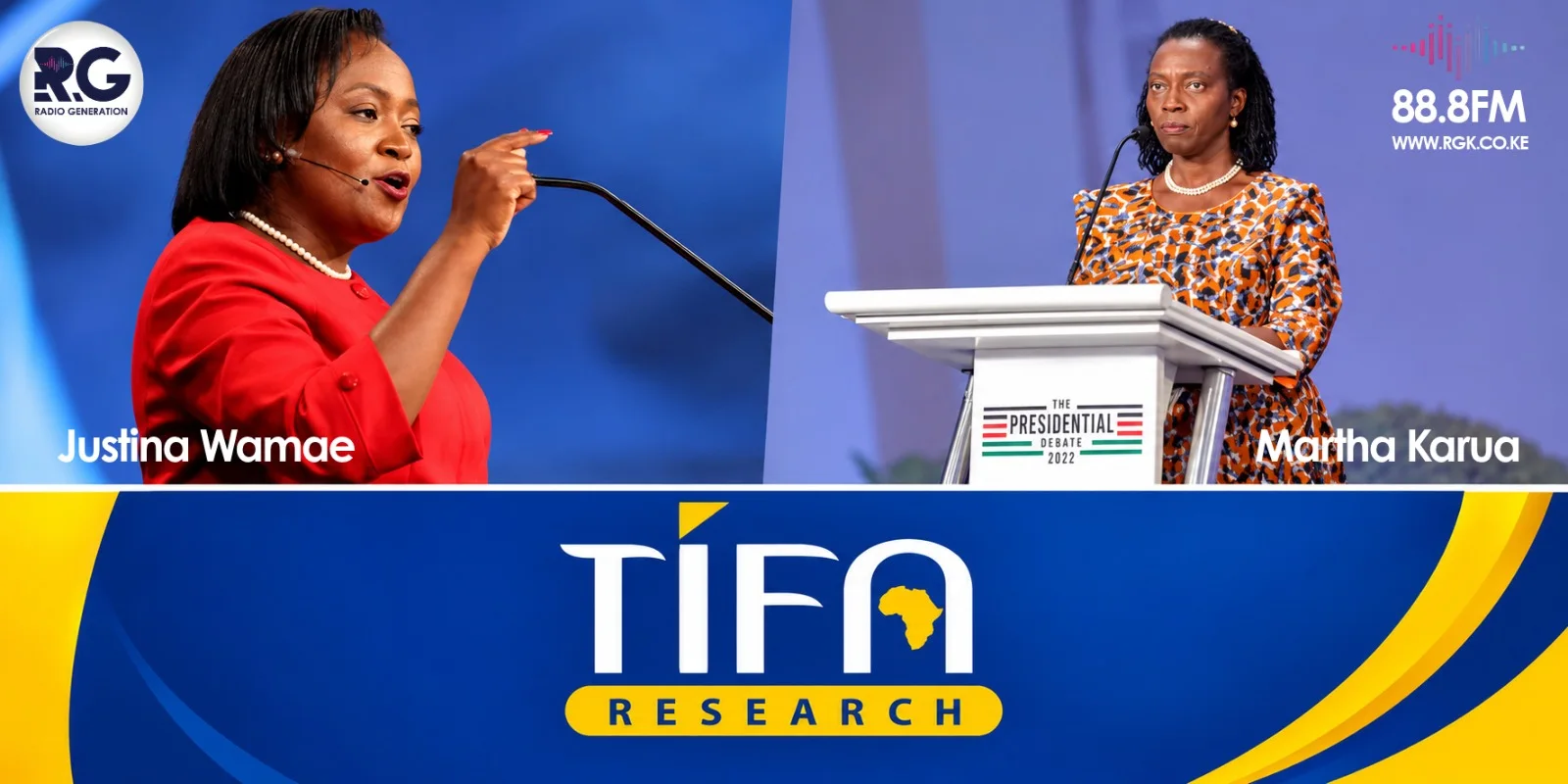
William Ruto, Edwin Sifuna, Kalonzo Musyoka, Fred Matiang’i, Rigathi Gachagua and Ndindi Nyoro. These are the six politicians featured in the latest presidential opinion poll released by Trends and Insights For Africa (TIFA). Interestingly, all six are men.
But wait a minute! As the country gradually shifts its attention towards the 2027 General Election, two women have already publicly declared their interest in contesting the presidency. So, where are they?
Interestingly, both women announced their presidential ambitions live, here on Radio Generation.
Martha Karua, of the People's Liberation Party (PLP), officially declared her presidential bid on February 26, 2026, during an interview at our station.
Justina Wamae, of the Imarisha Uchumi Party (IUP) followed suit on Sunday, October 25, 2026.
These are not women who have suddenly emerged from nowhere. Both have been part of Kenya's political conversations, with previous experiences in presidential politics and national leadership.
Martha Karua: A political figure too significant to overlook?
Let's begin with Martha Karua, a lawyer by profession and an Advocate of the High Court of Kenya. She has been in active politics for approximately 34 years, having served as a Member of Parliament, a Cabinet Minister and a presidential candidate in the 2013 General Election under NARC Kenya.
In the 2022 poll, she was picked as Raila Odinga's presidential running mate, making history as one of the most prominent women to occupy that position in Kenya's presidential politics.
Her political career extends beyond Kenya's borders. She has also been involved in regional legal and political engagements, including representing opposition figures in Uganda and Tanzania.
With such a political background, one cannot help but ask: Is Martha Karua a political figure who can simply be overlooked in a conversation about Kenya's next president?
Really, how many Kenyans are unfamiliar with Martha Karua?
More importantly, did TIFA include her name among the potential presidential candidates presented to respondents during its field interviews? If so, what explains her absence from the final list?
Justina Wamae: The running mate who stepped out of the shadow
Then comes Justina Wamae, a woman whose political journey attracted considerable public attention during the 2022 General Election.
She contested as the running mate of George Wajackoyah, the former Roots Party presidential candidate.
However, she would later distinguish herself through her independent political positions, including congratulating William Ruto following his victory in the presidential election.
One of the most unforgettable moments of her political career was her discussion of the Roots Party's unconventional economic proposals, particularly the controversial proposal involving the commercial use of hyena “private” parts to generate revenue.
It was an unusual proposition that sparked widespread public debate and left many Kenyans surprised. Whether one agreed with the proposal or not, it demonstrated her willingness to participate in conversations about alternative approaches to economic development.
Now, Wamae is back, this time seeking the country's highest political office. Yet, despite publicly declaring her presidential ambition, her name is nowhere to be seen among the six politicians featured in TIFA's latest presidential poll.
Does TIFA even know that she is running? Or could her absence be another reflection of the challenges women face in a political environment that remains largely dominated by men?
Dear TIFA, what happened?
Dear TIFA, does the absence of these two women suggest that Kenyans have no interest in expressing their opinions about their presidential ambitions and political parties?
What exactly were the researchers asking respondents during the field interviews? Were the names of all declared presidential aspirants presented to participants, or were respondents simply asked to mention the politicians they considered likely presidential contenders?
And what about gender representation in the research process?
With a reported sample size of 2,036 respondents drawn from a population of approximately 55 million people, questions about the survey's sampling methodology, respondent demographics and gender balance are worth asking.
Did the researchers consider the gender dimension when designing the survey? Were female presidential aspirants included among the options presented to respondents? Or were they simply missing from the conversation?
These are legitimate questions that TIFA should be willing to address.
To be clear, the absence of female candidates from a list of six politicians does not automatically prove that the research was deliberately biased against women.
Opinion polls measure public perceptions, and the results must be understood within the context of the questions asked, the sampling methodology and the research design.
However, that is precisely why transparency matters. Kenyans deserve to understand how these candidates were selected for consideration and whether all declared aspirants were given an equal opportunity to be assessed.
Women deserve to be heard
As Kenya approaches the 2027 General Election, gender representation must remain an important part of our national political conversation.
Women are Kenyans. Women are taxpayers. Women are voters. Women are equally capable of leading this country.
The right to participate in leadership should not be determined by gender, just as the opportunity to be heard should not be reserved for men.
The Constitution of Kenya recognises the equality of men and women and provides for equal opportunities in political, economic, cultural and social spheres.
It is therefore important that institutions shaping public conversations, including opinion polling organisations, remain conscious of how their research methodologies influence the visibility of different groups in society.
Perhaps Martha Karua and Justina Wamae may not command the same popularity as some of the men featured in TIFA's poll. That is a matter for Kenyans to decide through their opinions and, ultimately, their votes.
But shouldn't they at least be part of the conversation?
The 2027 presidential race should be about ideas, leadership, competence, experience and the ability to transform Kenya, not gender.
We are all equal under the law and in the eyes of the Almighty. Women deserve to be heard, women deserve to be considered, and women deserve an equal opportunity to lead.
Six men. Zero women. Is this a reflection of Kenyans' political preferences, or does it expose a bigger problem in how women are recognised in our country's presidential politics?
That is a question worth asking. TIFA owes Kenyans an explanation.