
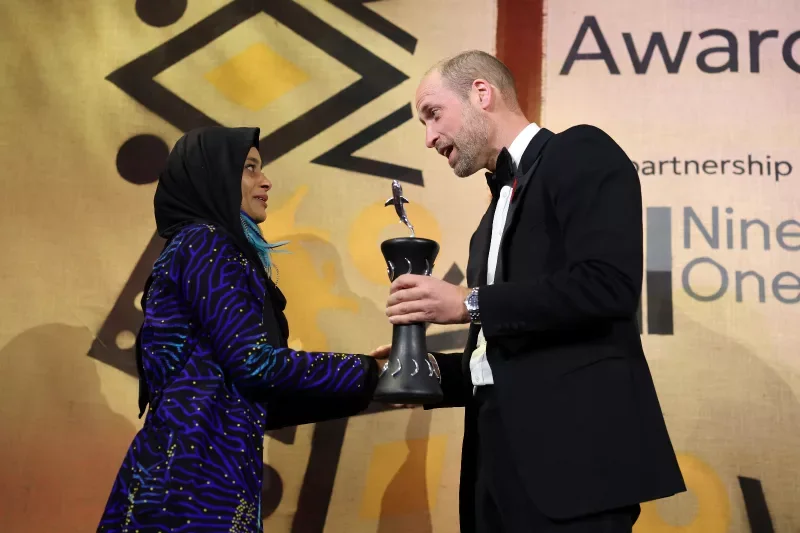
Kenya's conservation efforts have received a major international endorsement after two local wildlife champions were recognised by Prince William for their work protecting endangered species, defending threatened ecosystems and securing the return of black rhinos to Laikipia.
Raabia Hawa and Daniel Yiankere were among three conservationists honoured at the 14th annual Tusk Conservation Awards held in London, where their contributions to preserving Africa's natural heritage received international attention.
Hawa, who established Ulinzi Africa Foundation, took home the Tusk Award for Conservation in Africa, sponsored by Defender. Yiankere, who heads security operations at Loisaba Conservancy in Laikipia, received the Tusk Wildlife Ranger Award, sponsored by the Nick Maughan Family Foundation.
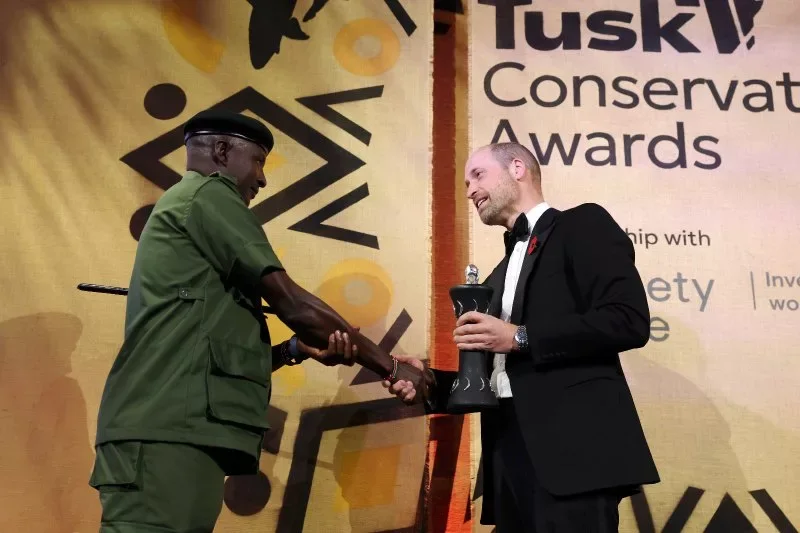
The awards recognise people whose work has helped protect wildlife and natural habitats while addressing challenges facing communities affected by environmental destruction, climate change and pressure on available land.
Hawa's recognition follows more than a decade of conservation work along Kenya's northern coastline, where she has focused on protecting vulnerable wildlife and ecosystems in the Tana Delta and Lamu.
Through Ulinzi Africa Foundation, she has helped organise operations against poaching, particularly targeting the protection of elephants and endangered coastal topi. She has also mobilised local communities to resist harmful mining activities, illegal fishing and developments that threaten forests and mangrove habitats.
Her work extends beyond field operations, combining wildlife protection with legal interventions and campaigns that give communities a stronger voice in defending their environment.
Receiving the award, Hawa said the recognition would help bring greater attention and resources to the people working to protect coastal ecosystems.
“For more than a decade, our rangers and the communities we work with in the Tana Delta and Lamu have kept showing up for this place, even when the work was difficult, and few people knew what it took,” she said.
She further recognised the contribution of the Kenya Wildlife Service (KWS), saying its partnership had played an important role in advancing their conservation programmes.
Yiankere's award, meanwhile, reflects more than three decades of experience in wildlife protection, including his current responsibilities at Loisaba Conservancy.
Having started his career with KWS, he now supervises more than 100 personnel involved in security operations and wildlife monitoring at the Laikipia conservancy.
The facility has not recorded a single poaching incident since 2017 under his leadership, highlighting the impact of sustained surveillance and protection measures.
One of his major achievements was coordinating security preparations ahead of the 2024 relocation of 21 critically endangered eastern black rhinos to Loisaba.
The conservation programme has since registered encouraging results, with the population increasing to 28 animals following the birth of seven calves.
Beyond protecting the existing population, Yiankere is engaging communities in neighbouring Koija, where residents have expressed interest in making their community-owned land available for an expansion of rhino habitat.
He attributed the progress made at Loisaba to the combined commitment of conservation teams, government agencies and surrounding communities.
“Bringing black rhinos back took years of preparation, and seeing nine calves born makes that work feel worthwhile,” he said.
The London ceremony also recognised Mozambique-based conservationist Dr Colleen Begg, who received the Prince William Award for Conservation in Africa for her contribution to wildlife protection spanning more than 30 years.
Begg has worked with communities in northern Mozambique to conserve large carnivores while promoting ways for people and wildlife to coexist. Her work has also extended to mentoring and supporting more than 100 women conservation leaders in 24 African countries.
Prince William, who presented the honours, acknowledged the difficult circumstances under which many conservationists carry out their work and stressed the importance of sustaining their efforts.
“It is critical that we continue to support the vital work being spotlighted here this evening,” he said, noting that the winners' accomplishments should motivate others to become more involved in protecting wildlife.
Animal biologist and broadcaster Liz Bonnin hosted the ceremony, which took place at Raffles London for the first time.
The event also provided an opportunity to acknowledge two conservationists who received Tusk honours in 2020 but could not attend the ceremony in person.
Kenyan conservationist John Kamanga, who won the Tusk Award for Conservation in Africa that year, was unable to travel because of COVID-19 restrictions. Zimbabwean wildlife ranger Amos Gwema, the 2020 recipient of the Tusk Wildlife Ranger Award, was also recognised.
The awards are organised by international conservation charity Tusk in partnership with Ninety One, with Prince William serving as the charity's Royal Patron.
Although the honours are presented to individuals, the accompanying financial grants are channelled to their organisations to support ongoing conservation programmes.
The Prince William Award for Conservation in Africa comes with £100,000 spread over three years, while the Tusk Award for Conservation in Africa carries £75,000 over the same period. The Wildlife Ranger Award provides £50,000 over three years.