
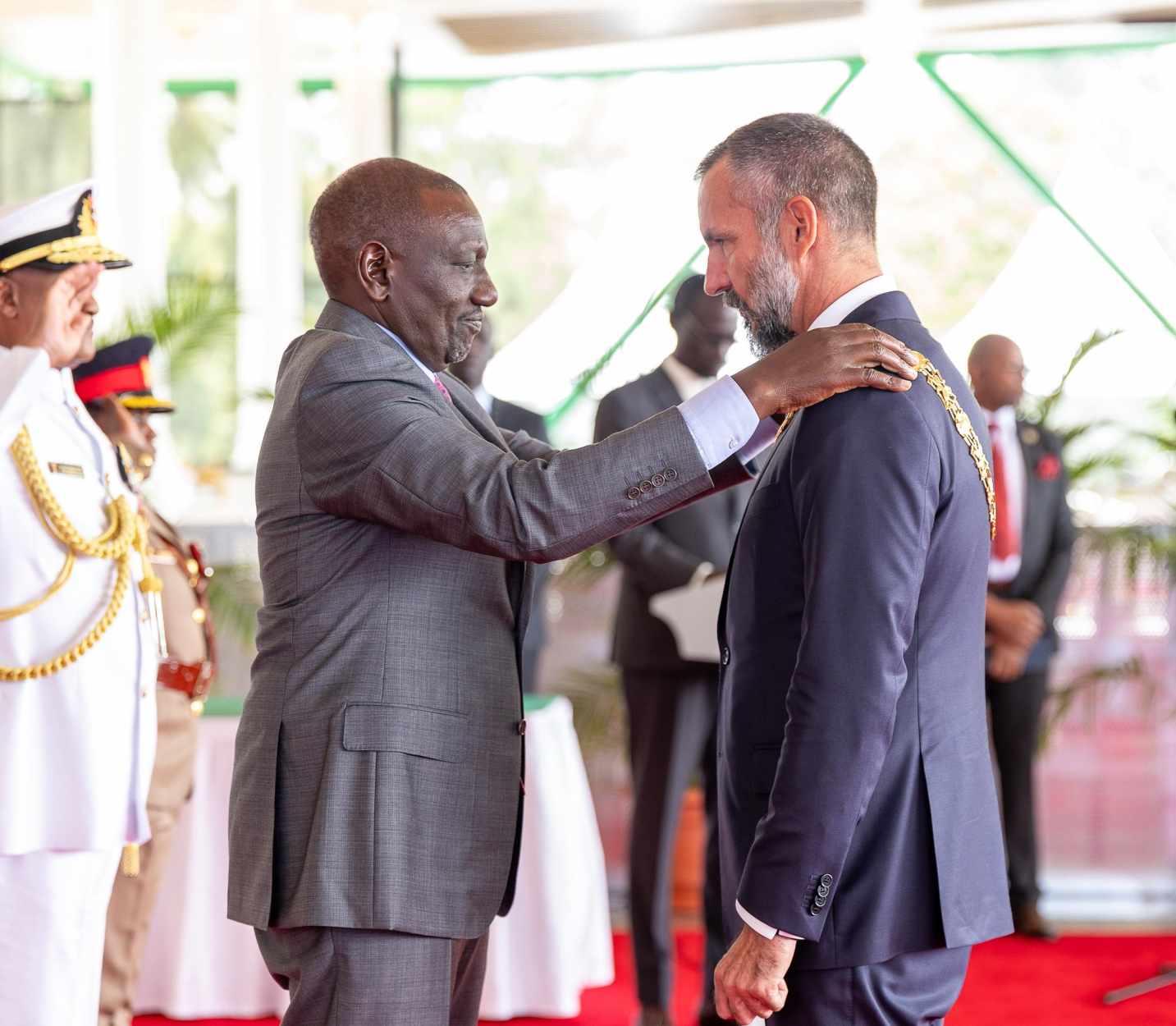
Kenya’s Presidential honours are among the country’s most significant forms of official recognition, acknowledging exceptional service, leadership, patriotism, and contributions to national development.
They are conferred by the President under Article 132(4)(c) of the Constitution and the National Honours Act, 2013.
The honours recognise achievements across public administration, governance, education, science, business, journalism, sports, security and other fields. They may be awarded to individuals, organisations and other eligible bodies.
The system includes the Order of the Golden Heart of Kenya and the Order of the Burning Spear, alongside other medals and commendations. Each order has three classes, with the Chief ranking above the Elder and Moran.
The Order of the Golden Heart of Kenya is the country's highest national honour. Its three classes are Chief of the Order of the Golden Heart (CGH), Elder of the Order of the Golden Heart (EGH) and Moran of the Order of the Golden Heart (MGH).
The Order of the Burning Spear follows in the national honours hierarchy. Its classes are Chief of the Order of the Burning Spear (CBS), Elder of the Order of the Burning Spear (EBS) and Moran of the Order of the Burning Spear (MBS).
Chief of the Order of the Golden Heart (CGH) recognises exceptional contributions to Kenya and is frequently associated with heads of state and distinguished individuals whose work has had a significant national impact.
In August 2025, President William Ruto conferred Kenya’s highest civilian honour, the Chief of the Order of the Golden Heart (CGH), on Prince Rahim Al-Hussaini Aga Khan V in recognition of his commitment to Kenya and the contributions of the Aga Khan Development Network.
President Ruto also posthumously awarded the same honour to former Prime Minister Raila Odinga in recognition of his service to the nation on October 20, 2025, in Kitui County.
Moran of the Order of the Golden Heart (MGH) recognises distinguished service and achievement at a level below the Chief and Elder classes. The title reflects formal national recognition rather than a specific job or public office.
Chief of the Order of the Burning Spear (CBS) recognises outstanding service and contributions to the nation. The order covers achievements in areas including public service, leadership, academia, the arts and other professional fields.
Moran of the Order of the Burning Spear (MBS) recognises meritorious service and notable contributions to the country. Recipients may come from different professions and sectors, depending on their achievements and the recommendations made through the honours process.
The National Honours Act establishes advisory committees that consider nominations and make recommendations to the President. The relevant committee depends on the category of nominee, including national and county government officials, parliamentary representatives and judicial officers.
The law allows honours to be conferred on national days or at other times considered appropriate by the President. Nominations are assessed against the individual's contribution, achievements, leadership, patriotism and service to the country.
The honours formally acknowledge service that might otherwise receive limited national recognition. They also provide a public record of achievements, encourage excellence and offer examples of service to future generations.
Recipients can use the corresponding initials after their names, identifying their class of honour in formal settings. However, receiving an award does not automatically confer a government position, salary, diplomatic passport or other special entitlement.
The National Honours Act provides for regulations on possible privileges, but an honour should not be confused with a financial reward.
Ultimately, the distinctions are symbols of national appreciation. Their significance rests on the service recognised, the credibility of the selection process and the example recipients set for the country.