
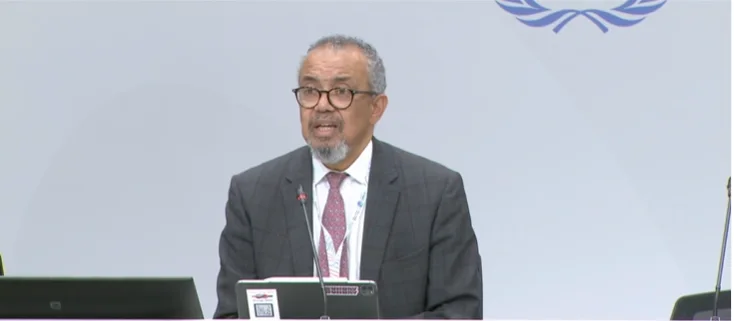
World Health Organization (WHO) Director-General Dr Tedros Adhanom Ghebreyesus has called on governments to place public health at the centre of climate action, warning that extreme weather events and rising temperatures are increasingly putting lives at risk, damaging health facilities and interrupting essential medical services.
Tedros said climate change had evolved into an immediate health emergency, urging countries to move beyond promises and invest in stronger healthcare systems capable of withstanding the effects of environmental changes.
Speaking on Monday, November 9, during the COP31 Health Day press conference in Antalya, Türkiye, the WHO chief warned that extreme heat, floods, droughts, wildfires and air pollution were already taking a toll on communities and exposing weaknesses in healthcare systems.
“The climate crisis is a health crisis. The health impacts of climate change are not a theoretical risk for the future; they are here and now,” he said.
He noted that climate-related disasters were increasingly affecting hospitals and other health facilities, disrupting the delivery of essential services while placing healthcare workers in more dangerous working conditions.
Tedros called for greater investment in health infrastructure to ensure hospitals and other medical facilities can continue operating during climate emergencies.
He identified reliable electricity and water supplies, effective early warning systems, dependable medical supply chains and properly trained healthcare workers as some of the key areas requiring attention.
The WHO Director-General further challenged governments to turn existing climate and health commitments into practical interventions, pointing to inadequate funding, limited capacity and poor coordination as major barriers to progress.
“What is missing too often is the finance, capacity and coordination to apply them at scale,” he said.
He urged ministries responsible for health, finance, environment and energy to work closely together, insisting that public health considerations should be included in national climate adaptation plans and commitments.
Tedros also welcomed the launch of the Antalya Initiative for Health Resilience, describing it as an important platform for helping countries identify successful climate and health interventions, share experiences and adopt effective approaches in different settings.
The initiative is expected to complement WHO's Alliance for Transformative Action on Climate and Health (ATACH), which brings together governments and partners to advance efforts towards building healthcare systems that can withstand climate-related challenges.
The WHO chief encouraged countries to openly share their experiences, including both successful interventions and setbacks, to help improve collective responses to the growing health threats posed by climate change.
He also called on climate negotiators and financial partners to give health greater consideration when making decisions on climate policies and funding, arguing that investments in climate action would deliver benefits beyond environmental protection.
“Climate action is not simply a cost; it's an investment in healthier people, more resilient communities, and stronger economies,” he said.
His remarks came as the 31st United Nations Climate Change Conference (COP31) officially opened in Antalya on Monday, November 9, bringing together governments, climate negotiators, scientists and development partners for discussions on international efforts to address climate change.
The two-week summit, which runs until November 20, has identified health as one of its priority areas, with the opening day focusing on health as well as food and agriculture.
The launch of the Antalya Initiative for Health Resilience formed part of the conference's efforts to turn existing commitments on climate and public health into practical measures that countries can implement.