Treasury sets aside Sh1.3 trillion for debt in Sh4.79 trillion budget
Revenue projections stand at Sh3.63 trillion from ordinary collections and Sh644 billion from Appropriation-in-Aid. This leaves a funding gap of Sh1.11 trillion, which the government plans to cover through borrowing—Sh995.7 billion from the local market and Sh145.6 billion from external sources.
A large portion of Kenya’s next budget will go into settling loan obligations, with the government planning to spend Sh1.3 trillion on interest payments in the 2026/2027 financial year. The estimates, submitted to Parliament on April 30, place debt servicing at the centre of a proposed Sh4.79 trillion spending plan.
The new budget is higher than the current Sh4.6 trillion and also goes beyond the amount approved earlier in the Budget Policy Statement by Sh64 billion. If adopted without changes, the national government will take Sh2.9 trillion, distributed among the Executive at Sh2.82 trillion, Parliament at Sh48.7 billion and the Judiciary at Sh30.44 billion.
Out of the Executive’s share, Sh1.98 trillion has been set aside for day-to-day operations, while Sh840.61 billion will support development projects. County governments are expected to receive Sh420 billion as their equitable share from the national government.
Revenue projections stand at Sh3.63 trillion from ordinary collections and Sh644 billion from Appropriation-in-Aid. This leaves a funding gap of Sh1.11 trillion, which the government plans to cover through borrowing—Sh995.7 billion from the local market and Sh145.6 billion from external sources.
The funds for debt repayment fall under the Consolidated Fund Services, which also includes Sh247.1 million for pensions and salaries of state officers.
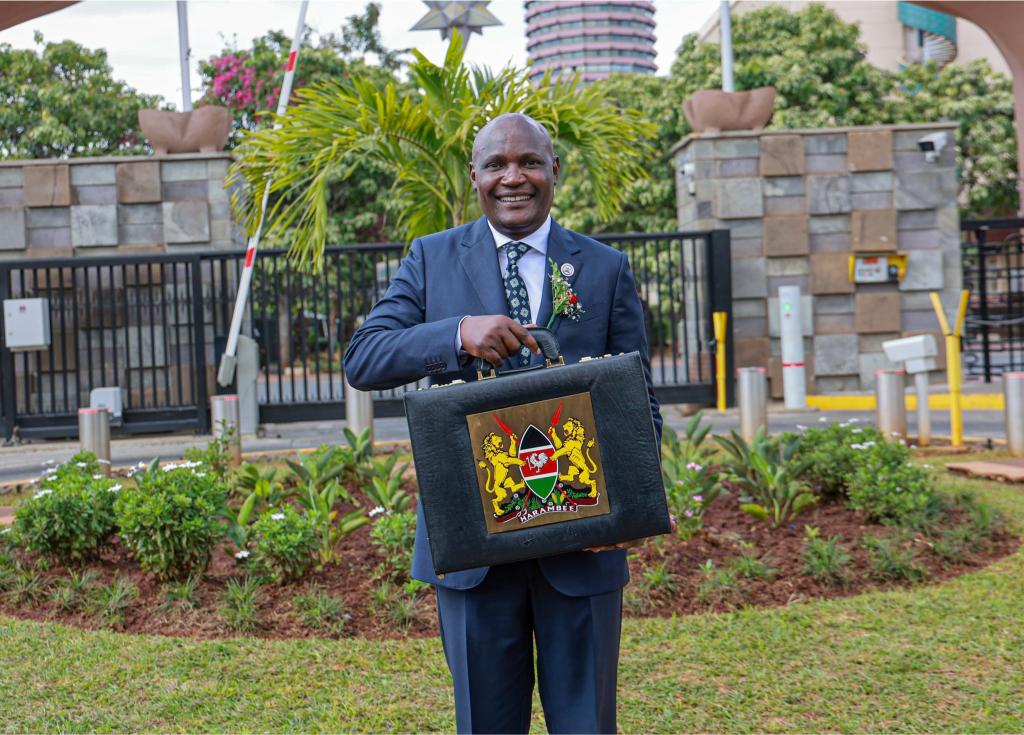
Treasury Cabinet Secretary John Mbadi said the budget is aimed at keeping the economy stable while managing public debt. “The government plans to reduce the fiscal deficit to 4.1 per cent of GDP while maintaining a balanced financing mix between domestic and external borrowing,”says Mr Mbadi.
According to data from the Office of the Controller of Budget, Kenya’s public debt has reached Sh12.29 trillion. With revenue collection falling short in recent years, there are expectations that the government could rely more on borrowing, which may push the deficit higher than planned.
Mbadi said efforts are underway to improve how public funds are managed. These include expanding oversight of state agencies to ensure compliance with international accounting standards, carrying out value-for-money audits, and linking systems such as the Votebook Management System with IFMIS at sub-county level.
Education has received the biggest allocation within the Executive at Sh781.3 billion. This covers Sh422.7 billion for the Teachers Service Commission, Sh164.13 billion for higher education, Sh135.34 billion for basic education, Sh57.96 billion for technical training, and Sh1.2 billion for science, innovation and research.
Even with the increased allocation, several education programmes have faced cuts. Funding for secondary teachers’ in-service training has dropped by 27.6 per cent to Sh224.95 million, while Free Primary Education has been reduced by 11.7 per cent to Sh15.84 billion. Primary teachers’ training has gone down by 4 per cent to Sh771.53 million, and the budget for special needs education in secondary schools has been cut by 3 per cent to Sh271.6 million.
Other sectors have also received major funding, including Sh234.7 billion for roads, Sh147 billion for the National Police Service, Sh138.3 billion for housing and urban development, and Sh175.6 billion for health. Within the health sector, Sh133 billion is for medical services and Sh42.6 billion for public health and professional standards.
The Treasury has been allocated Sh132.5 billion, while transport will receive Sh63.9 billion.
Spending on agriculture has been reduced by about 7 per cent to Sh79.1 billion, although the food security programme has been increased to Sh31.1 billion.
With the 2027 General Election approaching, the Independent Electoral and Boundaries Commission has been allocated Sh24.97 billion. This includes Sh12.8 billion for voter registration and electoral operations, Sh4.73 billion for technology, and Sh1.8 billion for voter education and partnerships.


Comments
Sign in with Google to comment, reply, and like comments.
Continue with Google