
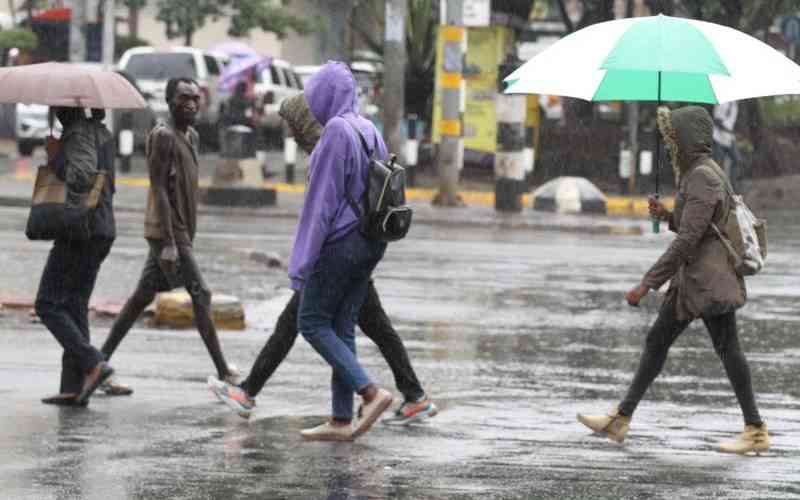
Kenya could be headed for a wet and flood-prone end to the year as scientists warn that rising temperatures in the Indian Ocean may combine with the growing El Niño to bring heavier than usual rainfall.
While global attention remains on El Niño, weather experts say the climate pattern forming closer to East Africa is likely to play the biggest role in determining how much rain the country receives between October and December.
The latest warning comes after the World Meteorological Organization (WMO) confirmed that El Niño has already formed in the tropical Pacific Ocean and is expected to become stronger over the next few months.
Even so, the UN weather agency says the effects of El Niño on Kenya cannot be looked at on their own because they are closely linked to other climate systems, especially thee Indian Ocean Dipol (IOD).
Scientists say the Indian Ocean Dipole has a strong influence on Kenya's short rains and often determines whether the country receives normal, below-normal or above-normal rainfall during the October to December season.
Forecasts from the WMO show that a positive Indian Ocean Dipole is likely to develop later this year. This happens when sea surface temperatures near East Africa become warmer than those around Indonesia, creating conditions that favour increased rainfall across Kenya and neighbouring countries.
The WMO said the strengthening El Niño is expected to affect weather patterns across many parts of the world.
“This will intensify the chances of drought and heavy rainfall and the risk of heatwaves on land and marine heatwaves in many regions of the world,” WMO secretary general Celeste Saulo said.
The agency, however, stressed that El Niño is only one part of the climate picture.
“Effects of every El Niño depend on how strong it becomes, when it develops and how it interacts with other climate variability modes (such as the Indian Ocean Dipole),” the WMO said.
The Kenya Meteorological Department has also warned that weather conditions could change sharply before the end of the year, with relatively dry months giving way to heavy rains and possible flooding.
KMD acting director Edward Muriuki said the Indian Ocean Dipole is currently in a neutral phase but could become positive later in the year.
If that happens while El Niño continues to gain strength, the two climate systems could work together to increase rainfall across Kenya and other parts of East Africa.
“It is important to note that the influence of El Niño does not occur in isolation. KMD is also closely monitoring the Indian Ocean Dipole (IOD) signal, which modulates the effect of El Niño in Kenya,” Muriuki said last month.
The Indian Ocean Dipole measures the difference in sea surface temperatures between the western and eastern parts of the Indian Ocean. During a positive phase, waters along the East African coast become warmer than those near Indonesia.
The warmer waters release more moisture into the atmosphere, leading to increased rainfall over Kenya and neighbouring countries.
Climate experts say this is why the Indian Ocean Dipole has remained the main driver of East Africa's October to December rains. Although El Niño shapes weather across the globe, they say the amount of rainfall Kenya eventually receives often depends on what happens in the Indian Ocean.
Current forecasts point to two contrasting weather periods this year, with relatively dry conditions expected during the middle of the year before the possibility of heavy rainfall and floods towards the end of 2026.