
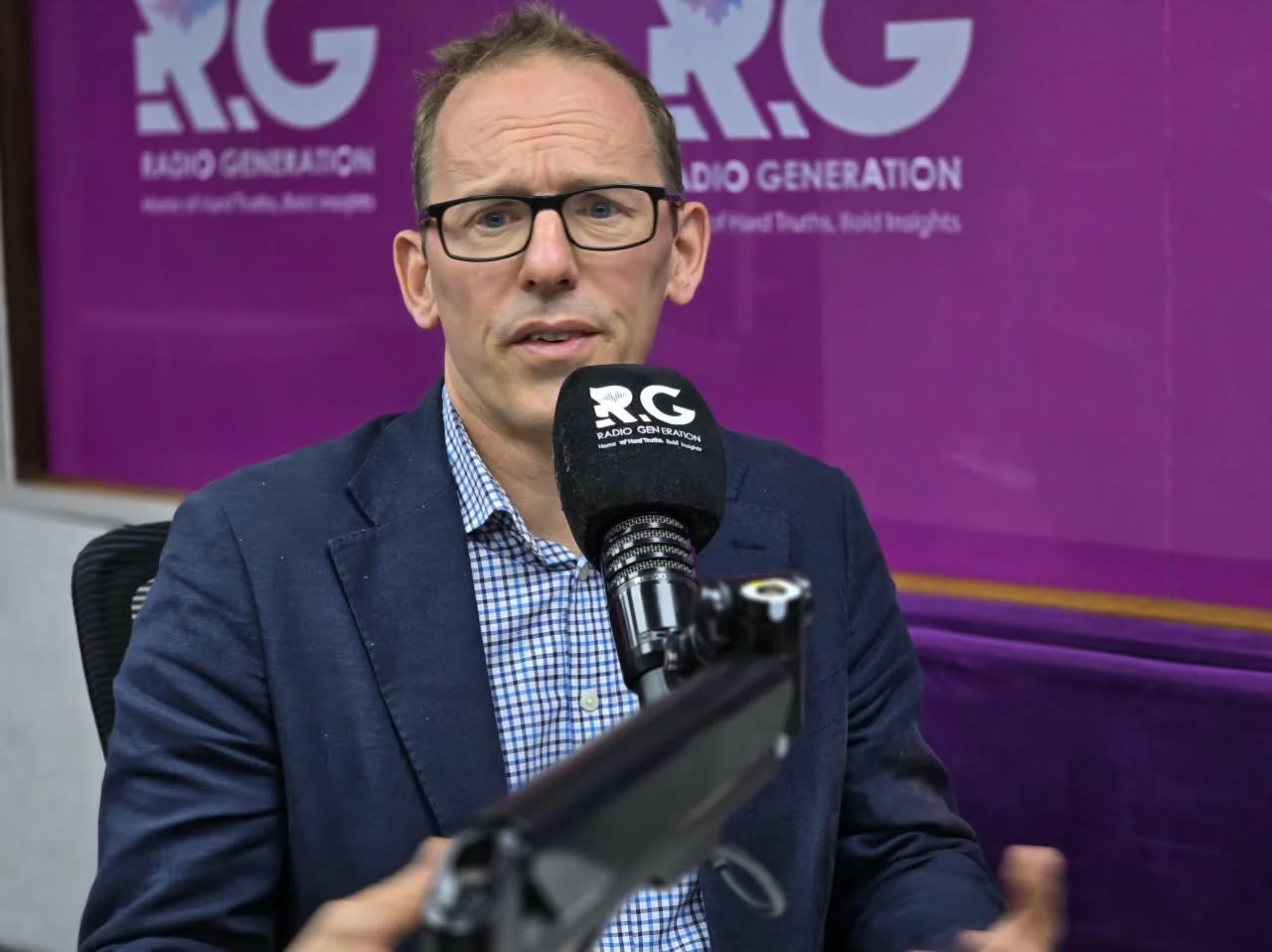
British High Commissioner to Kenya Matt Baugh has recounted his diplomatic work in some of Africa's most troubled regions, describing years spent supporting peace efforts in Sudan, Somalia and the Great Lakes region, where conflict, insecurity and humanitarian emergencies shaped his assignments.
Speaking to Radio Generation on Friday, October 9, Baugh reflected on his career across the continent, including his early involvement in efforts to end Sudan's civil war and his appointment as Britain's first ambassador to Somalia in more than two decades.
“My first posting was in Sudan during the peace process 24 years ago,” Baugh said, recalling his time at the British embassy in Khartoum before South Sudan became an independent country.
“South Sudan had not emerged, and we were a team in the embassy, basically helping to facilitate the peace process based here in Kenya,” he added.
Baugh said the assignment required him to travel regularly between Khartoum, Nairobi and southern Sudan, bringing him into contact with communities and organisations involved in efforts to resolve the conflict.
His posting came as diplomatic efforts intensified to end Sudan's long-running civil war, which had caused widespread deaths and forced millions of people from their homes.
On January 9, 2005, the Sudanese government and the Sudan People's Liberation Movement signed the Comprehensive Peace Agreement in Nairobi. The deal set out power-sharing and security arrangements and created an interim period during which southern Sudan would prepare for a referendum on whether to remain part of the country.
The United Nations estimated that the conflict had killed at least two million people, displaced four million others and forced about 600,000 people to seek refuge in neighbouring countries.
The agreement paved the way for South Sudan to hold a referendum on its future. The country became independent on July 9, 2011, bringing the six-and-a-half-year interim period to an end.
Baugh recalls first British ambassadorial role in Somalia
After his Sudan assignment, Baugh took on another challenging role in the Horn of Africa, serving as Britain's ambassador to Somalia between 2010 and 2013.
The UK government identifies him as the first person appointed to the position in more than 20 years, at a time when Somalia was facing serious security threats and a worsening humanitarian situation.
Baugh said he remained based in Kenya during the assignment, with his family living in the country as he travelled to Mogadishu to carry out his diplomatic duties.
“I was our first ambassador to Somalia 15 years ago. Again, based here in Kenya, so my kids first went to school here. Family was all living here. I was basically commuting to Mogadishu, ” he said.
He described the period as an important part of his diplomatic career, involving close cooperation with Kenya, Ethiopia and Uganda, alongside security partners seeking to improve conditions in Somalia.
“A fascinating time working with the Kenyan government, working with the Ethiopian government, the Ugandan government, and the various security operators to try and change the story in here.”
At the time, Somalia was dealing with militant attacks, piracy and a severe food crisis that left millions of people in need of assistance.
In July 2011, the United Nations declared famine in two regions of southern Somalia. Nearly 3.7 million people across the country were facing a crisis, including an estimated 2.8 million in the south.
The situation was driven by a combination of drought, conflict and food shortages, forcing many Somalis to leave their homes in search of safety and assistance in neighbouring countries, particularly Kenya and Ethiopia.
Baugh recalled how Kenyan communities received people fleeing the crisis, praising their willingness to offer shelter and support to those escaping violence and drought.
“The abiding generosity of the Kenyan people, who just opened their doors, opened their communities to hosting hundreds of thousands of Somalis escaping both the conflict and a disastrous drought,” he said.
He said the challenge extended beyond responding to the immediate humanitarian needs, raising questions about how the deeper causes of Somalia's instability could be addressed.
“And how do we change that? How do we change the kind of root cause, which was basically state failure?”
His remarks pointed to the difficulties facing diplomatic and security efforts in a country where weak state institutions had contributed to prolonged instability.
Great Lakes peace efforts
Baugh later served as Britain's envoy to the Great Lakes peace process, taking part in diplomatic efforts aimed at resolving recurring conflicts in the region.
He recalled working alongside former US senator Russ Feingold, former UN envoy Mary Robinson and other international figures involved in efforts to advance peace agreements.
“I was our first envoy to the Great Lakes as well. Spent a lot of time working with then U.S. Senator Jeff Feingold, Mary Robinson, who was the UN envoy, and a number of others trying to shepherd sort of peace settlements in the Great Lakes,” he said.
The UN-backed Peace, Security and Cooperation Framework for the Democratic Republic of the Congo and the wider Great Lakes region was signed by 11 countries in 2013. Kenya and Sudan joined the framework in 2014.
The agreement sought to address the underlying causes of conflict, strengthen regional cooperation and end repeated violence in eastern Democratic Republic of the Congo and neighbouring areas.
Baugh's work in the region involved engaging with international and regional partners as they sought political solutions to conflicts that had persisted despite repeated peace initiatives.
He said the Great Lakes region deserved greater international attention, pointing to the need for continued diplomatic engagement and cooperation among neighbouring countries.
His assignments in Sudan, Somalia and the Great Lakes region have given him experience in peace negotiations, regional security efforts and responses to humanitarian emergencies.
Reflecting on those roles, Baugh highlighted the importance of working with African governments, international organisations and local communities to address conflicts and the conditions that allow them to persist.