
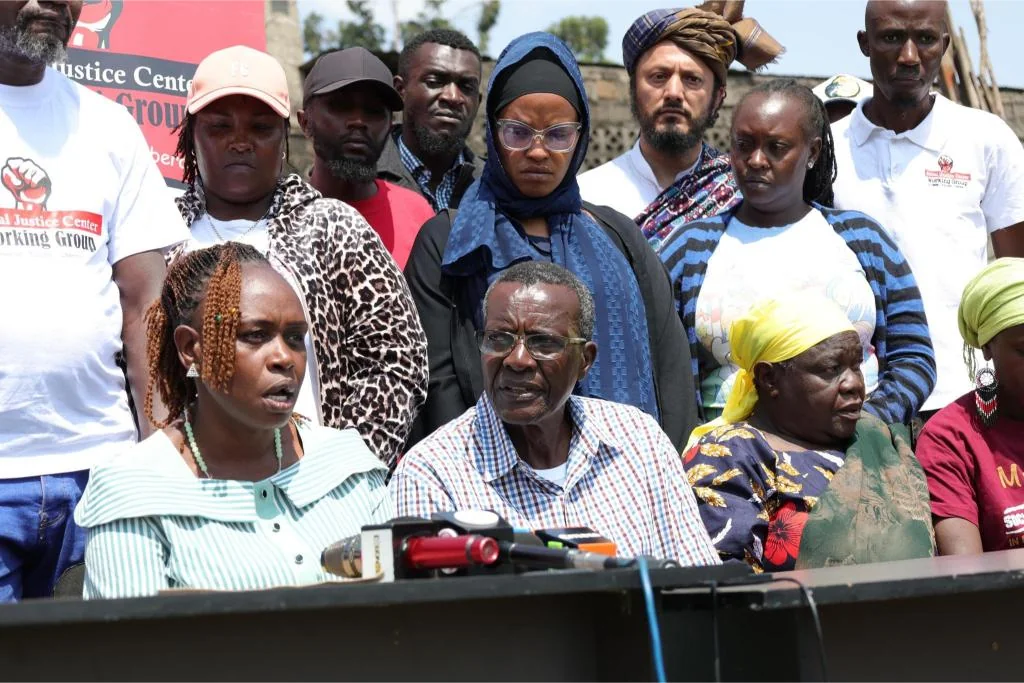
Former Chief Justice David Maraga has accused President William Ruto of disregarding the Constitution after failing to reconstitute his Cabinet to comply with the two-thirds gender principle within a 120-day court deadline.
In a press statement issued on Friday, Maraga said the President had failed to implement a High Court judgment requiring the appointment of more women to the Cabinet, despite being given four months to address the constitutional violation.
The deadline expired on Wednesday, October 28, without the required changes being announced.
Maraga said the court had declared the 25-member Cabinet unconstitutional because it did not meet the gender representation requirements under Articles 27(8) and 81(b) of the Constitution.
“As an advocate for Constitutionalism and a defender of the rule of law in our republic, I am deeply troubled by President Ruto's blatant refusal to honour the Constitution of Kenya that he took the oath of office to obey, protect, and defend! The High Court's landmark judgment in the Katiba Institute & Others v. President William Ruto & Another (2026) explicitly declared the current 25-member Cabinet unconstitutional. It has failed to meet the mandatory two-thirds gender principle enshrined under Article 27(8) and Article 81(b) of the Constitution of Kenya,” Maraga said.
The former Chief Justice also criticised the government's attempt to suspend the High Court judgment through an application filed by Attorney General Dorcas Oduor at the Court of Appeal.
He argued that filing a stay application did not automatically suspend the existing court order, insisting that the President remained obligated to comply unless the appellate court expressly suspended the judgment.
“The filing of a stay application by Attorney General Dorcas Oduor does not grant the President a single second of legal justification to delay compliance. A court order remains fully active, alive, and binding unless and until a higher court explicitly stays it,” he said.
Maraga further questioned the timing of the application, saying it was dated October 6, but Katiba Institute only received communication and the court papers on October 29, a day after the compliance deadline expired.
He said the Court of Appeal declined to certify the application as urgent and instead directed the parties to serve and exchange submissions within 30 days.
The appellate court's decision did not suspend the High Court order, leaving the government under the obligation to comply as its legal challenge proceeds.
The two-thirds gender principle is anchored in Kenya's 2010 Constitution, which introduced stronger guarantees on equality and representation in public institutions.
Article 27(8) requires the State to take legislative and other measures to implement the principle that no more than two-thirds of members of elective or appointive bodies should be of the same gender.
Article 81(b) separately requires Kenya's electoral system to comply with the same principle in elective public bodies.
The provisions are intended to address the historical under-representation of women in political leadership and decision-making institutions.
However, implementing the requirement has remained a longstanding challenge, particularly in Parliament.
In 2012, the Supreme Court considered whether the gender principle had to be implemented before the 2013 General Election. It held that its achievement in Parliament could be progressive, while requiring legislation to provide a mechanism for implementation by August 2015.
Parliament subsequently failed to enact the required legislation within the extended timelines. In 2017, the High Court ordered Parliament to enact the necessary legislation within 60 days, but the requirement remained unresolved.
The debate gained further attention in September 2020 when then Chief Justice Maraga advised President Uhuru Kenyatta to dissolve Parliament over its failure to implement the gender principle.
That recommendation was never implemented, leaving the question of gender representation in elective institutions unresolved.
The current dispute arose from a petition challenging the composition of President Ruto's Cabinet.
On June 30, 2026, the High Court ruled that the Cabinet did not meet the constitutional requirement, finding that it had 18 men and seven women among its 25 members.
The court calculated that at least nine members needed to be women to satisfy the constitutional threshold and gave the President 120 days to reconstitute the Cabinet.
It also rejected the argument that the Secretary to the Cabinet could count toward the required gender representation.
Maraga said the failure to implement the judgment amounted to contempt for the Constitution and the rule of law.
“President Ruto and the Attorney General have been contemptuous since the moment the judgment was delivered. Now, they return to court to plead 'urgency' when they failed to act,” he said.
The Court of Appeal is yet to determine the government's challenge to the High Court judgment.