
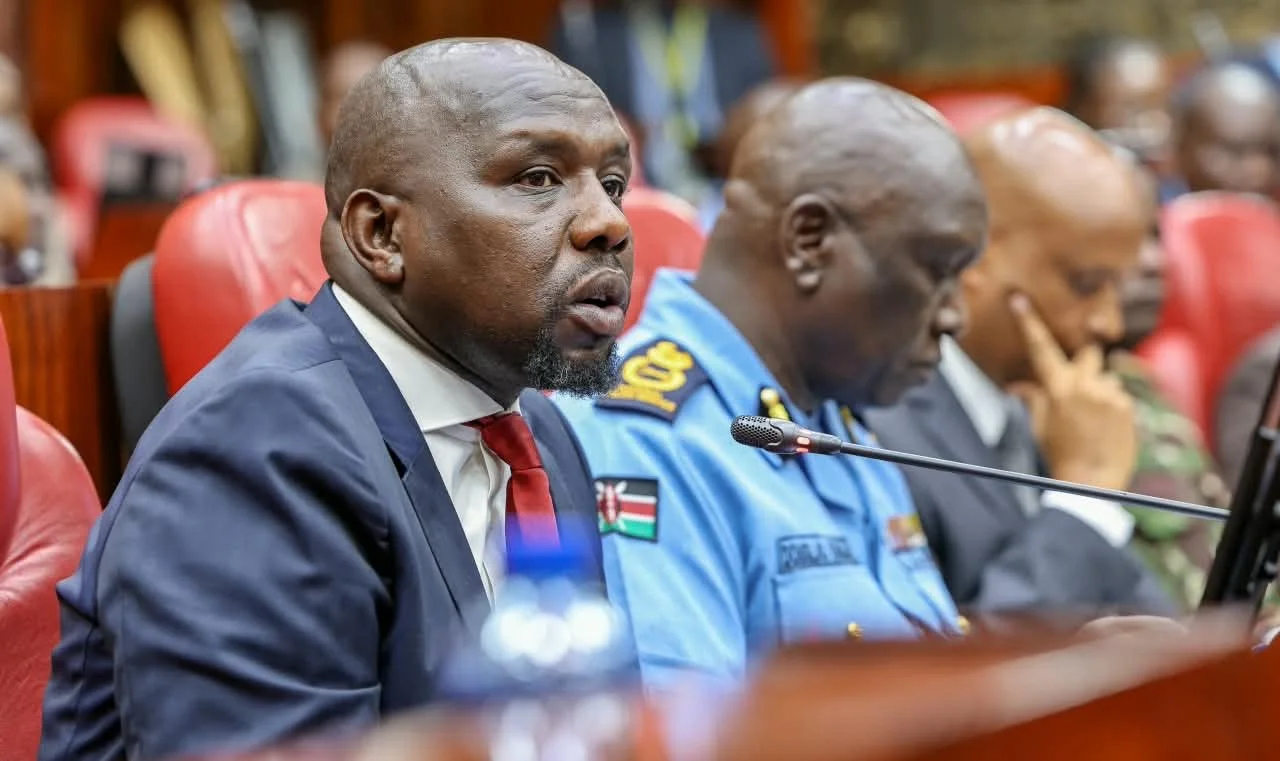
The government is struggling to maintain long-term security operations in banditry-prone areas of Samburu, Meru and Isiolo due to shortages of personnel and equipment, Interior Cabinet Secretary Kipchumba Murkomen has said.
Murkomen told the National Assembly Departmental Committee on Administration and Internal Security on Wednesday, October 7, 2026, that security agencies had made progress in containing insecurity but continued to face threats from bandits, cattle rustlers, livestock thieves and people holding illegal firearms.
“Current resources in terms of personnel and equipment are not adequate for sustained security coverage,” Murkomen told the committee on October 7, 2026.
He said the challenge was made worse by the vast areas that security officers are required to cover, difficult terrain, poor roads and limited communication networks.
The long distances between security installations have also made it harder for security agencies to maintain a strong presence across the affected areas.
Murkomen said parts of the North Rift, Upper Eastern and Northern Kenya had recorded continued cases of banditry, cattle rustling and highway robberies.
He said livestock theft had also grown into an organised crime, with several factors contributing to the insecurity.
These include illegal firearms, cross-border networks, retaliatory attacks, movement of communities in search of pasture and water, and competition for the available resources.
The CS also identified long-running county boundary disputes, ready markets for stolen livestock and inadequate infrastructure as other factors contributing to insecurity.
Despite the challenges, security agencies recovered 3,221 livestock from the 4,306 animals reported stolen between June and September 2026.
Murkomen said security agencies also recovered 2,395 illegally held firearms during targeted disarmament operations conducted between September 2025 and September 2026.
The government has deployed specialised units to affected areas, among them the General Service Unit (GSU), Anti-Stock Theft Unit (ASTU), Quick Response Unit (QRU) and Special Operations Group (SOG).
Additional security camps have also been set up in strategic locations, including Lii and Magado in Meru, to help protect communities from banditry and cattle rustling.
Five killed in September ambush
Murkomen said insecurity had nevertheless continued to claim lives, with 14 people killed and 17 others injured across the affected region between June and September.
He singled out the September 16 attack near a GOTU ASTU camp, where security officers and National Police Reservists responding to a banditry report were ambushed.
Five people died in the incident, including two police officers, one National Police Reservist and two civilians.
The attackers also made away with several government weapons and ammunition during the incident.
Murkomen said security agencies were still working to recover the stolen firearms and ammunition.
The CS also spoke about a separate incident in Samburu East in which livestock were reportedly killed.
He said investigations had been launched to determine the number of animals that were killed or injured, establish where the incident happened and establish the circumstances surrounding the deaths.
The inquiry will also determine whether security officers were involved in the incident.
More funding, reservists planned
Murkomen said the government would not rely on security operations alone to address the problem, with peacebuilding efforts also planned in the affected communities.
The efforts will bring together community elders, religious leaders, elected leaders, youth, women’s groups and peace committees.
The government is also supporting alternative sources of income for young people while working to improve early-warning systems that can help prevent disputes from developing into violence.
Murkomen said discussions were ongoing with Parliament to secure additional funds for the construction and improvement of security roads.
He further said the government intends to recruit more National Police Reservists during the next six months to increase the number of personnel available to provide security in affected areas.
“The government is committed to enhance security… through a multi-agency, intelligence-led and community-supported approach,” he said.