Ruto pushes Africa to ditch aid and fund own growth through investment-led model
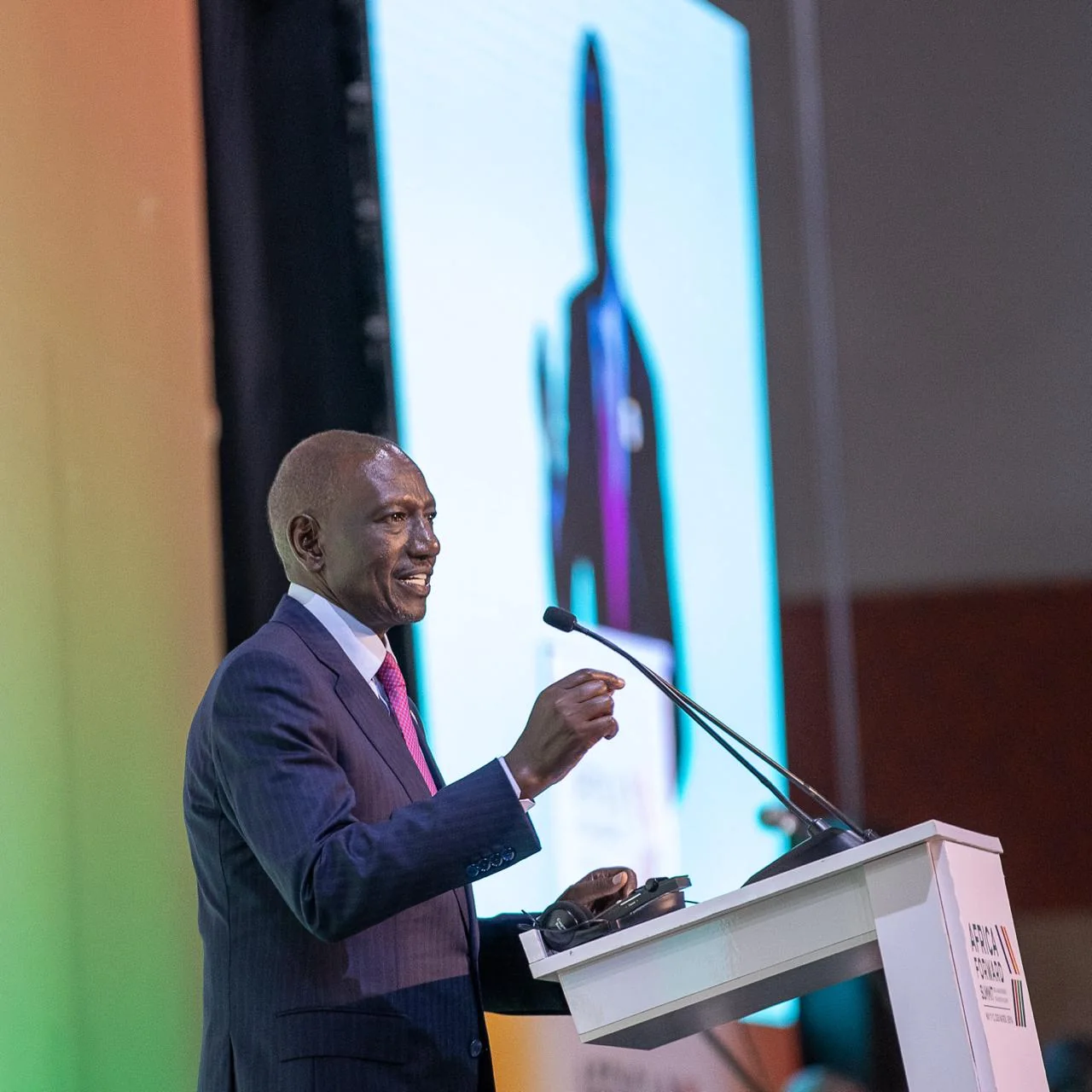
President William Ruto said Africa must fund its own transformation by mobilising domestic resources and pushing fairer global financial systems. Speaking at the Africa Forward Summit in Nairobi, he urged investment-driven growth and stronger multilateral cooperation.
President William Ruto has urged African countries to rethink how they engage with the global economy, calling for a clear break from aid dependence and a stronger focus on investment-led development anchored on domestic resources and coordinated financial systems.
Speaking on Tuesday at the Africa Forward Summit 2026 in Nairobi, he said Africa must take charge of its transformation by mobilising local capital, fixing weaknesses in global finance systems, and strengthening continental institutions to support industrial growth and shared prosperity.
He noted that global economic conditions are changing fast, pointing to shifting trade patterns, emerging power centres, and redesigned supply chains that are reshaping how the world does business.
Ruto warned that the response to these shifts should not be isolation or fragmentation, but deeper cooperation built on fairness and mutual respect among nations.
“Yet in moments such as this, fragmentation cannot be the answer, nor isolation the strategy,” the President explained, stressing that future partnerships must be based on equality rather than hierarchy.
He said Africa, alongside partners such as France, has an opportunity to build stronger and more forward-looking economic ties that support long-term transformation.
The President emphasised that Africa should no longer be treated as a passive participant in global affairs, but as a key strategic player with natural resources, expanding markets, and a fast-growing youth population.
He further projected that by 2051, “in every four people on earth will be Africa,” noting that this shift will strongly influence global labour markets, cities, energy demand, and overall economic growth.
Discussions at the summit focused on ways to improve domestic revenue mobilisation, reform international financial systems, expand infrastructure, advance energy transition, and equip young people with skills in innovation and artificial intelligence.
Ruto stressed that Africa must confront the challenge of financing its own development, saying the era of aid dependency and unsustainable borrowing must end in favour of investment, innovation, and stronger use of local resources.
“Africa is not part of the global problem. Africa is, in fact, the solution to the global challenges that exist today,” he stressed.
He pointed out that the continent holds vast resources, including critical minerals, fertile land, renewable energy potential, and a large youthful population, adding that what is needed is not charity but productive investment and fair partnerships.
The President also criticised the global financial system, saying it remains uneven, with African countries facing high borrowing costs, limited access to concessional funding, and risk ratings that do not reflect actual economic conditions.
He supported reforms in global credit rating systems and backed the creation of the African Credit Rating Agency to ensure fairer assessment of African economies.
https://twitter.com/RadioGenKe/status/2054140760400793696
Ruto revealed that Africa holds more than $4 trillion in domestic savings but much of it remains unused in development.
“What do I mean? Across our continent, enormous pools of domestic capital remain underutilized. Africa today holds more than $4 trillion in long term domestic savings, including over $1 trillion in pensions and insurance assets, and more than $500 billion in central bank reserves. I am not talking about Europe,” the President highlighted.
He said this capital could transform infrastructure, housing, energy, and industrial projects if properly mobilised, noting that the main challenge is not lack of money but risk perception.
Ruto also backed the Alliance of African Multilateral Financial Institutions, bringing together development banks and investment bodies to strengthen financing across the continent.
“You remember colleagues that we did endorse at the last AU summit, the alliance of African multilateral institutions, starting with the World Bank and all the other institutions, through institutions such as the Africa Development Bank, Africa Export Import Bank, African Finance Corporation, the Trade and Development Bank, Shelter Afrique Development Bank, Africa50 and Africa Trade and Investment Development Insurance,” he stressed.
He said these institutions can help Africa finance infrastructure, trade corridors, housing, climate resilience, and industrial growth.
“Africa is steadily strengthening its capacity to finance infrastructure, industrialization, trade, housing, climate resilience and economic transformation,” the President noted.
Ruto further supported the African Financial Architecture for Development framework, which seeks to bring together institutions, pension funds, and private investors into one coordinated system aimed at keeping African savings within the continent and directing them to productive sectors.
He concluded by reaffirming a central message of the summit, saying, “Africa must increasingly finance Africa,”



Comments
Sign in with Google to comment, reply, and like comments.
Continue with Google