
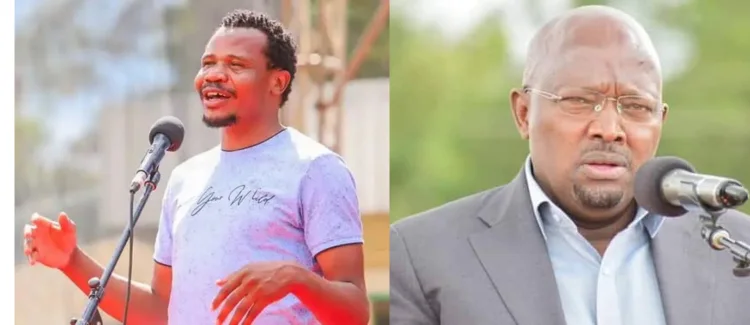
Mumias East Member of Parliament Peter Salasya and former Agriculture Cabinet Secretary Kipruto Arap Kirwa are set to take up deputy party leader positions in the Democratic Action Party of Kenya (DAP-K), replacing Kakamega Deputy Governor Ayub Savula and Trans Nzoia Governor George Natembeya in a leadership restructuring ahead of the 2027 General Election.
DAP-K party leader Eugene Wamalwa said on Thursday that the party's Management Committee recommended Salasya and Kirwa for the positions, and that the proposals are expected to be presented to the National Executive Council (NEC) and General Council next week for approval.
The changes will see Salasya take over from Savula, who defected to the ruling United Democratic Alliance (UDA) in January 2026, while Kirwa is proposed to replace Natembeya, who announced his departure from DAP-K in July following disagreements with Wamalwa over the party's political direction.
Wamalwa described Kirwa as an experienced political leader whose inclusion would strengthen the party's national leadership.
"Alongside PK Salasya, we have received a very eminent Kenyan who will also be joining our National Executive Council as another deputy party leader. And this is not a stranger to many Kenyans. He is a very seasoned and respected Kenyan leader who has been a Cabinet minister, who has been a Member of Parliament, and his name is Honorable Kipruto Arap Kirwa," Wamalwa said.
The party leader indicated that the proposed appointments were part of a wider restructuring exercise, with additional leadership positions expected to be announced after the governing organs consider the recommendations.
"We will also be proposing several other names, including two new deputy party leaders, for approval of NEC and General Council next week, so the full list shall be revealed," he added.
The changes follow the departure of two senior party officials who previously occupied deputy leadership positions.
Savula publicly distanced himself from DAP-K after disagreements over the party's opposition politics and his support for President William Ruto's administration. He subsequently joined UDA and declared his intention to contest the Kakamega governorship in 2027.
Natembeya, on the other hand, announced his exit after accusing the party leadership of frustrating his efforts to transform DAP-K into a broader national political movement.
The governor had sought greater influence over the party's direction, arguing that it needed to expand beyond its Western Kenya support base.
His departure followed months of disagreements between factions associated with him and Wamalwa, after the party received petitions seeking changes to its leadership.
The proposed restructuring also comes after former Kanduyi MP Wafula Wamunyinyi, another former DAP-K deputy party leader and founding party leader, announced his departure in October 2026 to support Nairobi Senator Edwin Sifuna's Linda Mwananchi political movement.
Beyond the deputy leadership changes, Wamalwa announced plans to reconstitute DAP-K's National Elections Board following the expiry of the current team's five-year term.
He thanked outgoing chairperson Wanjala Jumbe and his team for serving their full term, saying the party's Management Committee had already recommended names for the NEC and General Council to consider.
"The board that was there, that we started with, has served its full term of five years, and we want to thank in a very special way the chair of the National Elections Board, outgoing, our brother Wanjala Jumbe, and his team," he said.
The incoming board will oversee internal nominations and coordinate the process through which aspirants seek the party's tickets for elective positions.
Wamalwa assured prospective candidates that the new team would promote transparency and fairness in the nomination process.
"All aspirants who are here today, you are going to have a new board that is going to process you, that is going to work with you, that is going to ensure free and fair nominations, that is going to ensure that you are clear and you have a date with IEBC," he said.
DAP-K's restructuring reflects a wider wave of political realignments as Kenyan parties reposition themselves, strengthen their leadership structures and seek to consolidate support ahead of the August 2027 General Election.
In September 2026, former President Uhuru Kenyatta handed over the Jubilee Party leadership to former Interior Cabinet Secretary Fred Matiang'i, who had been endorsed as the party's presidential candidate.
Kenyatta retained an advisory role in the party, with Jubilee seeking to strengthen its structures and prepare candidates for elective positions across the country.
The transition, however, has not ended internal disagreements, with competing factions continuing to contest the party's direction and leadership arrangements.
In August 2026, Wiper Party leader Kalonzo Musyoka also unveiled a new leadership team, appointing former Kigumo MP Jamleck Irungu Kamau as national chairman, advocate Ndegwa Njiru as spokesperson and Nyali MP Mohamed Ali as deputy party leader designate.
The Azimio coalition has similarly pursued organizational changes and rebranding as opposition parties explore new alliances and strategies ahead of the elections.
The restructuring is taking place as the Independent Electoral and Boundaries Commission prepares political parties for the next electoral cycle.
On November 20, 2026, IEBC announced that only 11 of the 105 political parties that submitted their nomination rules for the 2027 elections met the applicable requirements in its initial review, while 94 were required to amend their rules.
The developments underline the importance of internal party structures and credible nomination processes as political competition intensifies.
For DAP-K, the proposed elevation of Salasya and Kirwa, alongside the planned replacement of its elections board, marks an attempt to rebuild its leadership following the departure of senior officials and strengthen its preparations for the next general election.
The appointments will take effect subject to approval by the party's governing organs.