
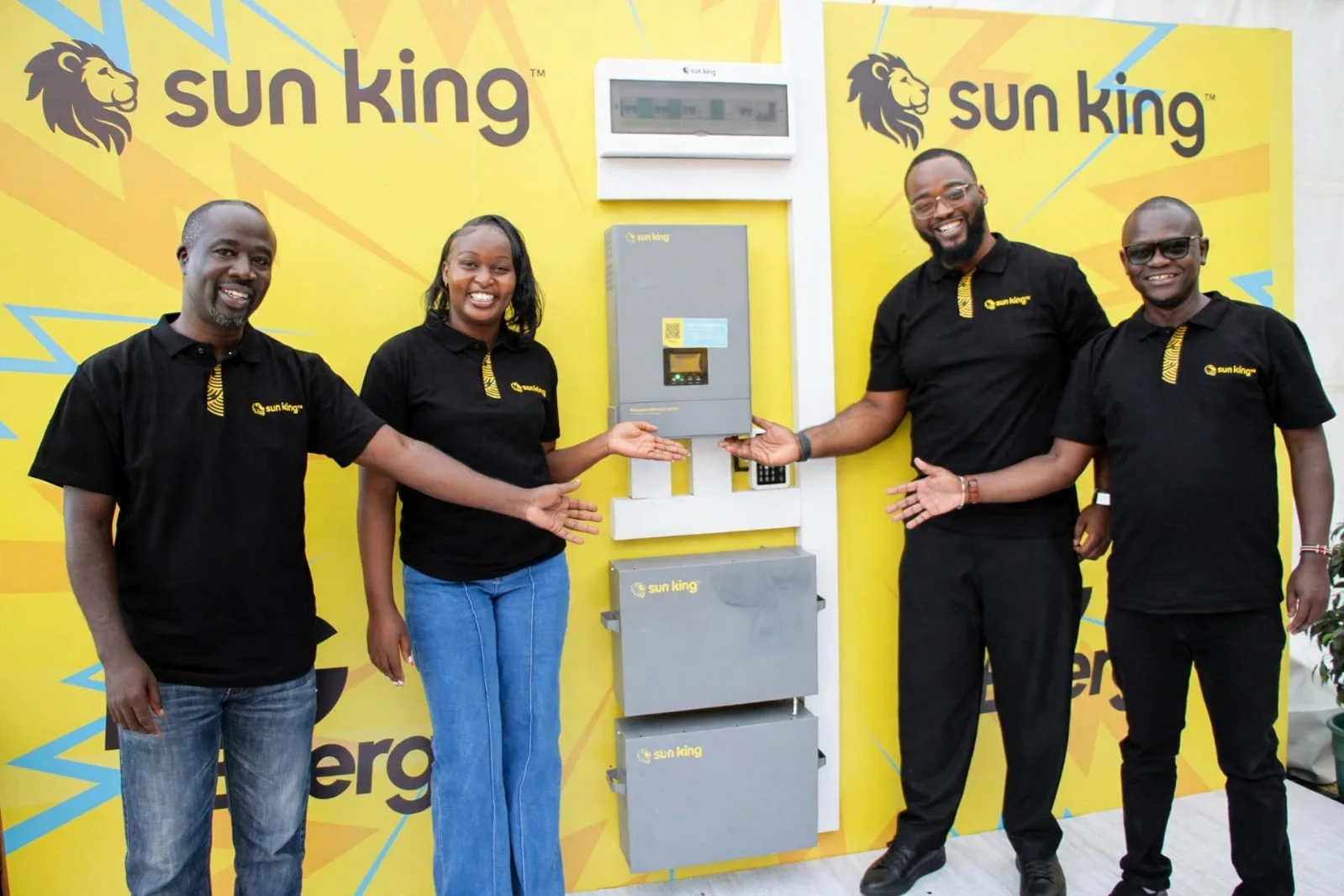
Kenyan households, businesses, schools and health facilities will have access to larger solar power systems following an expansion by Sun King that raises its inverter capacity to 30 kilowatts, offering customers an alternative source of electricity as their energy needs grow.
The new systems, which can be acquired through upfront payments or instalments, are designed to support everything from household appliances to the daily operations of commercial enterprises and essential public services.
The company unveiled the expanded Power Hub range in Kiambu County on Thursday, October 8, 2026, extending its solar offering to customers who require more power than smaller residential systems can provide.
The move comes as Kenya continues to expand electricity access and increase its use of renewable energy. World Bank figures show that about 77 per cent of the country's population had access to electricity in 2024, leaving a considerable number of people without a connection.
Sun King says the new systems will help meet a wider range of electricity needs, serving customers at home, in commercial establishments and in institutions that depend on a steady power supply.
Atta Arome, Sun King's Product Head for Global Solar Inverter Systems, said the expanded range builds on the company's existing products, which include solar lanterns, solar home systems and smaller inverters.
“The Power Hub has been in care homes and businesses for years, and now today it goes up from 3.3 to 30 kilowatts. We have a 5 kilowatt inverter, and you can run in parallel, which simply means that if you put two or more together, the power adds up,” Arome said.
The new offering includes a 5kW system capable of powering appliances such as water pumps, washing machines, microwaves and electric kettles. Customers who require more electricity can opt for the Power Hub Max, which combines two 5kW inverters to deliver 10kW of inverter capacity.
For customers with higher energy demands, the Power Hub Ultra offers 30kW of inverter capacity. The system supports battery storage ranging from 15kWh to 120kWh and solar generation capacity of up to 48kW, allowing it to serve users who need greater power output and storage.
Sun King Kenya Country Business Leader Elisha Omedo Adie said the wider product range would enable the company to serve customers with growing electricity demands while helping them keep their homes and businesses running when grid power is unavailable.
“When we talk about bringing big energy to Kenya, we are not just talking about power capacity and kilowatts. We are talking about changing what is possible for our customers at home, at work, and at business. Alongside the existing systems that start at 2.2 kilowatts, we are now offering systems up to 30 kilowatts,” Adie stated.
He pointed to Family Care Centre, a 24-hour clinic in Juja, as an example of how solar energy can help keep essential services running during power interruptions. According to Adie, the facility uses a Power Hub system to support lighting, diagnostic equipment and cold storage when electricity from the grid is unavailable.
The company also cited projects in other African countries as part of its efforts to extend solar power to institutions. One such initiative is a programme in Malawi that aims to reach 5,000 primary schools by 2030.
Kenya's energy mix offers further context for the company's expansion. A report by the Energy and Petroleum Regulatory Authority for the financial year ended June 2025 showed that renewable sources accounted for 80.17 per cent of the country's electricity generation.
Geothermal power contributed 39.51 per cent of total generation, followed by hydropower at 24.21 per cent, wind at 13.18 per cent and utility-scale solar at 3.27 per cent.
Sun King's Head of Inverter Business for Kenya, Veronica Mugwanja, said the expanded range would also allow customers to increase their electricity capacity as their needs change without having to move to another provider.
“You do not have to start again with a new energy company every time your power needs change. You can stick with the service that you know, provided by the trusted brand that is Sun King.”
The company has set the upfront price of its 5kW system at Sh354,500. Customers who prefer to pay in instalments can make an initial deposit of Sh35,600, followed by monthly payments of Sh22,600 over 18 months, according to Mugwanja.
Beyond supplying the equipment, Sun King says its services include delivery, installation and after-sales support, including for customers living in remote areas.
Mugwanja cited installations on islands in Lake Turkana and Lake Victoria as examples of the company's efforts to reach communities that may face challenges accessing reliable electricity and related services.
The company is also preparing to introduce three-phase inverter systems aimed at larger industrial and commercial users. The planned addition would broaden its offering beyond the single-phase systems currently being introduced, with financing options expected to help more customers access the technology.
The expanded range marks a move by Sun King to serve customers whose electricity requirements extend beyond basic household use, while giving existing customers the option to increase their solar capacity as their power needs rise.