Economic stability strengthens as Kenya records 5% average growth — Mbadi
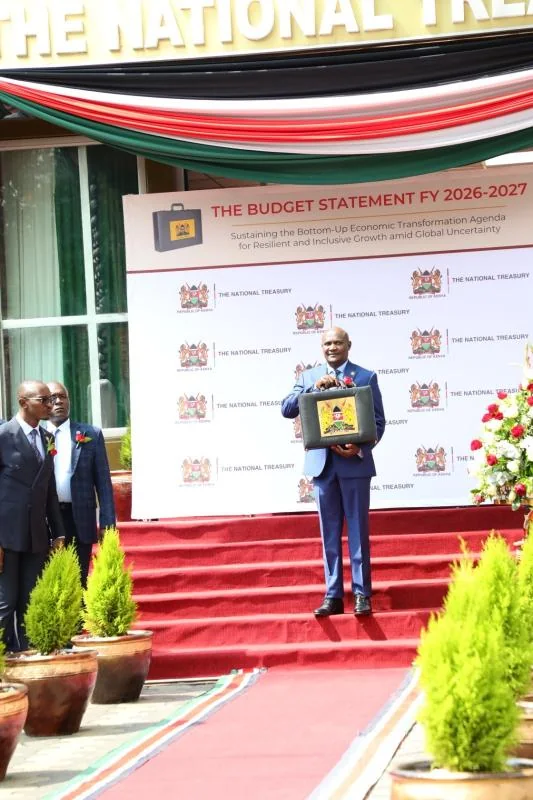
The Treasury CS reported that between 2022 and 2025, the economy expanded at an average rate of 5 per cent, outperforming the global average of 3.4 per cent and the Sub-Saharan Africa average of 4.1 per cent.
Kenya’s economy has posted stronger growth than global and regional peers over the past three years, with Treasury Cabinet Secretary John Mbadi crediting policy reforms under the Bottom-Up Economic Transformation Agenda for stabilising key macroeconomic indicators and boosting investor confidence.
Presenting the Budget Highlights and Revenue Raising Measures for the 2026/27 Financial Year in Parliament on Thursday, Mbadi said the country had maintained a steady recovery despite domestic pressures and external shocks, supported by targeted government interventions aimed at restoring stability and supporting growth.
He reported that between 2022 and 2025, the economy expanded at an average rate of 5 per cent, outperforming the global average of 3.4 per cent and the Sub-Saharan Africa average of 4.1 per cent.
He added that improved economic conditions had been reflected in lower inflation, easing interest rates, a more stable exchange rate and stronger private sector activity.
Mbadi said confidence in the economy had continued to strengthen, pointing to improved macroeconomic indicators and rising credit flows to the private sector.
“Kenya's economic journey over the past three years stands as a story of resilience. Difficult but necessary choices were made, delivering a steady recovery. Faced with significant domestic and external pressures, the government took difficult decisions to restore macroeconomic stability and lay the foundation for sustainable growth,”
He further noted that key economic fundamentals had shown improvement, with inflation and exchange rate stability returning, while reduced borrowing costs had supported lending to businesses across the country.
“Macroeconomic fundamentals such as inflation and exchange rate have strongly rebounded and are projected to remain stable. Interest rates have declined, supporting growth in private sector credit from the banking industry,”
Mbadi also highlighted a build-up in foreign exchange reserves, saying the country had reached a strong buffer position that would help cushion the economy against external shocks and global volatility.
“We have also accumulated the highest levels of official foreign exchange reserves of US dollars 13.2 billion (Sh1.7 trillion) which is equivalent to 5.6 months of import cover by May 2026, providing adequate cover and a buffer against short-term domestic and external shocks,”
Despite the progress, he cautioned that the 2026/27 budget was being prepared in an uncertain global environment, shaped largely by the ongoing conflict in the Middle East. He said the conflict had disrupted global supply chains, pushed up commodity prices and weakened investor confidence.
Mbadi pointed out that global oil prices had risen sharply, increasing from an average of US$63.06 per barrel in February 2026 to US$94.4 per barrel by the end of May, adding pressure to domestic economic activity and the cost of living.
“In addition, tighter financing conditions, weakening export demand, slower investment flows, and rising cost of living continue to exert pressure on economic activity,”
Even with these challenges, Mbadi said there were opportunities for economies that focus on competitiveness, stronger regional trade ties and building resilient production systems.
He added that the 2026/27 budget would prioritise programmes under the Bottom-Up Economic Transformation Agenda, targeting private sector-led growth, job creation, improved public services and fiscal stability.
Mbadi maintained that the government’s economic approach had already delivered measurable gains and positioned the country for continued growth even as global uncertainties persist.



Comments
Sign in with Google to comment, reply, and like comments.
Continue with Google