
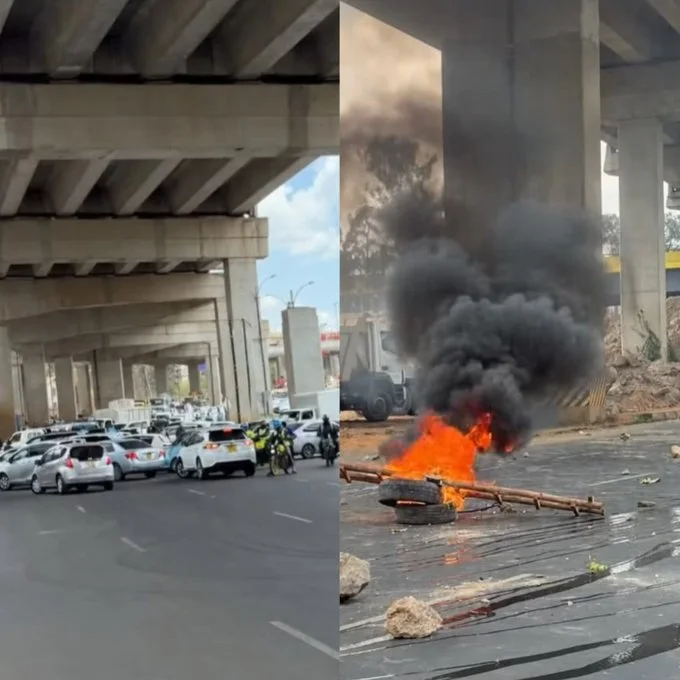
Transport was disrupted along Nairobi’s Waiyaki Way on Tuesday after University of Nairobi students staged demonstrations over the ongoing lecturers’ strike that has brought academic activities in public universities to a standstill.
The students lit bonfires and barricaded sections of the busy highway with stones, forcing motorists to seek alternative routes as traffic ground to a halt.
Police officers responded by firing tear gas to disperse the demonstrators, who fled in different directions in search of safety.
Images and videos from the scene showed students running as armed police officers lobbed tear gas canisters. Motorists were also seen turning in opposite directions to avoid the congestion caused by the demonstrations.
Police officers later began removing the barriers erected by the students in an effort to restore traffic flow along the highway.
The protests reflect growing frustration among university students over the prolonged disruption of teaching and uncertainty about when normal academic activities will resume.
The demonstrations come as university staff unions remain locked in a dispute with the government over the implementation of the 2025–2029 Collective Bargaining Agreement (CBA).
The nationwide strike began on October 2, 2026, following the collapse of negotiations over the agreement, affecting thousands of students in public universities.
University staff unions have accused the government of failing to conclude negotiations and provide adequate funding for the four-year agreement, despite earlier commitments to resolve the outstanding issues.
The dispute intensified on Monday, October 26, after negotiations collapsed over a government counter-offer of Sh11.9 billion for the 2025–2029 agreement.
The offer has become a key point of contention as the unions push for a financial commitment that would guarantee the implementation of the agreement.
University students have increasingly borne the consequences of the impasse, with teaching and other academic activities disrupted across public institutions.
The latest demonstrations also follow similar protests last week, as students expressed frustration over the continued suspension of learning and the lack of certainty surrounding the resumption of classes.
The disruptions have raised concerns about the academic calendar and the potential consequences for students whose studies have been interrupted by the industrial action.
Despite Monday’s breakdown in talks, the government and university staff unions are expected to resume negotiations later this week in another attempt to resolve the dispute.
Universities Academic Staff Union (UASU) Secretary General Constantine Wasonga has maintained that the agreement must be supported by a clear financial commitment from the government, particularly the National Treasury.

The unions have argued that resolving the dispute requires more than negotiations, insisting that the government must demonstrate its capacity and willingness to finance the agreed terms.
The anticipated resumption of talks offers another opportunity for both sides to address the outstanding issues and reach an agreement that could pave the way for lecturers to return to work.
However, until a breakthrough is reached, students remain caught in the dispute, with no confirmed date for the full resumption of normal academic activities.
The latest protests on Waiyaki Way underline the mounting pressure on the government and university staff unions to resolve the funding disagreement and end the strike.