African leaders adopt Nairobi Declaration to push financial independence and green growth
Under the Nairobi Declaration, countries agreed to strengthen African financial institutions, including banks, pension funds, and development finance bodies, to play a bigger role in funding infrastructure, industrial growth, and social development programmes.
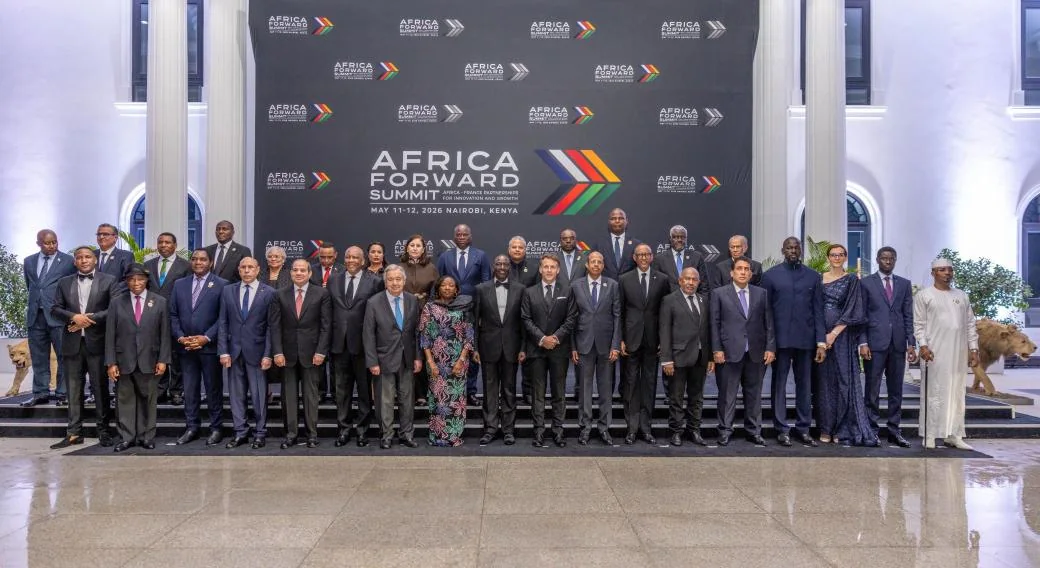
African leaders have concluded the Africa Forward Summit in Nairobi with the adoption of a new development framework known as the Nairobi Declaration, which sets out a shift in how the continent plans to finance growth, expand industry, and engage with global partners.
The agreement was announced at the end of the two-day summit by President William Ruto alongside French President Emmanuel Macron, following discussions focused on Africa’s economic direction, investment priorities, and long-term transformation agenda.
The leaders said Africa is entering a new phase where it will rely more on its own financial systems and internal resources, rather than depending heavily on external assistance.
“Africa has immense resources and capacity. We are not coming to beg for donations,” Ruto said.
“We are looking for mutual partnerships built on respect, investment and shared prosperity.”
Under the Nairobi Declaration, countries agreed to strengthen African financial institutions, including banks, pension funds, and development finance bodies, to play a bigger role in funding infrastructure, industrial growth, and social development programmes.
Youth and technology were placed at the centre of the new agenda, with leaders describing Africa’s fast-growing young population as a key driver of future economic growth.
Africa has the youngest population in the world, with a median age of about 18 years. By 2050, projections show that one in every four people globally will be African.
Leaders said this shift presents a major opportunity in innovation, digital economies, manufacturing, and services, if governments invest properly in education, skills development, and technology.
They also stressed the urgency of creating jobs for millions of young people entering the labour market each year, with focus areas including digital infrastructure, artificial intelligence, innovation hubs, and entrepreneurship.
Ruto said employment creation must be at the centre of Africa’s development plans.
“Africa’s youthful population is not a burden; it is our biggest competitive advantage,” he said.
Energy transition was also highlighted as a key pillar of the agreement, with leaders committing to increase investment in affordable and reliable energy to support industries, agriculture, and transport systems.
The plan includes scaling up renewable energy sources such as solar, wind, geothermal, and nuclear power to reduce costs and expand access across the continent.
Leaders said stable electricity supply remains critical for industrial growth, job creation, and poverty reduction.
On international cooperation, Emmanuel Macron said France supports a renewed partnership with Africa built on fairness, respect, and shared goals.
“We want a partnership anchored on respect and shared responsibility,” Macron said.
He added that African countries are often the most affected by global crises such as climate change, conflicts, and economic shocks, despite contributing least to their causes.
Macron also confirmed he had invited Ruto to attend the upcoming G7 Summit in June, saying global decision-making must include stronger participation from developing economies.
He said Africa’s voice in global governance must grow in line with its population size and economic potential.
The Nairobi Declaration is expected to guide future cooperation between African countries and global partners as the continent moves toward greater self-reliance, industrial expansion, and stronger influence in international affairs.



Comments
Sign in with Google to comment, reply, and like comments.
Continue with Google