
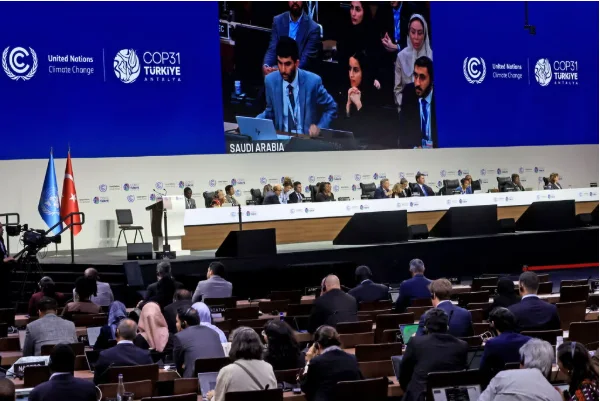
Efforts to secure a global agreement on reducing reliance on fossil fuels collapsed at the COP31 climate conference in Antalya, Turkey, after countries failed to agree on how to address the use of oil, gas and coal in the final negotiations.
The talks ended without a political agreement for the first time since 2009, exposing deep divisions between countries pushing for a faster transition to clean energy and major oil-producing nations seeking to protect fossil fuels.
Negotiators from Europe, small island states, Latin America, Asia and Africa accused Saudi Arabia of exerting disproportionate influence over the discussions, saying its officials had regular access to the conference presidency while representatives of other countries struggled to secure meetings.
Riyadh was accused of leading opposition to language calling for reduced reliance on fossil fuels, insisting that the final text should instead promote carbon capture technologies designed to reduce emissions.
The European Union and several climate-vulnerable countries rejected the approach, arguing that any meaningful agreement had to explicitly recognise oil, gas and coal as major drivers of global warming.
"This COP, I believe, was hijacked by some oil states," Ireland's climate minister Darragh O'Brien told Reuters on behalf of the European Union.
The Turkish COP presidency denied giving any country preferential treatment, while representatives of Saudi Arabia and Australia did not immediately respond to requests for comment.
Tensions increased after the presidency released a revised draft agreement that excluded references to fossil fuels.
Germany subsequently coordinated efforts by members of the High Ambition Coalition, bringing together around 130 countries to demand that the final agreement include a commitment to transition away from fossil fuels.
However, a subsequent draft released early on Sunday ignored the coalition's demands and retained language promoting carbon capture.
"It seems like we are negotiating with the Saudis," Tuvalu's climate minister Maina Talia said.
The absence of active US engagement and limited coordination between Washington and Beijing also weakened efforts to broker a compromise, Singapore Environment Minister Grace Fu said.
As negotiations dragged into Sunday, delegates began leaving to catch flights, with some small island representatives complaining that promised meetings with the conference leadership had repeatedly been cancelled.
COP31 president Murat Kurum eventually confirmed during the closing plenary that there was no agreement and that he would not present another draft text.
The collapse highlighted growing tensions over the influence of fossil fuel producers in international climate negotiations and the pace of the global transition to cleaner energy.