
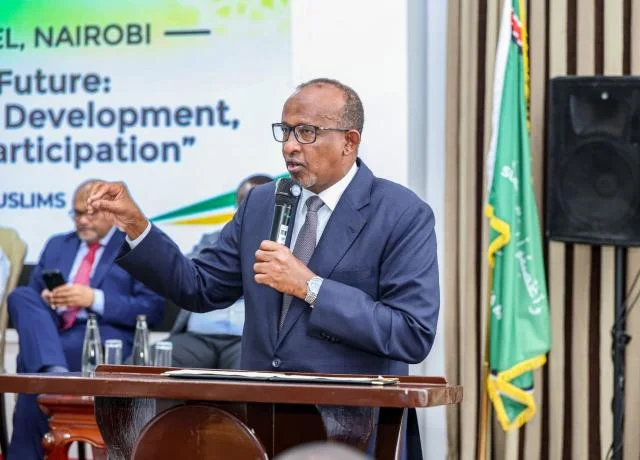
Health Cabinet Secretary Aden Duale has taken President William Ruto’s re-election campaign to Muslim leaders, urging them to support his bid for a second term while promoting a political alliance aimed at bringing together communities he says have been sidelined in Kenya’s development.
Duale made the appeal on Thursday, October 15, while representing Ruto at the National Muslim Leaders Convention 2026 in Nairobi, where he defended the administration’s record and called for greater inclusion of Muslim communities in government decisions and national development.
“Anybody who returns our dignity is who we want,” Duale said, presenting the government’s approach to development and public service delivery as a reason for Muslim leaders to support the President.
He said the proposed coalition of marginalised communities would unite Muslims, pastoralist groups and regions that have not benefited fairly from development. The initiative is part of a broader effort to build political partnerships ahead of the 2027 General Election.
Duale has previously outlined plans for an alliance spanning northern Kenya, the Coast, Nyanza and western Kenya, seeking to bring together communities whose interests he says have not received adequate attention in national affairs.
In defending the government’s record, Duale cited renewed activity in western Kenya’s factories and investment in infrastructure, arguing that the administration was extending development opportunities beyond traditionally favoured regions.
“Today in western Kenya, the factories are running. Kenya now is very soon going to be sugar self-sufficient and will export it,” he said.
He also highlighted the expansion of passport services, including the establishment of an office in Garissa, as an example of efforts to make government services more accessible to people outside major urban centres.
Duale said access to national documents should not depend on a person’s religious background, insisting that Muslims, Christians and other Kenyans should be treated equally when applying for identity cards and passports.
He traced some of the inequalities affecting communities to past government policies, referring to Sessional Paper No. 10 of 1965 and Africanisation. He argued that addressing the effects of historical decisions was necessary to create a more balanced distribution of development and opportunities.
The Cabinet Secretary said Muslim communities should have a stronger presence in government appointments and a greater say in how public resources are shared and national policies are implemented.
“President Ruto is committing to structurally create an equitable Kenya, where public appointments, resource allocation, national policies reflect the true diversity of our nation,” Duale said.
He also pointed to discussions between the government and Muslim leaders on healthcare reforms, education and the Bottom-Up Economic Transformation Agenda, saying these areas could help expand the community’s participation in the economy.
Duale cited Islamic financing models as another approach intended to widen participation in government development programmes and make economic opportunities more accessible to different groups.
His message placed the proposed coalition alongside the administration’s broader argument that addressing historical exclusion and improving representation should be central to Kenya’s development agenda.
SUPKEM seeks formal channel for engagement
The convention, organised by the Supreme Council of Kenya Muslims (SUPKEM), brought Muslim leaders together to discuss governance, development and their engagement with state institutions.
SUPKEM called for closer cooperation among Muslim leaders and more organised consultations with government agencies to ensure that the community’s concerns are considered when policies are formulated and implemented.
One of the meeting’s resolutions was to establish a permanent policy liaison directorate to improve engagement with government ministries and the National Treasury.
The proposed office is expected to provide a formal channel through which Muslim leaders can present their concerns and engage public institutions on policy decisions and the allocation of resources.
The convention’s resolutions came as Duale urged the community’s leaders to support Ruto’s second-term ambitions, linking his appeal to the government’s development record and commitments to more inclusive governance.