
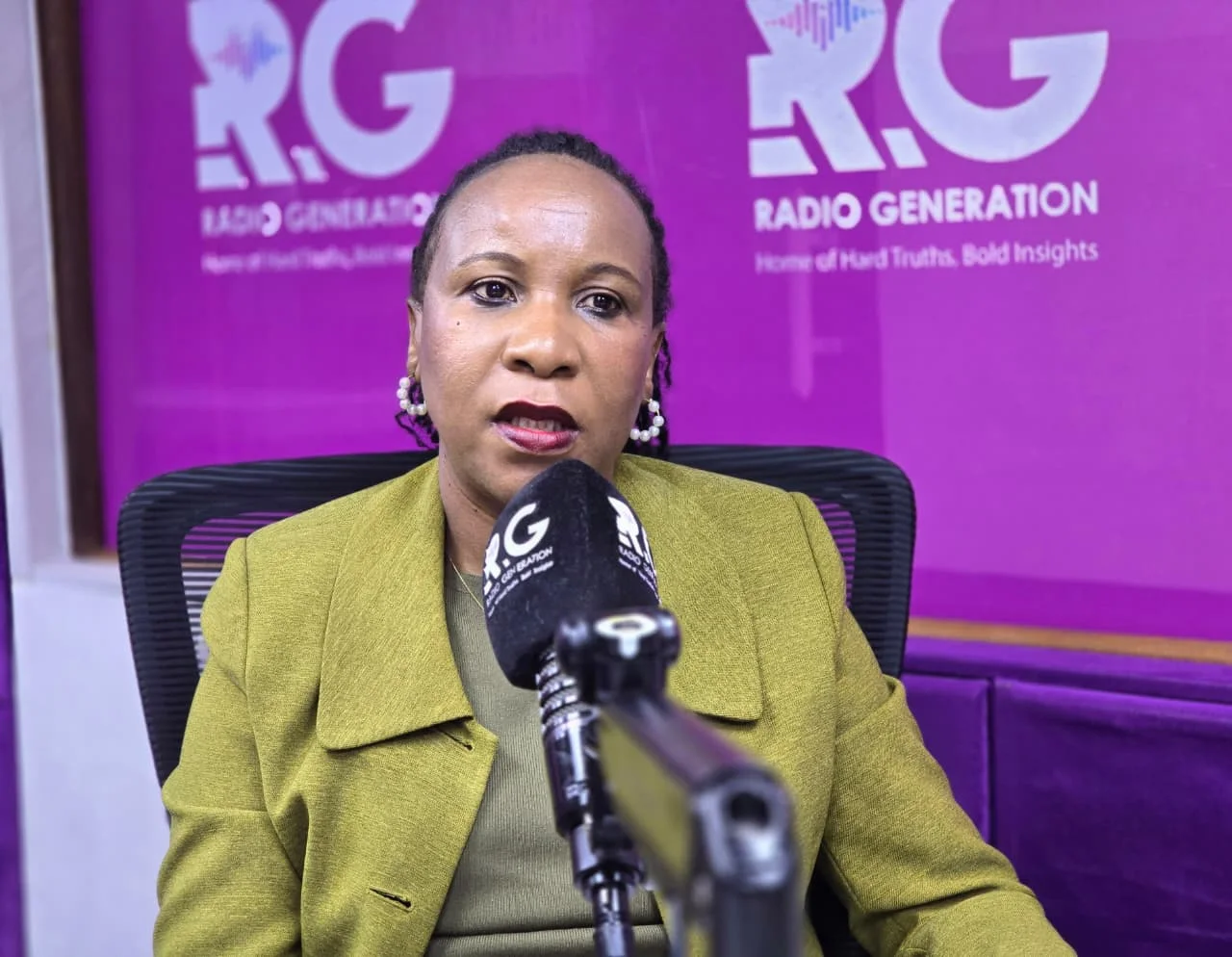
Infotrak Research and Consulting Chief Executive Officer Angela Ambitho has explained how biased sampling, leading questions and compromised fieldwork can be used to manipulate opinion polls, warning that researchers can manufacture findings that support predetermined outcomes.
Speaking on Radio Generation on Thursday, Ambitho said the credibility of opinion polls depends on the methodology used, particularly how respondents are selected, questions are framed, and information is collected and verified.
She cautioned that poorly conducted surveys can be presented to the public as representing the views of Kenyans when, in reality, they reflect the opinions of a deliberately selected group.
Ambitho illustrated how misleading polls can be manufactured through a hypothetical survey targeting people who already dislike a particular political leader.
"An unscrupulous researcher, very shrewd, can decide to ask a leading question to a biased sample. If I ask a group of people who I know don't like you, do you think so and so is a bad person? Just as that, you'll get a very high percentage," she said.
She explained that a researcher could subsequently release the findings as the opinion of Kenyans, without disclosing that the respondents were selected because they were already predisposed to give a particular answer.
"Then we will release a poll and say, so and so, Kenyans have said, and it is not Kenyans," Ambitho warned.
She identified selection bias and questionnaire bias as two major weaknesses that can undermine polling credibility, arguing that combining the two allows researchers to generate results that support a predetermined position.
Ambitho explained that credible political polling begins with identifying the population being studied and developing a representative sample that reflects its geographical and demographic composition.
For a national presidential opinion poll, she said researchers must consider the country's eight former provinces, 47 counties, 290 constituencies and 1,450 wards when designing the sample.
She emphasised that respondents should not be selected based on convenience, personal preferences or the political interests of the organisation commissioning the survey.
"If you're looking at Kenyans, you go to the census. There's no other place to go. You don't guess. That is what will guide your sampling frame," she explained.
For surveys targeting registered voters, she said the Independent Electoral and Boundaries Commission's voter register should guide the sampling process.
The sample must also reflect the population distribution across different geographical areas, meaning densely populated counties should receive a proportionate share of interviews rather than researchers concentrating on locations that are easier or cheaper to access.
Ambitho gave the example of Nairobi, explaining that researchers cannot arbitrarily allocate half of a national sample to the capital simply because conducting interviews there is more convenient.
She also discussed sample size, margin of error, and confidence levels as important considerations when interpreting polling results.
According to her, a national survey of approximately 500 respondents could produce a margin of error of about plus or minus five percentage points, but such a sample would not provide sufficient representation for reliable analysis at county and constituency levels.
She said she was more comfortable with a national margin of error of plus or minus two or three percentage points and a confidence level of 95 per cent.
As researchers break down national findings into smaller geographical units, the margin of error increases because fewer respondents are interviewed in each area.
She noted that a county sample of approximately 110 respondents could have a margin of error of about plus or minus nine percentage points, making conclusions about smaller differences less reliable.
Beyond sample selection, Ambitho maintained that the quality of fieldwork determines whether the information presented in polling reports accurately reflects respondents' opinions.
She disclosed that Infotrak conducts structured training lasting between two and three days before every study, covering research methodology, ethics and the responsibilities of interviewers.
"The training is structured. In many cases, it's two up to two to three days. The first day, just generally, is a reorientation on research methods and research ethics, the do's and don'ts, what you must and you must never do. It is not your opinion; it's the opinion of the respondent. You must, in no way, manner or form influence how that respondent answers," she said.
She explained that interviewers are trained to select respondents using established procedures, including the Kish grid, which helps identify the eligible individual within a household.
Rather than interviewing whoever opens the door, interviewers establish the eligible adults in the household and use their birthdays to determine who should participate.
Infotrak also deploys five interviewers under each supervisor during face-to-face surveys, with supervisors conducting field visits and coordinators providing additional oversight.
The company further conducts callbacks to verify interviews and investigate questionable responses.
The Infotrak Founder explained that interviewers' body language must also remain neutral because facial expressions can influence how respondents answer sensitive political questions.
Ambitho identified social desirability bias as another challenge, particularly in communities where influential political figures shape public opinion.
She explained that respondents might conceal their actual political preferences or give answers they believe their community leaders want to hear.
To address this, Infotrak uses control questions to compare responses and identify inconsistencies that require further investigation.
Respondent anonymity is also emphasised to encourage honest participation without fear of political reprisals.
Ambitho further disclosed that the company subjects completed questionnaires to a straight-line test, which helps identify suspicious patterns where interviewers repeatedly record the same response across different questions.
Questionnaires flagged through the process are investigated, with interviewers contacted to establish whether the interviews were properly conducted.
She maintained that polling is a scientific process requiring transparent sampling, neutral questioning, proper field supervision, and verification rather than simply collecting opinions and publishing percentages.