
Kenya’s first reported imported Ebola patient was buried under tight security at Langata Cemetery in Nairobi, with health officials carrying out extensive disinfection measures to limit the risk of exposure after the 40-year-old man died from Bundibugyo virus disease.
The burial took place at about 2 pm on October 6, shortly after the Ministry of Health confirmed that the Kenyan man had tested positive for Ebola and died after arriving in the country.
Only a small group of relatives and Ministry of Health officials attended the burial, which was held in an isolated section near a water tank on the Muslim side of Langata Cemetery. Security officers restricted access to the area, with some people reportedly escorted away after trying to document the proceedings.
The strict arrangements were put in place because of the infectious nature of Ebola and the need to prevent possible exposure while handling and burying the remains.
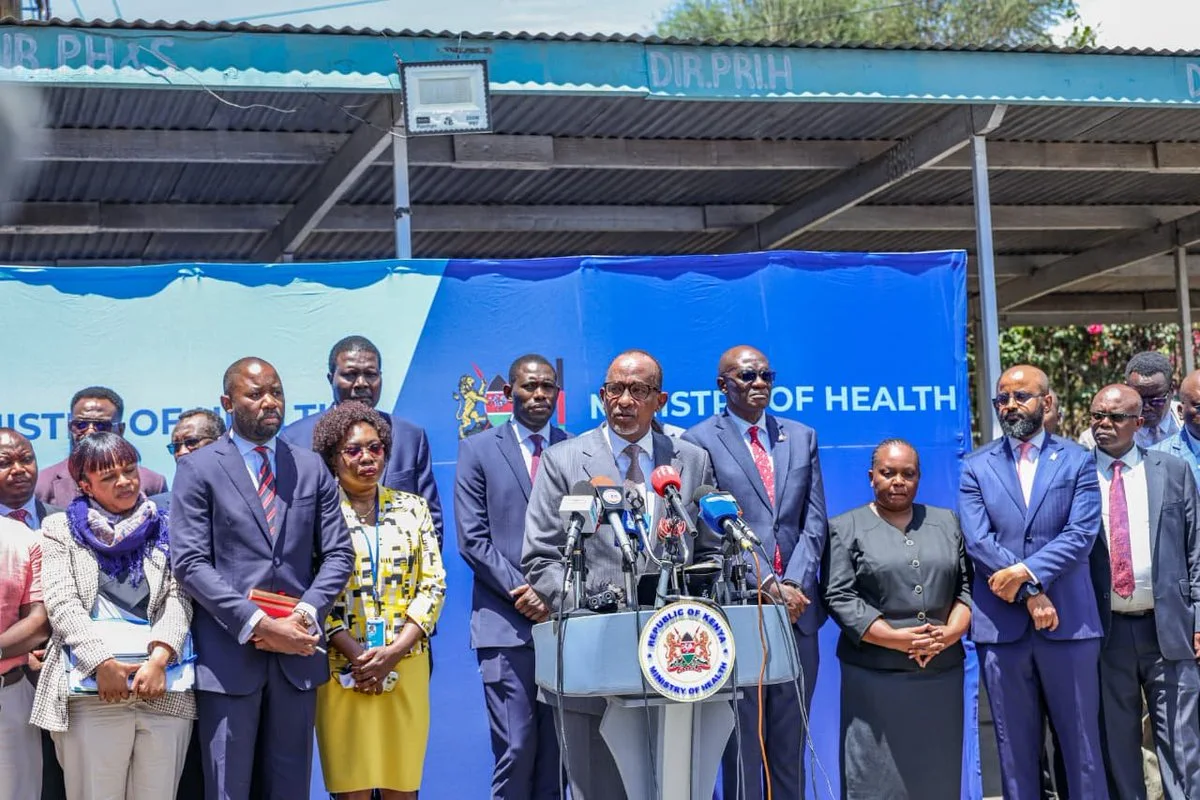
Health Cabinet Secretary Aden Duale had earlier ruled out media access to the burial site.
“If you are a Kenyan media house, you know the burial sites, but you will not be allowed. Yes, so that question does not arise,” Duale said.
“It’s part of the public health safety protocols,” he added.
Patient’s journey from DRC
The deceased had lived in the Democratic Republic of Congo (DRC) for seven years before travelling to Kenya.
Information released after his death showed that he travelled by bus from Buta in north-western DRC to Beni before continuing by road into Uganda.
On Saturday, October 3, he boarded a Jambojet flight at Entebbe International Airport at 11:31 am and arrived at Jomo Kenyatta International Airport (JKIA) in Nairobi at 1:04 pm.
He later fell ill and was taken to Nairobi Hospital, where his condition became severe before his death.
His movements across the DRC, Uganda and Kenya have since become central to investigations as health officials work to establish who may have come into contact with him during his journey and after his arrival in Nairobi.
Body and vehicle disinfected
Authorities took extensive precautions before and during the burial.
Images published by a local media house showed the body being cleaned and disinfected before it was wrapped in several layers of protective material and transported to Langata Cemetery.
The body was carried in a red Toyota Fielder, the same vehicle that had transported the patient from JKIA to Nairobi Hospital after his arrival in Kenya. The vehicle was later used to transport members of his family to the burial site.
After the burial, a health worker dressed in a hazmat suit fumigated the grave and the surrounding area as part of the safety measures.
Another Ministry of Health official, wearing protective clothing and gumboots, remained at the site during the disinfection exercise.
The red Toyota Fielder was also thoroughly disinfected, with the health worker spraying what appeared to be disinfectant on both the inside and outside of the vehicle before moving towards the grave.
A Ministry of Health official was later seen washing his gumboots near the water tank close to the burial site.
The health worker in the hazmat suit then removed the protective equipment layer by layer before setting it on fire.
Security officers remained at the cemetery throughout the operation as health officials completed the burial and disinfection procedures.
Contact tracing stepped up
The burial came as health authorities intensified efforts to identify and monitor people who may have been exposed to the deceased.
His travel route is a major focus of the investigation because he crossed from the DRC into Uganda before flying to Nairobi, where he was later taken from JKIA to Nairobi Hospital after falling ill.
Health officials are expected to trace people who had close contact with him during his journey, at the airport, during his transportation and after his arrival in Kenya.
Contact tracing remains central to the response because people who may have been exposed can be monitored for symptoms and isolated quickly if they become ill.
The case has also put increased focus on health checks and disease surveillance at Kenya’s points of entry, particularly airports, as authorities seek to identify possible infections as early as possible.
The government’s response is now centred on tracing and monitoring contacts, strengthening infection prevention measures in health facilities and following up on the deceased’s movements.
The careful handling of the body and the controlled burial at Langata reflect the precautions being taken to reduce the risk of further exposure.
As investigations continue, the journey from Buta and Beni in the DRC through Uganda and finally to Nairobi remains key to determining the number of people who may have been exposed and preventing further infections.