Ruto links education funding to economic growth plans
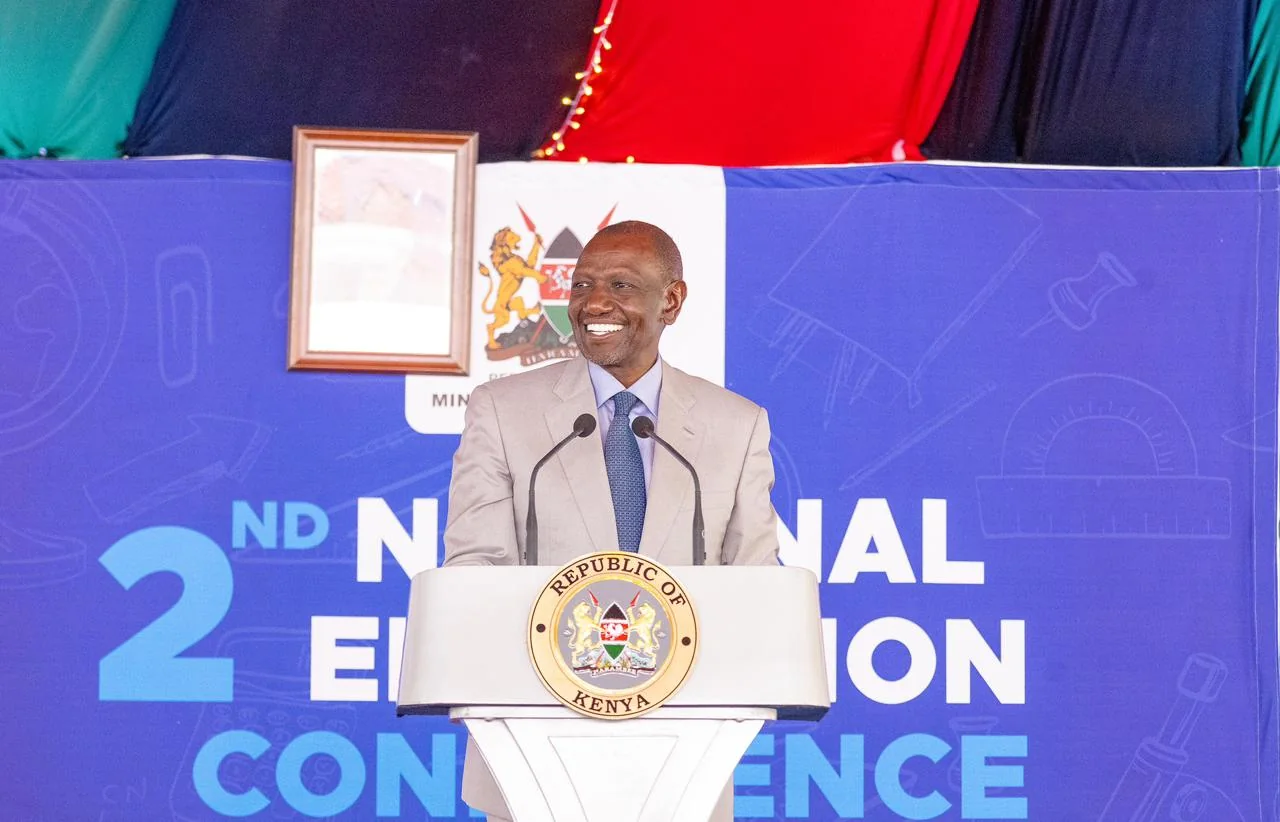
President William Ruto defended the government’s education infrastructure expansion at the National Education Conference in Naivasha, citing funding increases and the shift to Competency-Based Education, while announcing an audit that found ghost learners and schools.
President William Ruto has defended the government’s heavy investment in education, insisting that the ongoing expansion of classrooms, laboratories, teacher recruitment, and digital systems is central to Kenya’s long-term economic transformation agenda.
Speaking at the National Education Conference in Naivasha on Thursday, the President said the education sector remains a key pillar of national development, even as the government moves to clean up the system following an audit that exposed thousands of ghost learners and non-existent schools benefiting from public funds.
Ruto said education is not just a social service but a strategic national priority that must be protected and strengthened.
“We are meeting at a profound moment in our country’s development journey,” the President noted, adding that the government’s Bottom-Up Economic Transformation Agenda was focused on “expanding opportunity, strengthening productivity and ensuring that no Kenyan is left behind.”
He said countries that invested early and consistently in education were able to transform their economies and improve living standards, pointing to Japan, Germany, South Korea, China, Singapore and Israel as examples.
“Education is the single greatest investment a nation can make in managing its present and shaping its future,” he said.
The President said Kenya’s ongoing reforms in education are meant to support the full rollout of the Competency-Based Education system, whose first cohort has now progressed to Grade 10.
According to him, the government has already constructed more than 23,000 classrooms across the country since taking office, alongside 1,600 laboratories currently under construction to improve science and technical learning.
“We are also accelerating the expansion of classrooms, laboratories and other learning facilities to cope with a growing number of learners and the demand by the CBE curriculum,” the President argued.
He further noted that Nairobi alone is receiving 1,000 additional classrooms, targeting informal settlements where schools are overcrowded and learning space remains limited.
“We’re building an extra 1000 classrooms in the city of Nairobi alone, just to make sure that the students, especially in informal settlements, have access to education.”
Ruto said the reforms are aimed at shifting learning spaces to environments that encourage creativity, problem-solving, and practical skills development to prepare learners for real-life challenges.
He added that the first cohort under the competency-based system recorded a transition rate of more than 99 per cent to senior school, which he said reflected early success of the reforms.
“Learners who have transitioned to senior school are already demonstrating strong learning outcome that have found the soundness of our decision to reform the curriculum,” he stated.
On funding, the President defended increased budget allocations to education, saying the sector’s financing has grown from about Sh500 billion in 2022 to Sh702 billion in the current financial year, with a proposal to raise it to Sh767 billion in the next budget.
“We don’t treat the investment and the resources we are putting in education as a cost to us. It is an investment we are making in our present and in our future,” Ruto noted.
He also revealed that a nationwide audit had uncovered major irregularities in the education system, including ghost learners and schools receiving capitation illegally.
“We got to know that there were 87,000 or there about ghost students in our secondary schools,” he said.
He added that about 800,000 non-existent pupils had been identified in primary schools, alongside nearly 200 schools that existed only on paper.
“We are asking some very difficult questions to some of our head teachers and to some of our leaders in education at the county level, because accountability integrity is central,” he said.
To address the gaps, Ruto announced that the government will digitise all education records within two months in collaboration with Konza Technopolis, covering learners, teachers, schools, and bursary systems.
“We are going to be working with the Konza technopolis to make sure that we digitize all the education details of every learner, every school, teachers, bursaries and everything else,” he stressed.
He also took issue with school administrators resisting digital fee payment systems, particularly e-Citizen, questioning their opposition to transparency measures.
“We have some head teachers who have taken us to court that they do not want parents to pay school fees on e-Citizen,” he said.
“I don’t think asking for transparency is too much.”
On teacher recruitment, Ruto said the government has employed more than 100,000 teachers in the last three years, describing it as the fastest expansion of the teaching workforce in Kenya’s history.
“The teachers we have hired in the last three years, it would take us 20 years if we hired them at the rate at which we were hiring before,” he said.
He further highlighted growth in technical and vocational training, noting that enrolment in TVET institutions has risen from about 300,000 students in 2022 to 800,000 currently, while fees have been reduced from nearly Sh100,000 to about Sh67,000.
“We want to make sure that we have more people equipped with technical skills,” he said.
Ruto concluded that the government will continue prioritising education infrastructure, digital transformation, and staffing to ensure the sector supports national development goals and prepares learners for future economic demands.




Comments
Sign in with Google to comment, reply, and like comments.
Continue with Google