
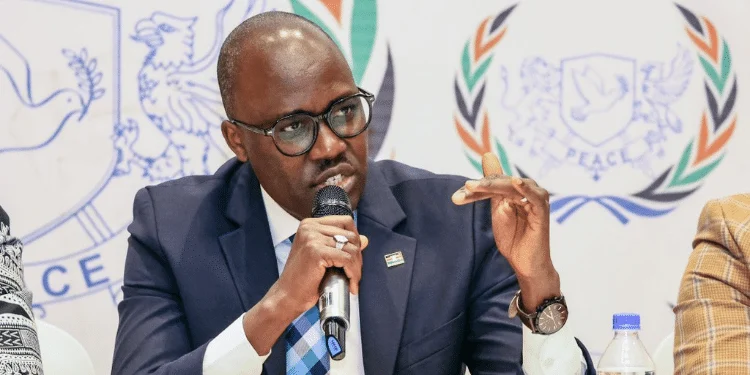
Foreign Affairs Principal Secretary Korir Sing’Oei has defended Washington’s decision to urge Americans to reconsider travel to Kenya amid the Ebola outbreak, maintaining that the warning is meant to alert travellers to possible risks and does not amount to a ban on visits to the country.
Speaking on Wednesday, October 21, 2026, Sing’Oei said the United States had a right to issue travel guidance to its citizens, particularly on matters involving public health. He described Ebola as a sensitive issue that requires countries to work together to contain the disease and limit its spread.
“Well, the immediate reaction, of course, is that the United States is duty-bound to advise its citizens with respect to decisions that it deems important,” Sing’Oei said.
“The issue around Ebola is a sensitive matter, and it is important for them to advise its citizens.”
The PS said Kenya’s placement under Category 3 of the US travel advisory system should not be interpreted as a measure that prevents American citizens from entering the country.
“As you can see, Kenya has been put on Category 3, which is more of a caution, and there are no implications with respect to, you know, barring travellers coming from Kenya associated with that advisory,” he said.
His comments followed a decision by the US Department of State to move Kenya’s travel advisory from Level 2, which recommends increased caution, to Level 3, which advises American citizens to reconsider travelling to the country.
The advisory, issued on October 19, cited the Ebola outbreak among several concerns facing travellers. Other risks listed included crime, kidnapping, terrorism, civil unrest and road safety.
The United States also maintained separate, more restrictive travel warnings for specific parts of Kenya where security threats remain a concern.
Sing’Oei said the Kenyan government had been engaging the United States and other international partners for months to strengthen its ability to respond to an Ebola outbreak.
He explained that the preparations were aimed at putting in place facilities and systems to isolate people suspected of carrying the virus and prevent further transmission before the disease was detected locally.
“We have been working very closely with the United States. Over the last almost six months, I think you know a bit of the history when there was an attempt by the Kenyan government to set up infrastructure to isolate and contain potentially Ebola-infected persons,” he said.
According to the PS, the preparations involved cooperation between Kenya, the United States and other members of the international community, with the government seeking to build the necessary capacity before a case was reported in the country.
“At that point, it was Americans and the international community, and the whole idea of the Kenyan government was, ‘Let’s build this capability before this issue hits home,” Sing’Oei added.
He said officials had not foreseen that Kenya’s first confirmed case would involve a citizen returning from the Democratic Republic of Congo, where he had been working.
“Nobody at that point was anticipating that the first case would be brought into the country by a Kenyan national, you know, from DRC, you know, who was working in DRC and just showed up,” he said.
The PS acknowledged that the outbreak had triggered public anxiety, with the government continuing to work alongside international partners as health authorities stepped up measures to contain the virus.
Kenya’s confirmed Ebola infections had reached nine by October 19, after health officials detected another case linked to the first patient.
The Ministry of Health said the latest person to test positive was a close family member of the initial patient and had been placed in quarantine before the infection was confirmed.
Health Director-General Patrick Amoth said on October 20 that all nine patients belonged to the same cluster. He added that there was no evidence at the time of transmission beyond the group.
Health officials had identified 135 contacts linked to the confirmed cases, with 134 placed in quarantine to limit the risk of further infections.
Kenya’s first imported case was confirmed on October 6 and involved a Kenyan national who had been living and working in the Democratic Republic of Congo.
The patient travelled by road to Kampala, Uganda, before taking a flight to Nairobi on October 3. After arriving in Kenya, he was taken to Nairobi Hospital, where he was isolated and assessed before testing positive for Ebola. He died on October 5.
The infections reported afterwards have been linked to the initial patient. Health authorities have continued tracing people who may have been exposed, isolating suspected cases and monitoring contacts in an effort to stop the virus from spreading further.
Sing’Oei said the growing number of cases had heightened concern, even as the government and its international partners continued efforts to manage the outbreak.
“And as a result of that, we now have nine cases, all of them under quarantine, but really creating a lot of anxiety and a lot of concern,” he said.