
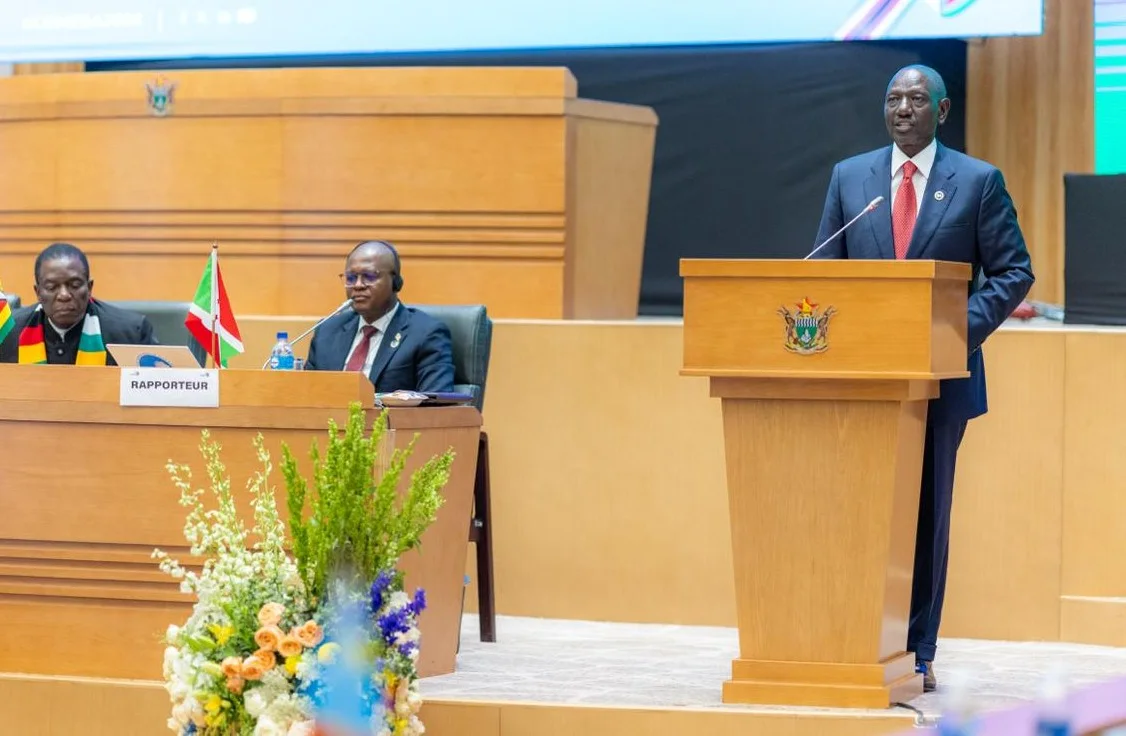
President William Ruto has challenged member states of the Common Market for Eastern and Southern Africa (COMESA) to secure reliable funding for regional projects, warning that ambitious integration plans risk failing if governments do not provide the resources needed to implement them.
Ruto said the regional bloc must make sustainable financing a priority to maintain economic progress and ensure that programmes approved by member states translate into tangible benefits for citizens.
Speaking during the 25th COMESA Summit in Harare, Zimbabwe, on Thursday, the President said governments needed to align their financial commitments with their regional ambitions, arguing that promises made at meetings would have little value if budgets could not support them.
"One challenge now demands our collective attention: sustainable and predictable financing for our programs and our institutions.
"We cannot be ambitious in our plans and timid in our financing. Every program we agree upon must be matched by the resources to deliver it. Otherwise, our communiques will promise what our budgets cannot pay for," Ruto said.
The summit marked the end of Kenya's chairmanship of COMESA, with Ruto handing over leadership of the bloc to Zimbabwean President Emmerson Mnangagwa.
As he passed on the leadership, Ruto called on the COMESA Secretariat to speed up the implementation of Article 168 of the COMESA Treaty, which he identified as part of the measures needed to improve resource mobilisation.
He said officials from finance ministries, central banks and other relevant government agencies in member states were expected to consider a draft strategy aimed at strengthening the bloc's ability to raise money for its programmes.
According to Ruto, the proposed strategy should encourage member states to take greater financial responsibility for regional initiatives while exploring new ways of raising funds to support agreed priorities.
"That strategy demands two things of us: greater ownership by member states and greater innovation in how we raise resources."
The President said the need for dependable financing had become more pressing amid global economic uncertainty, disruptions to trade and supply chains, and rising geopolitical tensions, which had tested the region's economic strength during his tenure as COMESA chair.
Despite these challenges, the bloc's economy grew by 6.4 per cent in 2025, up from 5.6 per cent in 2024.
Ruto maintained that sustaining this growth and advancing regional integration would require more than political agreements, saying member states needed to ensure that the institutions and programmes they approve received adequate and consistent funding.
He argued that the bloc's ability to meet its development goals would depend on whether governments could turn their commitments into funded projects and deliver the expected results.
The Kenyan President also called on African countries to make better use of their domestic financial resources to support development, reduce reliance on external funding and increase investment in projects across the continent.
He pointed to more than $4 trillion in financial assets held by African central banks, insurance companies and capital markets, saying a greater share of this money should be directed towards financing African development.
"Yet, too much of it sits in foreign accounts, earning very little, while our own projects wait for capital," he said.
Ruto argued that African countries needed to build greater confidence in their own financial institutions and use them more actively to fund regional infrastructure and other development priorities.
He named the African Development Bank, Afreximbank, the Africa Finance Corporation and the Trade and Development Bank among the institutions that could play a greater role in mobilising capital for projects across the continent.
He proposed that African governments place more of their reserves with these institutions, channel development projects through them and support their bonds and guarantees to strengthen their ability to finance regional programmes.
Such measures, he said, could expand the institutions' financial capacity and help ensure that more African resources were invested in projects that serve the continent's development needs.
Ruto also highlighted the Alliance of African Multilateral Financial Institutions as a platform through which countries could pool resources and strengthen their ability to finance shared priorities.
He said African governments needed to demonstrate confidence in their own institutions if they expected international partners to support them.
"We cannot ask the world to trust African institutions if we do not trust them ourselves."
Ruto maintained that the success of COMESA's integration agenda would ultimately depend on the bloc's ability to fund the programmes agreed upon by its member states and ensure they produce results.
He said reliable financing was central to building strong regional institutions and maintaining confidence in the bloc's plans, warning that commitments without the means to implement them could weaken the credibility of the entire integration process.
"The strength of our institutions and the credibility of our integration agenda will rest on one test: Can we finance what we commit, and can we deliver what we finance?" he said.
As he handed over the chairmanship to Mnangagwa, Ruto urged member states to place financing at the centre of COMESA's next phase, calling for greater responsibility in raising and allocating resources.
He said the bloc's ambitions must be supported by dependable funding if regional programmes are to move beyond agreements and deliver practical benefits to citizens across its 21 member states.
His appeal placed the responsibility on member governments to ensure that regional priorities are matched by adequate financial support, as COMESA seeks to sustain economic growth and deepen cooperation among its members.